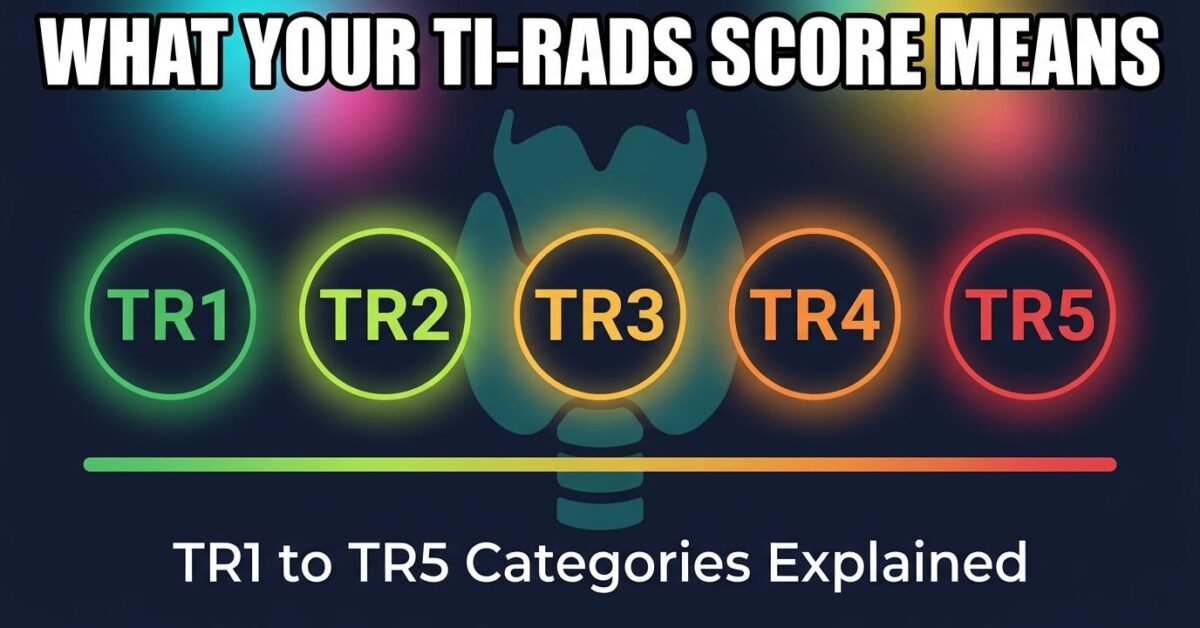
If your ultrasound report lists a “TI-RADS score” or a category like TR3 or TR4, you are looking at a standardized way radiologists rate a thyroid nodule. Understanding the TI-RADS score meaning helps you know how concerning a nodule is and what usually comes next. This guide explains each category in plain English, then points you to a free tool to check the numbers yourself.
What TI-RADS actually measures
TI-RADS stands for Thyroid Imaging Reporting and Data System. It is a point-based system from the American College of Radiology (ACR) that scores five features of a thyroid nodule on ultrasound: composition, echogenicity, shape, margin, and echogenic foci. Each feature earns points, the points are added up, and the total places the nodule into one of five categories from TR1 to TR5.
The goal is simple. A higher score means the nodule has more features linked to thyroid cancer, so it deserves closer attention. A lower score means the nodule looks benign and usually needs no further workup. You can see how the points add up using our TI-RADS calculator.
TI-RADS categories and what they mean
Here is what each category tells you about malignancy risk, based on the ACR TI-RADS guidelines.
TR1 — Benign (0 points)
A TR1 nodule scored zero points. Its estimated risk of being cancer is about 0.3 percent, which is very low. These are typically simple cysts or spongiform nodules. No biopsy and no follow-up ultrasound are recommended.
TR2 — Not suspicious (2 points)
A TR2 nodule is still considered not suspicious, with a malignancy risk around 1.5 percent. Like TR1, it needs no biopsy and no routine follow-up. If you received a TR1 or TR2 result, the nodule is almost certainly not cancer.
TR3 — Mildly suspicious (3 points)
This is where many people start asking what does TR3 mean. A TR3 nodule carries a malignancy risk of roughly 4.8 percent. Biopsy is only suggested if the nodule is 2.5 cm or larger. If it measures 1.5 cm or more but under 2.5 cm, a follow-up ultrasound is advised. Smaller TR3 nodules usually need no action.
TR4 — Moderately suspicious (4 to 6 points)
A TR4 thyroid nodule has more concerning features and a malignancy risk near 9.1 percent. Biopsy is generally recommended when the nodule is 1.5 cm or larger, and follow-up imaging applies at 1 cm or larger. Many nodules that combine solid composition with a suspicious margin or echogenicity land here.
TR5 — Highly suspicious (7 or more points)
A TR5 nodule is the highest category, with an estimated malignancy risk around 35 percent. Biopsy is recommended at 1 cm or larger, and even smaller nodules of 0.5 cm or more are followed with annual ultrasound for up to five years.
Why size matters as much as the score
A common surprise is that nodule size does not change the TI-RADS category, but it decides what happens next. The same TR4 score leads to a biopsy in a 2 cm nodule but only follow-up in a 1.2 cm nodule. That is why your report lists both the category and the measurement. Our calculator combines the two and shows the exact recommendation for your size.
What a TI-RADS score does not tell you
The TI-RADS score meaning has limits. It rates ultrasound appearance only. It does not include your family history, blood tests, symptoms, or how a nodule has changed over time. It also depends on image quality and the radiologist’s reading, which can vary. A score is a guide, not a verdict, and it never replaces your doctor’s judgment.
What to do with your result
Bring your report to your radiologist or endocrinologist and ask three questions: what is my TI-RADS category, how large is the nodule, and do the two together mean biopsy, follow-up, or nothing. If a fine needle aspiration (FNA) is suggested, it is a quick outpatient test that samples cells to check for cancer. Learn more in our guide on when a thyroid nodule needs a biopsy.
Check your TI-RADS score now
You can reproduce the scoring in seconds. Open the TI-RADS calculator, select the same features listed in your report, enter the nodule size, and see the category, malignancy risk, and recommendation side by side. For the full point breakdown, see our TI-RADS chart.
Frequently asked questions
Is TR3 something to worry about?
A TR3 nodule is mildly suspicious with a low malignancy risk near 5 percent. Most need only monitoring, and biopsy is reserved for larger nodules. Discuss your size and history with your doctor.
Which TI-RADS category needs a biopsy?
Biopsy is typically considered for TR3 at 2.5 cm or larger, TR4 at 1.5 cm or larger, and TR5 at 1 cm or larger. TR1 and TR2 do not need biopsy.
Can I calculate my own TI-RADS score?
Yes. Using the features in your ultrasound report, you can enter them into a TI-RADS calculator to see the category. It is for understanding only and does not replace your physician’s assessment.
What is a TI-RADS score and what does it mean for my thyroid nodule?
A TI-RADS score is the total points a thyroid nodule receives when a radiologist evaluates five ultrasound features: composition, echogenicity, shape, margin, and echogenic foci. The total places the nodule into a category from TR1 (benign) to TR5 (highly suspicious), which guides whether biopsy or follow-up is needed.
How do I calculate my TI-RADS score from my ultrasound report?
Find the five features described in your report (composition, echogenicity, shape, margin, echogenic foci), enter each one into a TI-RADS calculator, and the tool adds the points automatically. The total gives you the TI-RADS category and a size-based recommendation.
What size thyroid nodule needs a biopsy?
It depends on the TI-RADS category. TR3 nodules need biopsy at 2.5 cm or larger, TR4 at 1.5 cm or larger, and TR5 at 1.0 cm or larger. TR1 and TR2 nodules do not need biopsy at any size.
