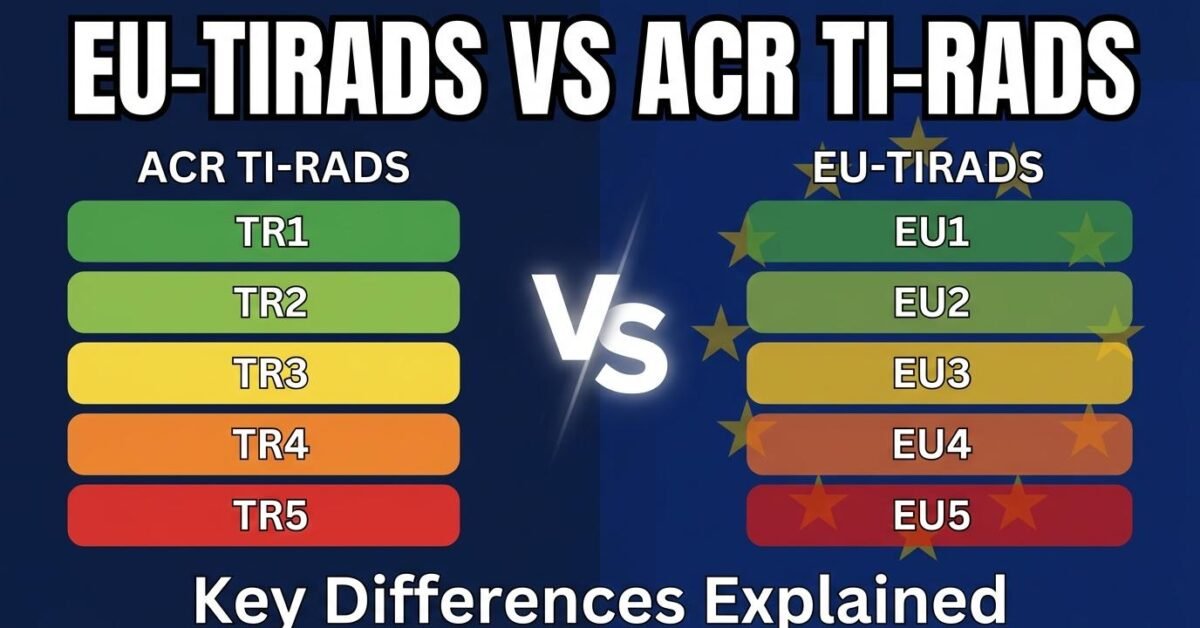
If you have encountered both EU-TIRADS and ACR TI-RADS on ultrasound reports or in clinical literature, you may wonder how they differ and which one applies to you. Both systems assess thyroid nodule risk on ultrasound, but they use different approaches. This guide compares the two.
What They Have in Common
Both EU-TIRADS and ACR TI-RADS are ultrasound-based risk stratification systems for thyroid nodules. Both assign categories that estimate malignancy risk and guide decisions about biopsy or follow-up. Both aim to reduce unnecessary biopsies of benign nodules while still catching significant cancers.
How ACR TI-RADS Works
The ACR TI-RADS (2017) uses a point-based system. Five ultrasound features are scored individually (composition, echogenicity, shape, margin, echogenic foci), and the points are summed. The total determines the category from TR1 (benign, 0 points) to TR5 (highly suspicious, 7 or more points). Each category has a size threshold for biopsy.
This is the system our TI-RADS calculator uses.
How EU-TIRADS Works
EU-TIRADS (2017, published by the European Thyroid Association) uses a pattern-based system rather than a point system. Instead of adding points, the radiologist classifies the nodule into one of five categories based on its overall ultrasound pattern:
| EU-TIRADS Category | Description | Malignancy Risk |
|---|---|---|
| EU-TIRADS 1 | Normal (no nodule) | — |
| EU-TIRADS 2 | Benign (pure cyst, spongiform) | ~0% |
| EU-TIRADS 3 | Low risk (oval, smooth, iso/hyperechoic) | 2–4% |
| EU-TIRADS 4 | Intermediate risk (mildly hypoechoic, oval, smooth) | 6–17% |
| EU-TIRADS 5 | High risk (at least one: irregular shape/margin, microcalcifications, markedly hypoechoic) | 26–87% |
The presence of any single high-risk feature is enough to classify a nodule as EU-TIRADS 5. This is different from ACR TI-RADS, where a single feature earns points but the total determines the category.
Key Differences
Scoring method. ACR uses additive points across five categories. EU-TIRADS uses pattern recognition based on the most suspicious feature present.
Number of features. ACR scores five separate features independently. EU-TIRADS focuses primarily on echogenicity, shape, margins, and the presence of high-risk features, weighting them differently.
Biopsy thresholds. Both systems use size-based thresholds, but the specific sizes differ:
| Category level | ACR TI-RADS FNA threshold | EU-TIRADS FNA threshold |
|---|---|---|
| Mildly suspicious | 2.5 cm (TR3) | 2.0 cm (EU-TIRADS 3) |
| Moderately suspicious | 1.5 cm (TR4) | 1.5 cm (EU-TIRADS 4) |
| Highly suspicious | 1.0 cm (TR5) | 1.0 cm (EU-TIRADS 5) |
Sensitivity vs specificity. Studies comparing the two systems generally find that ACR TI-RADS has higher specificity (fewer unnecessary biopsies) while EU-TIRADS may have slightly higher sensitivity (catches slightly more cancers). Both perform well clinically.
For clinicians: The system you use depends on your institution’s protocol and regional preference. ACR TI-RADS dominates in the United States; EU-TIRADS is standard across much of Europe. When comparing studies or transferring patients internationally, note which system was used, as the categories are not directly interchangeable.
For patients: If your report uses EU-TIRADS categories, the principles are similar to ACR TI-RADS but the specific numbers differ. Ask your doctor which system was used and what the recommendation is for your nodule’s category and size.
Other TIRADS Systems
ACR and EU are the two most widely used, but others exist. K-TIRADS (Korean) and C-TIRADS (Chinese, 2020) are used in their respective regions. Each has slightly different criteria and thresholds. The concept is the same: standardize thyroid nodule risk assessment to reduce variability and unnecessary procedures.
Frequently Asked Questions
Is EU-TIRADS the same as ACR TI-RADS?
No. They are different scoring systems from different organizations. EU-TIRADS uses pattern-based classification while ACR uses a point-based system. Their categories are not directly interchangeable.
Which system is better?
Neither is definitively better. ACR TI-RADS tends to reduce unnecessary biopsies more (higher specificity), while EU-TIRADS may catch slightly more cancers (higher sensitivity). Your institution’s protocol determines which to use.
Can I use the TI-RADS calculator for EU-TIRADS?
Our calculator implements the ACR TI-RADS 2017 system specifically. It does not calculate EU-TIRADS categories. We are working on a dedicated EU-TIRADS calculator.
What is the difference between ACR TI-RADS and EU-TIRADS scoring?
ACR TI-RADS uses a point-based system where five ultrasound features are scored individually and added together. EU-TIRADS uses a pattern-based system where the nodule is classified by its overall appearance, and any single high-risk feature places it in the highest category. Their categories are not directly interchangeable.
Which is more accurate, TI-RADS or EU-TIRADS?
Neither is definitively more accurate. Studies generally find that ACR TI-RADS has higher specificity (fewer unnecessary biopsies), while EU-TIRADS may have slightly higher sensitivity (catches slightly more cancers). Both perform well clinically. The system used depends on your institution and region.
Is TR4 in ACR the same as EU-TIRADS 4?
No. ACR TR4 (4 to 6 points, moderately suspicious, ~9% malignancy risk) and EU-TIRADS 4 (intermediate risk, 6 to 17% malignancy risk) use different criteria and are not equivalent. A nodule classified as TR4 by ACR may be classified differently under EU-TIRADS.
How does TI-RADS compare to the Bethesda system?
TI-RADS classifies nodules based on ultrasound appearance before biopsy. The Bethesda system classifies nodules based on the cell sample obtained during biopsy. They are complementary: TI-RADS decides whether to biopsy, and Bethesda interprets the biopsy result.
