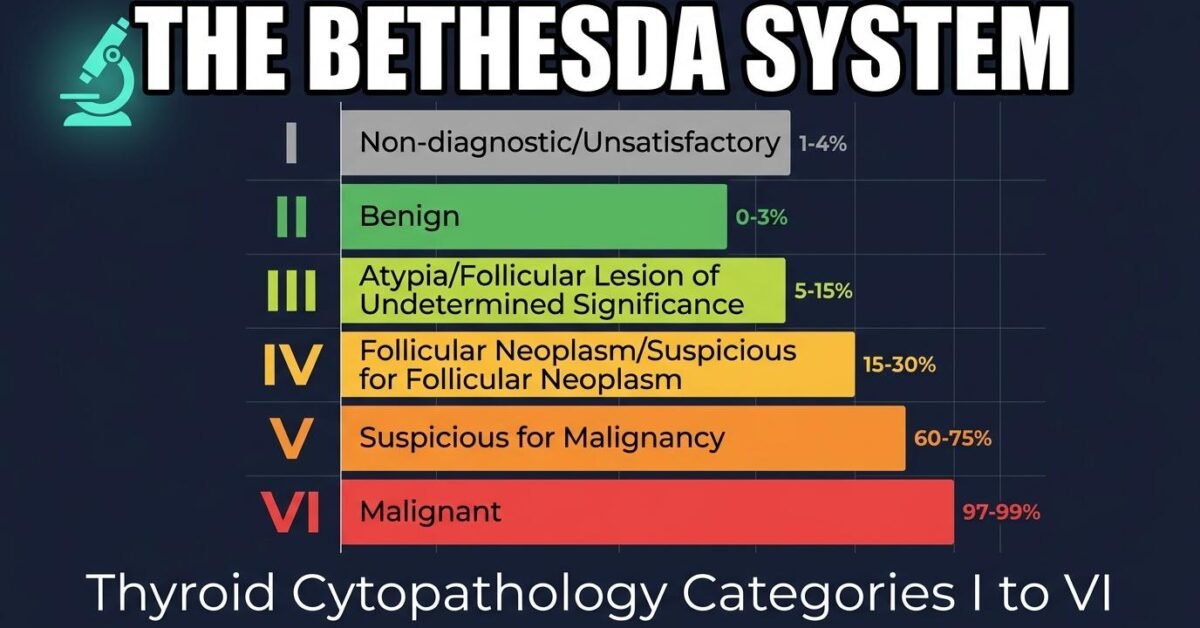
The Bethesda System for Reporting Thyroid Cytopathology is the standardized framework pathologists use to classify thyroid fine needle aspiration (FNA) results. Introduced in 2007 and revised in 2017 and 2023, it replaced inconsistent local terminology with six defined categories, each carrying an implied malignancy risk and a recommended management pathway.
Why the Bethesda System Exists
Before standardization, thyroid cytology reports used widely varying language across institutions. A finding described as “atypical” at one center might be called “suspicious” at another, with no shared understanding of what either implied for risk or management. The Bethesda system created a common vocabulary so that a Category III result means the same thing everywhere, allowing consistent clinical decisions and meaningful comparison across studies.
The Six Bethesda Categories
| Category | Diagnostic Term | Malignancy Risk | Usual Management |
|---|---|---|---|
| I | Non-diagnostic / Unsatisfactory | 5–10% | Repeat FNA with ultrasound guidance |
| II | Benign | 0–3% | Clinical and sonographic follow-up |
| III | Atypia of Undetermined Significance (AUS) | 6–18% | Repeat FNA, molecular testing, or surveillance |
| IV | Follicular Neoplasm | 10–40% | Molecular testing or diagnostic lobectomy |
| V | Suspicious for Malignancy | 45–60% | Surgery (lobectomy or thyroidectomy) |
| VI | Malignant | 94–99% | Surgery |
Category I — Non-Diagnostic
The sample contained too few follicular cells to permit interpretation, or the material was obscured by blood or processing artifact. Adequacy generally requires at least six groups of well-preserved follicular cells with ten cells per group. Cystic nodules frequently yield Category I results because the aspirate contains mostly fluid and macrophages.
Category II — Benign
This is the most common result, accounting for approximately 60 to 70 percent of thyroid FNAs. It includes benign follicular nodules, lymphocytic (Hashimoto) thyroiditis, and granulomatous thyroiditis. The false negative rate is very low, and management is typically clinical and sonographic follow-up rather than intervention.
Category III — Atypia of Undetermined Significance
AUS is a deliberately heterogeneous category for samples that show cytologic or architectural atypia insufficient for a more definitive classification. It is intended to be used sparingly, ideally in under 10 percent of cases. Options after an AUS result include repeat FNA, molecular testing, or continued surveillance depending on the sonographic risk and clinical context.
Category IV — Follicular Neoplasm
The sample shows a follicular-patterned lesion with cellular crowding and microfollicle formation. The fundamental limitation here is that cytology cannot distinguish follicular adenoma from follicular carcinoma, because that distinction requires demonstrating capsular or vascular invasion, which needs the intact tissue architecture that only surgical specimens provide.
Category V — Suspicious for Malignancy
The sample shows features strongly suggestive of malignancy, most often papillary thyroid carcinoma, but falls short of the threshold for a definitive diagnosis. Surgery is generally recommended given the substantial malignancy risk.
Category VI — Malignant
The cytologic features are diagnostic of malignancy. Papillary thyroid carcinoma is the most common, with characteristic nuclear grooves, intranuclear pseudoinclusions, and powdery chromatin. Medullary carcinoma, anaplastic carcinoma, lymphoma, and metastatic disease also fall in this category.
The 2023 third edition refined AUS subcategorization into nuclear atypia versus other atypia, which carry different malignancy risks. It also formally incorporated NIFTP into risk estimates, which lowered the implied malignancy risk for several categories compared with the original 2007 figures.
Your biopsy report will name a Bethesda category, often as a Roman numeral from I to VI. Ask your doctor which category you received and what the recommended next step is. Categories I and III often mean a repeat test rather than anything more serious.
How Bethesda Relates to TI-RADS
These two systems address different stages of the diagnostic pathway and are complementary rather than competing:
| TI-RADS | Bethesda | |
|---|---|---|
| Based on | Ultrasound appearance | Cells obtained by biopsy |
| Timing | Before biopsy | After biopsy |
| Question answered | Should we biopsy this nodule? | What did the biopsy show? |
| Categories | TR1 to TR5 | I to VI |
A nodule scored TR4 on the TI-RADS calculator that meets the size threshold proceeds to FNA, and the FNA result is then reported using Bethesda. Read more about the imaging side in our ACR TI-RADS overview.
Source
Ali SZ, Cibas ES, eds. The Bethesda System for Reporting Thyroid Cytopathology: Definitions, Criteria, and Explanatory Notes. Malignancy risk ranges vary modestly between editions and published series.
Frequently Asked Questions
What is the Bethesda system for thyroid?
The Bethesda System for Reporting Thyroid Cytopathology is a standardized six-category framework for classifying thyroid fine needle aspiration results. Each category carries an estimated malignancy risk and a recommended management pathway, ranging from Category I (non-diagnostic) to Category VI (malignant).
What is Bethesda category 3?
Bethesda Category III is Atypia of Undetermined Significance (AUS), meaning the cells show some abnormal features but not enough to classify them as a neoplasm or malignancy. The estimated malignancy risk is 6 to 18 percent. Management typically involves repeat FNA, molecular testing, or surveillance.
What Bethesda category needs surgery?
Categories V (suspicious for malignancy) and VI (malignant) typically proceed to surgery. Category IV (follicular neoplasm) often requires diagnostic lobectomy or molecular testing, since follicular carcinoma cannot be distinguished from adenoma on cytology alone.
How accurate is the Bethesda system?
The Bethesda system is highly reliable for its benign and malignant categories, with Category II carrying a false negative rate of roughly 0 to 3 percent and Category VI a positive predictive value of 94 to 99 percent. The indeterminate categories (III and IV) are inherently less definitive by design.
