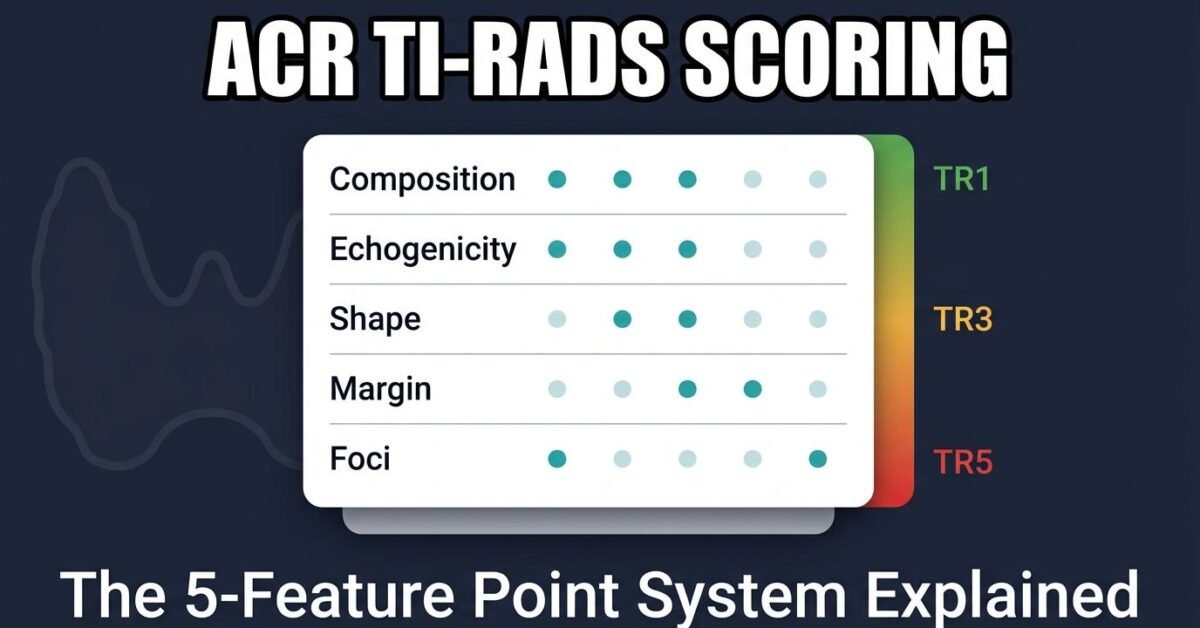
ACR TI-RADS is the standardized system radiologists use to rate thyroid nodules on ultrasound and decide whether a biopsy is needed. Published by the American College of Radiology in 2017, it turns five ultrasound features into a simple point score and a category from TR1 to TR5. This guide explains how the scoring system works and how to apply it.
What TI-RADS stands for
TI-RADS stands for Thyroid Imaging Reporting and Data System. It was designed so that any thyroid nodule can be classified consistently, no matter who reads the scan. The guiding idea was “no nodule left behind”: every nodule gets a category, which was not true of some earlier systems.
The five feature categories
To score a nodule, the reader selects one option from each of the first four categories and adds every option that applies in the fifth, then sums the points.
| Feature | Options and points |
|---|---|
| Composition | Cystic 0 · Spongiform 0 · Mixed 1 · Solid 2 |
| Echogenicity | Anechoic 0 · Hyper/isoechoic 1 · Hypoechoic 2 · Very hypoechoic 3 |
| Shape | Wider-than-tall 0 · Taller-than-wide 3 |
| Margin | Smooth 0 · Ill-defined 0 · Lobulated/irregular 2 · Extra-thyroidal 3 |
| Echogenic foci | None/comet-tail 0 · Macrocalcifications 1 · Peripheral 2 · Punctate 3 |
The echogenicity score is often the feature patients ask about most. The fifth category is additive, so a nodule with both macrocalcifications and punctate foci earns points for each.
From points to category
Once the points are summed, the total maps to a TR category:
| Total points | Category | Suspicion | Est. malignancy |
|---|---|---|---|
| 0 | TR1 | Benign | ~0.3% |
| 2 | TR2 | Not suspicious | ~1.5% |
| 3 | TR3 | Mild | ~4.8% |
| 4–6 | TR4 | Moderate | ~9.1% |
| 7+ | TR5 | High | ~35% |
Each category links to a detailed guide: TR3 and TR4 are the most common questions.
How size drives the recommendation
A key feature of ACR TI-RADS is that the category and the nodule’s size together decide the next step. The biopsy thresholds are:
- TR3 — biopsy at 2.5 cm or larger; follow-up at 1.5 cm or larger.
- TR4 — biopsy at 1.5 cm or larger; follow-up at 1.0 cm or larger.
- TR5 — biopsy at 1.0 cm or larger; follow-up at 0.5 cm or larger.
TR1 and TR2 need neither biopsy nor follow-up. The TI-RADS calculator combines the score and size to produce the recommendation instantly.
For patients: You do not need to memorize the table. The value of TI-RADS is that it gives your doctor a consistent, evidence-based way to decide whether your nodule needs anything at all.
Why TI-RADS matters
Before standardized systems, biopsy decisions varied widely. ACR TI-RADS has been shown to reduce unnecessary biopsies of benign nodules substantially compared with older approaches, while still catching significant cancers through its follow-up rules. That balance, fewer needless procedures without missing important disease, is the reason it has become the dominant system in the United States. For a plain-language walkthrough of results, see what your TI-RADS score means.
Frequently asked questions
What is ACR TI-RADS?
It is the American College of Radiology’s 2017 point-based system for classifying thyroid nodules on ultrasound into categories TR1 through TR5, each with biopsy and follow-up guidance.
How is a TI-RADS score calculated?
Points are assigned across five features, composition, echogenicity, shape, margin, and echogenic foci, then summed. The total determines the TR category.
Is TI-RADS the same everywhere?
The ACR version is standard in the United States. Other systems exist, such as EU-TIRADS, K-TIRADS, and C-TIRADS, which use different criteria and thresholds.
