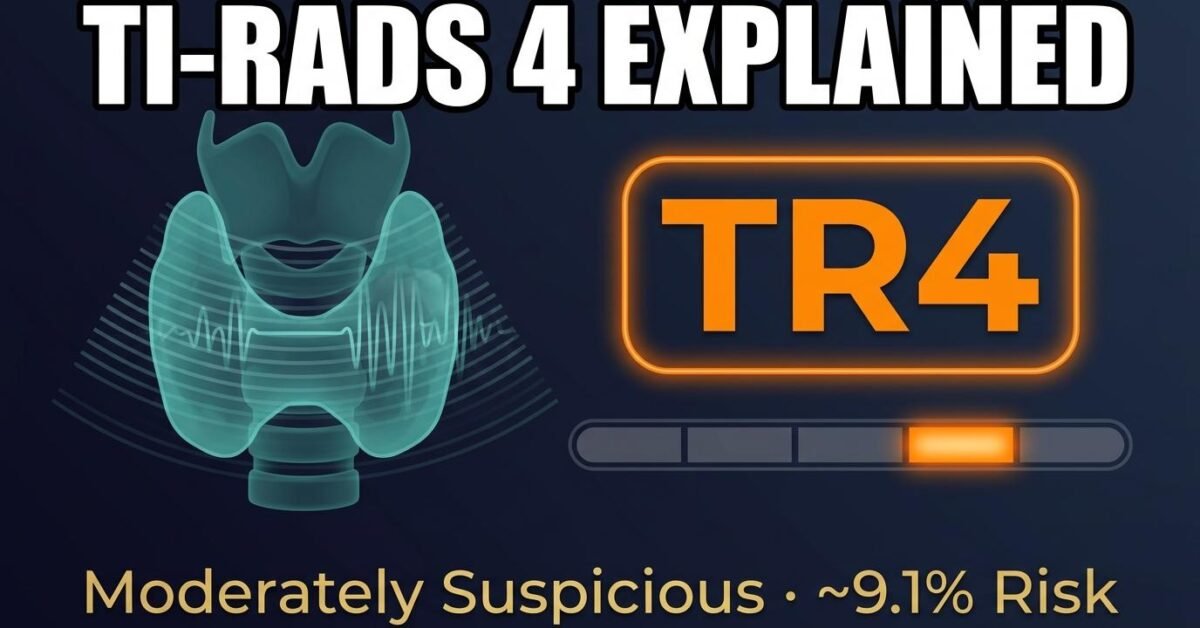
A TI-RADS 4 result, written as TR4 on most reports, means your thyroid nodule is moderately suspicious on ultrasound. It is the second-highest category in the ACR TI-RADS system and one of the most commonly assigned. This guide covers what the score means, the actual cancer risk, when biopsy is recommended, and what treatment involves.
What TI-RADS 4 Means
The ACR TI-RADS system scores five ultrasound features and adds the points. A nodule totalling 4 to 6 points is classified as TR4. The wide point range means TR4 covers nodules with quite different feature combinations, from one moderately concerning finding to several mild ones stacked together.
Moderately suspicious does not mean probably cancer. It means the nodule has accumulated enough risk features that the size threshold for biopsy drops relative to lower categories.
TR4 Cancer Risk
The estimated malignancy risk for a TR4 thyroid nodule is approximately 9.1 percent. Framed the other way, about 91 out of every 100 TR4 nodules are benign.
| Category | Points | Suspicion | Malignancy risk |
|---|---|---|---|
| TR3 | 3 | Mildly suspicious | ~4.8% |
| TR4 | 4–6 | Moderately suspicious | ~9.1% |
| TR5 | 7+ | Highly suspicious | ~35% |
ACR TI-RADS Risk Category TR4: How Nodules Reach 4 to 6 Points
Several different feature combinations land in the TR4 range. Common patterns include:
| Feature combination | Points | Total |
|---|---|---|
| Solid (2) + hypoechoic (2) + smooth margin (0) + wider-than-tall (0) + no foci (0) | 2+2 | 4 |
| Solid (2) + isoechoic (1) + irregular margin (2) + wider-than-tall (0) + no foci (0) | 2+1+2 | 5 |
| Solid (2) + hypoechoic (2) + smooth (0) + wider-than-tall (0) + macrocalcification (1) | 2+2+1 | 5 |
| Mixed (1) + very hypoechoic (3) + smooth (0) + wider-than-tall (0) + peripheral calcification (2) | 1+3+2 | 6 |
Enter your nodule’s specific features into the TI-RADS calculator to see the exact total, or review every point value on the TI-RADS chart.
When a TR4 Thyroid Nodule Needs a Biopsy
Size determines the next step for TI-RADS 4 nodules:
- 1.5 cm or larger — fine needle aspiration (FNA) biopsy is recommended
- 1.0 to 1.4 cm — follow-up ultrasound at 1, 2, 3, and 5 years
- Under 1.0 cm — no biopsy, no routine follow-up
This is why two people can both receive a TR4 result and get opposite recommendations. A 1.7 cm TR4 nodule is biopsied; a 1.1 cm TR4 nodule is watched. Read more in our guide on when a thyroid nodule needs a biopsy.
TR4 Thyroid Nodule Treatment
TR4 is an imaging classification, not a diagnosis, so there is no treatment for TR4 itself. Management depends entirely on what the biopsy shows and on symptoms:
- Benign biopsy (Bethesda II) — periodic ultrasound surveillance, no intervention
- Indeterminate biopsy (Bethesda III or IV) — molecular testing, repeat FNA, or diagnostic lobectomy
- Malignant biopsy (Bethesda V or VI) — surgery, typically lobectomy or total thyroidectomy
- Compressive symptoms — a large benign nodule causing swallowing difficulty or airway compromise may be removed regardless of biopsy result
See our Bethesda system guide for what each biopsy category means.
TI-RADS 4 vs Other Categories
If your nodule had scored one point lower it would be TR3, with a biopsy threshold of 2.5 cm instead of 1.5 cm. One point higher at 7 would make it TR5, dropping the threshold to 1.0 cm. The category boundaries matter more than they might appear, because each shift changes the size at which action is taken.
What to Ask Your Doctor
- What is my nodule’s exact maximum diameter in centimetres?
- Does that size meet the 1.5 cm biopsy threshold for TR4?
- Which specific features gave it 4 to 6 points?
- If we are monitoring, when is the next scan and what would prompt a biopsy?
Frequently Asked Questions
What percentage of TR4 thyroid nodules are cancerous?
Approximately 9.1 percent of TR4 thyroid nodules are malignant. That means roughly 91 out of every 100 TR4 nodules turn out to be benign. The exact figure varies modestly between published series but sits consistently in the 5 to 15 percent range.
Is TI-RADS 4 dangerous?
TR4 is classified as moderately suspicious, not dangerous. With about a 9 percent malignancy risk, the large majority of TR4 nodules are benign. Whether any action is needed depends on the nodule’s size rather than the category alone.
What size TR4 nodule needs a biopsy?
Fine needle aspiration is recommended for TR4 nodules measuring 1.5 cm or larger. Nodules from 1.0 to 1.4 cm are followed with ultrasound at 1, 2, 3, and 5 years. TR4 nodules under 1.0 cm generally require no biopsy and no routine follow-up.
What is the treatment for a TR4 thyroid nodule?
TR4 itself is not treated, because it is an imaging classification rather than a diagnosis. If biopsy confirms a benign nodule, monitoring is standard. If malignancy is confirmed, treatment typically involves surgery. Nodules causing compressive symptoms may be treated regardless of biopsy result.
Is a TI-RADS 4 thyroid nodule cancer?
Usually not. The estimated malignancy risk for TR4 is about 9 percent, meaning approximately 91 out of 100 TR4 nodules are benign. Whether biopsy is needed depends on the nodule’s size, not the category alone.
My ultrasound says TR4 and the nodule is 1.3 cm, do I need a biopsy?
For a TR4 nodule, FNA biopsy is recommended at 1.5 cm or larger. At 1.3 cm, follow-up ultrasound at 1, 2, 3, and 5 years is the standard recommendation rather than immediate biopsy.
How big does a thyroid nodule have to be before they do something about it?
It depends on the TI-RADS category. For TR3 (mildly suspicious), action starts at 1.5 cm for follow-up and 2.5 cm for biopsy. For TR4 (moderately suspicious), follow-up starts at 1.0 cm and biopsy at 1.5 cm. For TR5 (highly suspicious), follow-up starts at 0.5 cm and biopsy at 1.0 cm.
