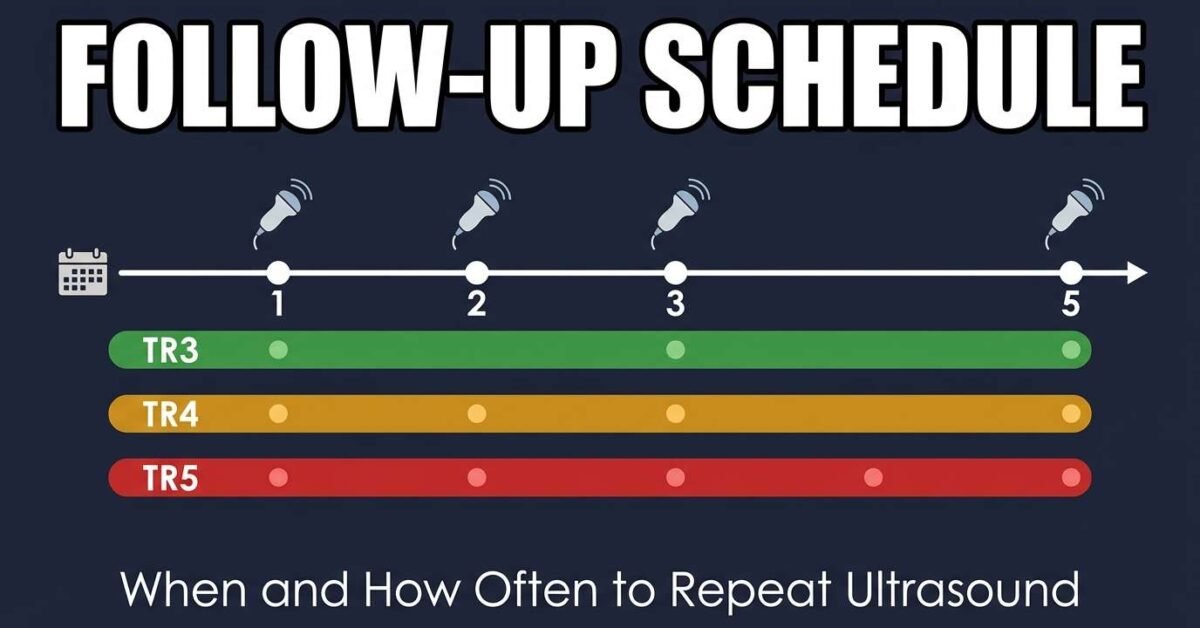
If your thyroid nodule does not meet the size threshold for biopsy, or if your biopsy returned benign, the next question is: when do I come back? The answer is not the same for everyone. The follow-up ultrasound schedule depends on your TI-RADS category, the biopsy result, and whether the nodule changes over time.
Follow-Up by TI-RADS Category (No Biopsy Done)
When a nodule falls in the surveillance range (above the lower threshold but below the biopsy threshold), the ACR recommends periodic ultrasound:
| Category | Size range | Follow-up ultrasound intervals |
|---|---|---|
| TR1 / TR2 | Any size | No follow-up needed |
| TR3 | 1.5 – 2.4 cm | 1, 3, and 5 years |
| TR4 | 1.0 – 1.4 cm | 1, 2, 3, and 5 years |
| TR5 | 0.5 – 0.9 cm | Annually for up to 5 years |
Nodules below the lower threshold for their category (TR3 under 1.5 cm, TR4 under 1.0 cm, TR5 under 0.5 cm) do not require routine follow-up imaging.
Follow-Up After a Benign Biopsy
When fine needle aspiration returns a Bethesda Category II (benign) result, the nodule does not disappear — it simply carries very low risk. The ACR recommends continued ultrasound monitoring because the false negative rate, though small, is not zero:
| TI-RADS category | First follow-up after benign FNA | Subsequent intervals |
|---|---|---|
| TR3 | 2 to 4 years | If stable, lengthen or discontinue |
| TR4 | 1 to 2 years | If stable, every 2 to 3 years for up to 5 years total |
| TR5 | 1 year | Annually until stable, then lengthen |
For highly suspicious nodules (TR5) that return benign, some centres recommend repeat biopsy at the first follow-up visit rather than ultrasound alone, to further reduce the chance of a false negative.
What the Follow-Up Ultrasound Looks For
At each follow-up, the sonographer measures the nodule in three dimensions and compares them to the prior examination. The two things that matter most are:
- Size change. Growth of 20 percent or more in at least two dimensions (or 50 percent in volume) is considered significant. Significant growth may lower the threshold for biopsy or repeat biopsy.
- Feature change. A nodule that develops new suspicious features, such as a change from smooth to irregular margins or the appearance of new microcalcifications, should be re-scored with TI-RADS and reassessed.
Stability on serial exams is reassuring. A nodule that has not changed over 5 years of surveillance has demonstrated benign behaviour, and routine monitoring can generally be discontinued.
When to Re-Biopsy
Repeat biopsy is considered when:
- The nodule shows significant growth meeting the criteria above
- New suspicious ultrasound features appear
- The initial biopsy was non-diagnostic (Bethesda I) and a repeat is needed
- The initial result was Bethesda III (AUS) and repeat FNA is the chosen management pathway
- A TR5 nodule returned benign and clinical concern remains high
Follow-up appointments are not a sign that something is wrong. They are a structured way to confirm that the nodule continues to behave as expected. Ask your doctor at each visit: has the nodule changed since the last scan, and when is the next appointment needed?
Ensure measurement consistency across serial exams. Use the same imaging planes and caliper placement technique. Intra-observer variability of 10 to 15 percent means minor fluctuations in measured dimensions should not be overinterpreted as growth. True growth requires change exceeding measurement error in at least two dimensions.
The Five-Year Horizon
The ACR surveillance intervals extend to 5 years. Beyond that, if the nodule has been stable across multiple exams and any biopsies have returned benign, long-term routine monitoring is not standard practice. Patients should continue to report any new symptoms or palpable changes, but scheduled imaging can generally stop.
For the full decision framework on when biopsy is indicated, see our guide on when a thyroid nodule needs a biopsy, or check your specific score with the TI-RADS calculator.
Frequently Asked Questions
How often should a thyroid nodule be checked with ultrasound?
The interval depends on the TI-RADS category and whether biopsy was performed. TR3 nodules in the follow-up range are scanned at 1, 3, and 5 years. TR4 nodules are scanned at 1, 2, 3, and 5 years. TR5 nodules in the follow-up range are scanned annually for up to 5 years.
Do I need follow-up if my thyroid nodule biopsy was benign?
Yes, usually. After a benign biopsy result (Bethesda II), the ACR recommends a follow-up ultrasound at 1 to 2 years for TR4 and TR5 nodules, and at 2 to 4 years for TR3 nodules. If the nodule is stable on the first follow-up, intervals can be lengthened.
When can I stop getting thyroid ultrasounds?
For nodules that remain stable across serial exams with no change in size or features, surveillance can generally be discontinued after 5 years. If a nodule has been biopsied and returned benign with no interval growth, long-term monitoring beyond 5 years is not routinely recommended.
What counts as significant growth in a thyroid nodule?
A nodule is considered to have grown significantly if it increases by 20 percent or more in at least two dimensions, or if its volume increases by 50 percent or more. Growth meeting these criteria generally lowers the threshold for biopsy or repeat biopsy.
