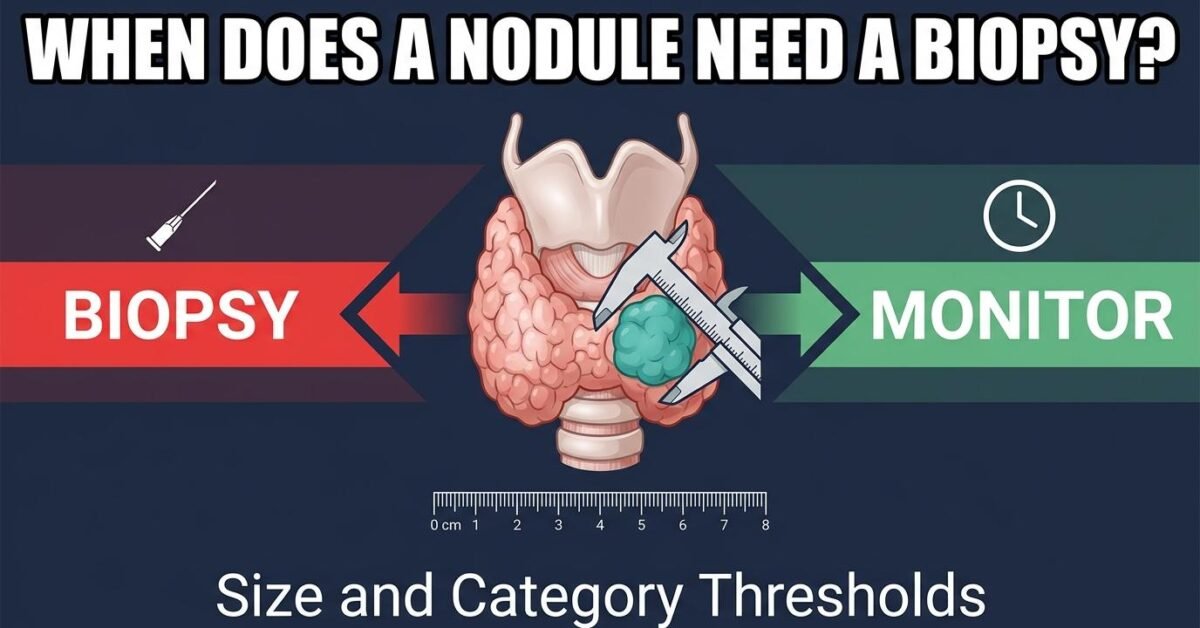
Most thyroid nodules never need a biopsy. Nodules are extremely common, found in up to 65 percent of adults when sensitive ultrasound is used, and the overwhelming majority are benign. The decision to biopsy rests on two factors working together: how suspicious the nodule looks on ultrasound, and how large it is.
The Two-Factor Decision
Neither appearance nor size decides alone. A highly suspicious nodule that is very small is usually monitored rather than sampled, while a large nodule with entirely benign features may still need no biopsy at all. The two must be considered together.
Step 1: The TI-RADS Category
A radiologist scores five ultrasound features (composition, echogenicity, shape, margin, and echogenic foci) and adds the points. The total assigns a category:
| Category | Points | Description | Malignancy Risk |
|---|---|---|---|
| TR1 | 0 | Benign | ~0.3% |
| TR2 | 2 | Not suspicious | ~1.5% |
| TR3 | 3 | Mildly suspicious | ~4.8% |
| TR4 | 4–6 | Moderately suspicious | ~9.1% |
| TR5 | 7+ | Highly suspicious | ~35% |
Step 2: The Size Threshold
Each category has its own size cutoff for biopsy and for follow-up imaging:
| Category | Biopsy (FNA) | Follow-up Ultrasound | No Action |
|---|---|---|---|
| TR1 | Never | Not needed | All sizes |
| TR2 | Never | Not needed | All sizes |
| TR3 | ≥ 2.5 cm | 1.5–2.4 cm | < 1.5 cm |
| TR4 | ≥ 1.5 cm | 1.0–1.4 cm | < 1.0 cm |
| TR5 | ≥ 1.0 cm | 0.5–0.9 cm | < 0.5 cm |
Enter your nodule’s features and size into the TI-RADS calculator to see which of these applies to your specific situation.
Worked Examples
The same size can lead to opposite recommendations depending on category, and the same category can lead to opposite recommendations depending on size:
- TR4 nodule, 1.8 cm — exceeds the 1.5 cm threshold, so FNA is recommended.
- TR4 nodule, 1.2 cm — below the biopsy threshold but within the follow-up range, so periodic ultrasound is recommended instead.
- TR2 nodule, 3.5 cm — large, but benign features mean no biopsy and no routine follow-up.
- TR5 nodule, 1.1 cm — small, but highly suspicious features exceed the 1.0 cm threshold, so FNA is recommended.
Factors That Change the Decision
Size and category are the framework, but several clinical factors can shift the threshold in either direction:
- Interval growth. A nodule that grows 20 percent in two dimensions between scans warrants closer attention regardless of its previous classification.
- Family history. A first-degree relative with thyroid cancer, or a syndrome such as MEN2 or familial adenomatous polyposis, lowers the threshold.
- Radiation exposure. Prior head or neck radiation, particularly in childhood, substantially raises baseline risk.
- Compressive symptoms. Difficulty swallowing, hoarseness, or breathing changes may prompt evaluation independent of ultrasound scoring.
- Suspicious lymph nodes. Abnormal cervical nodes on ultrasound are a strong indication to sample both the node and the nodule.
- Positive PET uptake. Incidentally FDG-avid thyroid nodules carry a higher malignancy rate and are often biopsied regardless of size.
Size thresholds are guidance, not mandates. Sonographically suspicious nodules with abnormal ipsilateral nodes should be sampled irrespective of the primary nodule’s diameter, and the node itself should be aspirated with thyroglobulin washout where available.
If your doctor recommends monitoring rather than biopsy, that is a considered decision based on published thresholds, not an oversight. Ask when your next ultrasound is scheduled and what size change would trigger a biopsy.
What Happens If Biopsy Is Recommended
Thyroid FNA is a brief outpatient procedure, usually completed in under 30 minutes with minimal discomfort and same-day discharge. Results are reported using the Bethesda classification within about a week. Read our full thyroid biopsy guide for what to expect, and the Bethesda system guide for interpreting results.
Frequently Asked Questions
What size thyroid nodule needs a biopsy?
It depends on the risk category. Under ACR TI-RADS, biopsy is recommended for TR3 nodules at 2.5 cm or larger, TR4 at 1.5 cm or larger, and TR5 at 1.0 cm or larger. TR1 and TR2 nodules do not require biopsy at any size.
Do all thyroid nodules need to be biopsied?
No. Most thyroid nodules never need a biopsy. Nodules scored TR1 or TR2 require no biopsy or follow-up at all, and nodules below the size threshold for their category are monitored with ultrasound rather than sampled.
Can a thyroid nodule be too small to biopsy?
Yes. Nodules under 1 cm are generally not biopsied even when suspicious, because sampling very small nodules is technically difficult and most subcentimeter thyroid cancers behave indolently. These are typically followed with periodic ultrasound instead.
What if my nodule grows between scans?
Significant growth, commonly defined as a 20 percent increase in at least two dimensions or a 50 percent increase in volume, generally lowers the threshold for biopsy even if the nodule previously fell below the size cutoff.
