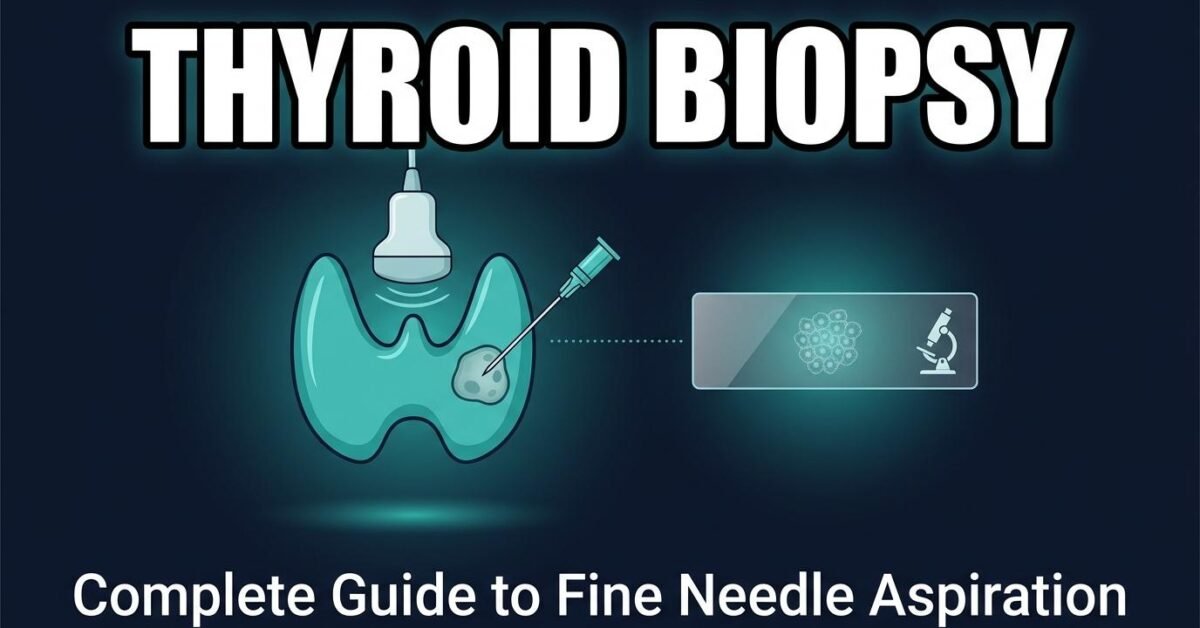
A thyroid biopsy is the test that answers the question an ultrasound cannot: is this nodule benign or malignant? Most thyroid biopsies use fine needle aspiration (FNA), a quick outpatient procedure that collects cells from the nodule for examination under a microscope. This guide covers who needs a biopsy, how the procedure works, what the results mean, and what happens afterward.
Who Needs a Thyroid Biopsy?
Not every thyroid nodule needs a biopsy. The decision depends on the nodule’s ultrasound appearance and its size. Radiologists use risk stratification systems, most commonly ACR TI-RADS, to score five ultrasound features and assign a category from TR1 to TR5. That category, combined with the nodule’s maximum diameter, determines whether FNA is recommended.
| TI-RADS Category | Malignancy Risk | Biopsy Recommended At |
|---|---|---|
| TR1 (benign) | ~0.3% | Not recommended |
| TR2 (not suspicious) | ~1.5% | Not recommended |
| TR3 (mildly suspicious) | ~4.8% | 2.5 cm or larger |
| TR4 (moderately suspicious) | ~9.1% | 1.5 cm or larger |
| TR5 (highly suspicious) | ~35% | 1.0 cm or larger |
Use the TI-RADS calculator to see whether your nodule meets the biopsy threshold, and read our guide on when a thyroid nodule needs a biopsy for the full decision framework.
Types of Thyroid Biopsy
Fine Needle Aspiration (FNA)
FNA is the standard first-line biopsy for thyroid nodules. A very thin needle, typically 25 to 27 gauge, is inserted into the nodule under ultrasound guidance. Cells are drawn into the needle by capillary action or gentle suction. This is called a cytology sample because it collects individual cells rather than a tissue block.
Core Needle Biopsy
A core needle biopsy uses a slightly larger needle to remove a small cylinder of tissue rather than loose cells. It preserves the tissue architecture, which can help when FNA results are repeatedly indeterminate. It is used less often because it carries a marginally higher risk of bleeding and discomfort.
Surgical Biopsy
In rare cases where needle sampling cannot resolve the diagnosis, a surgeon may remove part or all of a thyroid lobe for examination. This is a definitive but more invasive approach.
How a Thyroid Biopsy Is Performed
The procedure is straightforward and typically takes 15 to 30 minutes from start to finish:
- Positioning. You lie on your back with a pillow under your shoulders so your neck is gently extended.
- Ultrasound localization. The radiologist scans the neck to locate the nodule and plan the safest needle path.
- Skin preparation. The skin is cleaned with antiseptic. Local anesthetic may be injected, though some centers skip it because the anesthetic injection stings about as much as the biopsy needle.
- Needle passes. The thin needle is advanced into the nodule under real-time ultrasound guidance. Several passes, usually two to five, are taken from different parts of the nodule to ensure an adequate sample.
- Sample preparation. Cells are smeared onto glass slides and fixed, or placed in liquid preservative. Some centers have a cytotechnologist check adequacy on the spot.
- Pressure and discharge. Light pressure is applied for a few minutes. You can usually leave immediately and resume normal activity the same day.
You do not need to fast before a thyroid FNA, and you can usually drive yourself home. Tell your doctor beforehand if you take blood thinners such as warfarin, apixaban, or clopidogrel, as they may want to adjust timing.
What the Results Mean
Thyroid biopsy results are reported using the Bethesda System for Reporting Thyroid Cytopathology, a six-category framework that standardizes how cytology findings are described and what each implies for management.
| Category | Meaning | Approx. Malignancy Risk |
|---|---|---|
| I | Non-diagnostic or unsatisfactory | 5–10% |
| II | Benign | 0–3% |
| III | Atypia of undetermined significance (AUS) | 6–18% |
| IV | Follicular neoplasm | 10–40% |
| V | Suspicious for malignancy | 45–60% |
| VI | Malignant | 94–99% |
The most common result by far is Category II (benign), which accounts for roughly 60 to 70 percent of thyroid FNAs. See our complete Bethesda system guide for what each category means and what follows.
Risks and Recovery
Thyroid FNA is among the safest diagnostic procedures performed. The most common effects are mild neck soreness for a day or two and a small bruise at the needle site. Serious complications such as significant bleeding, infection, or injury to nearby structures are rare, occurring in well under 1 percent of procedures.
You can eat, drive, and return to work the same day. Some people prefer to avoid strenuous exercise for 24 hours. An ice pack helps if the area feels tender.
What If the Result Is Non-Diagnostic?
Roughly 5 to 10 percent of thyroid FNAs come back as Bethesda Category I, meaning too few cells were collected to make a determination. This is more common in cystic nodules or those with extensive calcification. The usual next step is a repeat FNA after 6 to 12 weeks, often with on-site adequacy assessment to reduce the chance of a second non-diagnostic result.
Non-diagnostic rates fall substantially with on-site cytologic adequacy assessment and with sampling the solid, vascular components of partially cystic nodules rather than the cystic portion. For nodules with a prior Bethesda I result, consider core needle biopsy if a second FNA is again inadequate.
Molecular Testing
When a result falls into the indeterminate categories (Bethesda III or IV), molecular testing of the same sample can refine the risk estimate. These tests analyze genetic markers associated with thyroid malignancy and can help patients avoid diagnostic surgery when the probability of cancer is low. Availability varies by institution and insurance coverage.
Next Steps
If your ultrasound suggests biopsy may be needed, confirm the TI-RADS category and nodule size with the TI-RADS calculator, then discuss the recommendation with your physician. If you have already had a biopsy, our biopsy results guide explains each Bethesda category in plain language.
Frequently Asked Questions
What is a thyroid biopsy?
A thyroid biopsy, most commonly fine needle aspiration (FNA), uses a thin needle guided by ultrasound to collect cells from a thyroid nodule. A pathologist examines the cells under a microscope to determine whether the nodule is benign, malignant, or indeterminate.
Does a thyroid biopsy hurt?
Most people describe a thyroid FNA as mild discomfort rather than pain, similar to a blood draw. Local anesthetic is often used. The procedure takes only a few minutes and does not require sedation or an overnight stay.
How long does a thyroid biopsy take?
The procedure itself usually takes 15 to 30 minutes including preparation and ultrasound positioning. The needle sampling portion lasts only a few seconds per pass, and several passes are typically taken.
When do I get thyroid biopsy results?
Results are usually available within 3 to 10 business days, depending on the laboratory. Your doctor will report the finding using the Bethesda classification system, which ranges from Category I through VI.
