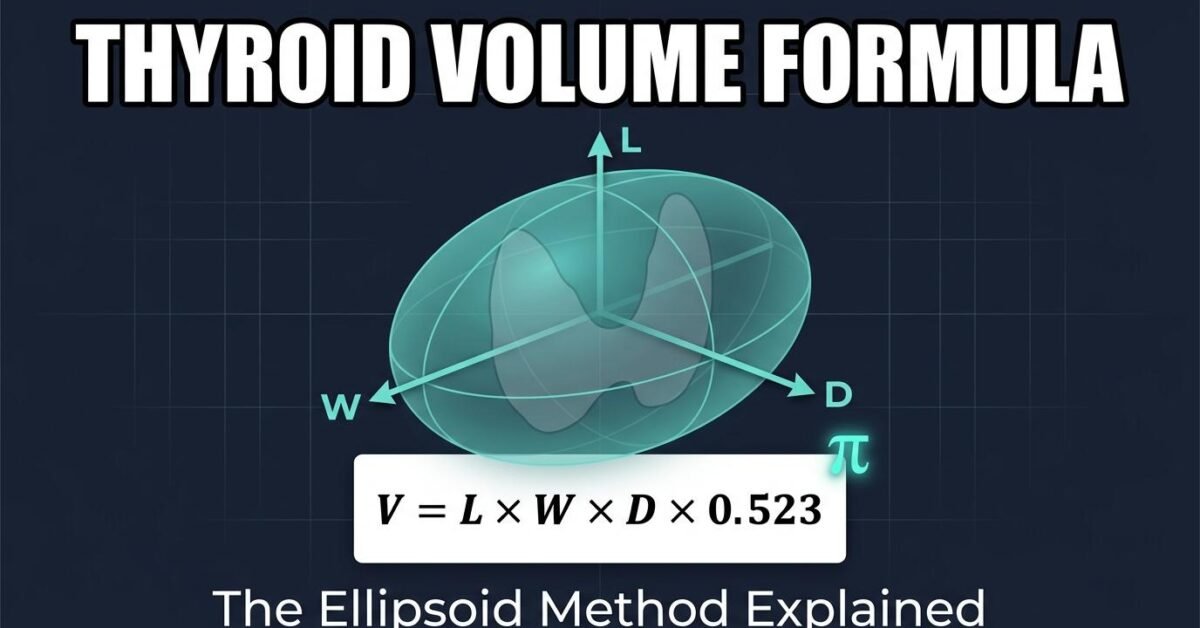
Thyroid volume is estimated from ultrasound measurements using the ellipsoid approximation, the most widely used method in clinical practice. This guide explains the formula, where the 0.523 constant comes from, its accuracy, and when alternative methods should be considered.
The Ellipsoid Formula
The standard formula for a single thyroid lobe is:
Volume (mL) = Length × Width × Depth × 0.523
Where length is the craniocaudal dimension, width is the mediolateral dimension, and depth is the anteroposterior dimension, all measured in centimeters. The total thyroid volume is the sum of the right and left lobe volumes. The isthmus is excluded unless its thickness exceeds 3 mm.
Try it yourself with the thyroid volume calculator.
Where 0.523 Comes From
The constant 0.523 is the mathematical value of pi divided by 6. It derives from the formula for the volume of an ellipsoid, which is (4/3) times pi times the product of the three semi-axes. When the three full diameters are used instead of semi-axes, the formula simplifies to length times width times depth times pi over 6, which equals approximately 0.5236.
This approximation treats each thyroid lobe as a smooth, regular ellipsoid, which closely matches the shape of most normal thyroid lobes.
Alternative Correction Factors
While 0.523 is the most commonly used factor, two alternatives appear in the literature. The Brunn method uses a correction factor of 0.479, derived from a 1981 cadaver study that remains the basis for most WHO epidemiological data. A 2006 study by Shabana et al. validated a factor of 0.529 against multi-detector CT volumetry, finding it slightly more accurate for adult clinical use.
In practice, the differences between these factors are small (typically less than 10 percent) and clinically insignificant for most routine measurements. The 0.523 factor remains the standard taught in most radiology training programs.
For clinicians: When comparing serial measurements, use the same correction factor consistently. Switching between 0.479 and 0.523 between exams introduces artificial volume changes that do not reflect true gland growth or shrinkage.
Accuracy and Limitations
The ellipsoid method carries an average measurement error of approximately 15 to 16 percent compared to true anatomical volume. This error increases in glands with irregular morphology such as multinodular goiters, asymmetric lobes, or retrosternal extension. For highly irregular glands, cross-sectional volumetry using CT or MRI segmentation provides more accurate results.
Operator variability is the single largest source of error. Consistent probe positioning, measurement technique, and caliper placement are more important than the choice of correction factor.
When Volume Measurement Matters Most
Thyroid volume estimation is most clinically relevant for evaluating suspected goiter, monitoring response to suppressive thyroid therapy, assessing iodine deficiency in population studies, pre-surgical planning for thyroidectomy, and tracking gland changes during serial ultrasound follow-up.
Combined with the TI-RADS calculator for nodule risk assessment, thyroid volume measurement completes the core thyroid ultrasound evaluation.
Frequently Asked Questions
Why is the thyroid volume formula multiplied by 0.523?
The constant 0.523 equals pi divided by 6, derived from the mathematical formula for the volume of an ellipsoid. It converts the product of three diameters into an estimated volume.
Is the ellipsoid method accurate?
It carries an average error of about 15 percent compared to true volume. For most clinical purposes this is acceptable, but for irregular glands, 3D volumetry is more precise.
Should I use 0.479 or 0.523?
Both are validated. Use 0.523 for standard clinical practice and 0.479 when comparing against older WHO epidemiological data. Be consistent across serial exams.
