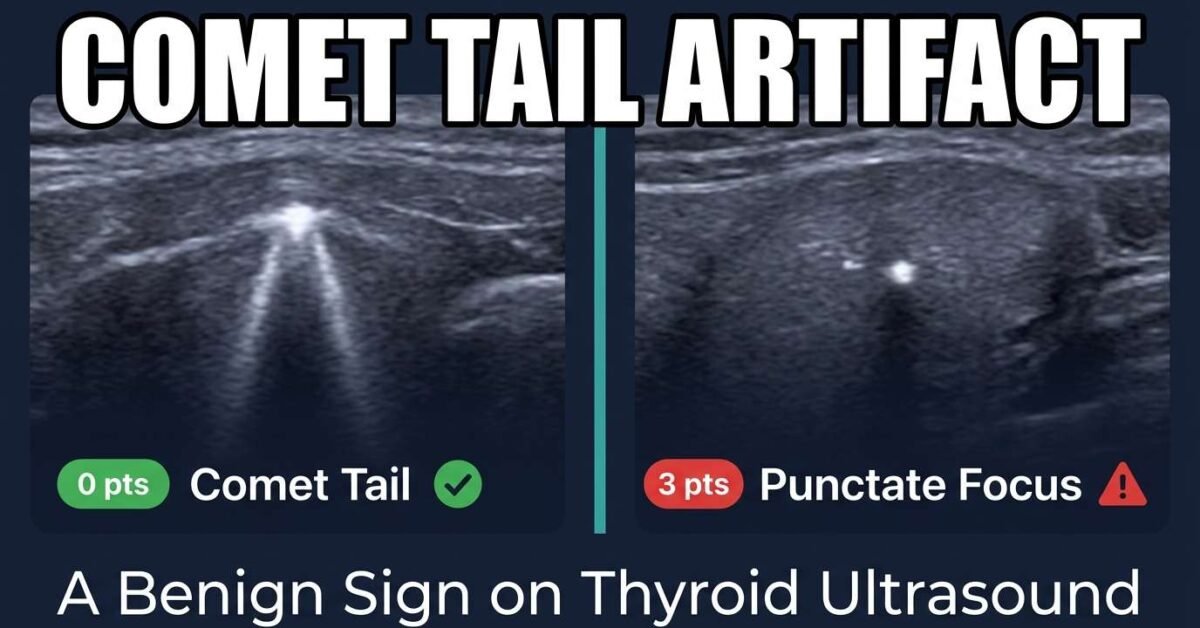
Seeing “echogenic foci” on your thyroid ultrasound report can sound alarming, but not all bright spots are concerning. The comet-tail artifact is a specific type that is actually a benign indicator, scoring 0 points in the ACR TI-RADS system. Understanding the difference between a comet tail and a true microcalcification can save a lot of unnecessary worry.
What Causes a Comet-Tail Artifact
A comet-tail artifact is produced when sound waves bounce back and forth within a tiny structure, creating a series of echoes that stack up behind it in a characteristic V-shaped or triangular bright tail. In the thyroid, these are most commonly produced by colloid crystals within small cystic spaces in benign colloid nodules.
The key visual feature is the trailing tail. A comet-tail artifact is not just a bright dot; it has a distinct downward-pointing bright extension behind the initial echogenic focus.
Comet-Tail Artifact vs Microcalcifications
This distinction is clinically important because the two findings score at opposite ends of the TI-RADS spectrum:
| Comet-tail artifact | Punctate echogenic foci (microcalcifications) | |
|---|---|---|
| Appearance | Bright focus with a V-shaped trailing tail | Isolated bright dot, no tail |
| Cause | Colloid crystal reverberation | Calcium deposit (psammoma body) |
| TI-RADS points | 0 | 3 |
| Clinical meaning | Benign indicator | Associated with papillary thyroid cancer |
When a radiologist sees a bright focus in a thyroid nodule, they determine whether it has the trailing tail characteristic of colloid (benign) or appears as an isolated dot without a tail (potentially suspicious). Read our full guide to thyroid microcalcifications and echogenic foci for the complete breakdown.
Where Comet Tails Are Typically Found
Comet-tail artifacts are characteristically found in colloid nodules and spongiform nodules, where the microcystic spaces contain viscous colloid material. These nodule types are among the most common benign thyroid findings and score 0 points for both composition (spongiform) and echogenic foci (comet-tail artifacts).
When multiple comet-tail artifacts are scattered throughout a nodule in a microcystic background, the pattern strongly favours a benign diagnosis regardless of the other features.
The ACR distinguishes between large comet-tail artifacts (clearly benign, 0 points) and small comet-tail artifacts, which can be harder to differentiate from true punctate echogenic foci. When the tail is absent or ambiguous, score conservatively as punctate foci (3 points) unless the overall nodule context strongly suggests colloid.
If your report mentions comet-tail artifacts, that is a reassuring finding. It suggests the bright spots in your nodule are caused by benign colloid material rather than calcium deposits. This adds 0 points to your TI-RADS score.
Scoring Comet-Tail Artifacts in TI-RADS
Echogenic foci is the one TI-RADS feature that allows multiple selections. A nodule can have comet-tail artifacts (0 points) and macrocalcifications (1 point) simultaneously. In that case, both are noted and the higher-scoring option contributes to the total.
Enter all five features into the TI-RADS calculator to see the combined category and recommendation.
Frequently Asked Questions
What is a comet-tail artifact on thyroid ultrasound?
A comet-tail artifact is a V-shaped or triangular bright tail that extends behind a small echogenic focus in a thyroid nodule. It is caused by reverberation of sound waves within colloid crystals or microcystic spaces and is considered a benign indicator, scoring 0 TI-RADS points.
Is a comet-tail artifact the same as microcalcification?
No. A comet-tail artifact is a reverberation artefact with a trailing bright tail, associated with benign colloid. A microcalcification (punctate echogenic foci) appears as an isolated bright dot without a tail and is associated with papillary thyroid carcinoma. They score 0 and 3 TI-RADS points respectively.
Does a comet-tail artifact mean the nodule is benign?
A large comet-tail artifact is a strong benign indicator that scores 0 points and is commonly seen in colloid nodules. However, the overall TI-RADS category depends on all five features combined. A nodule can have comet-tail artifacts and still score points from other features.
