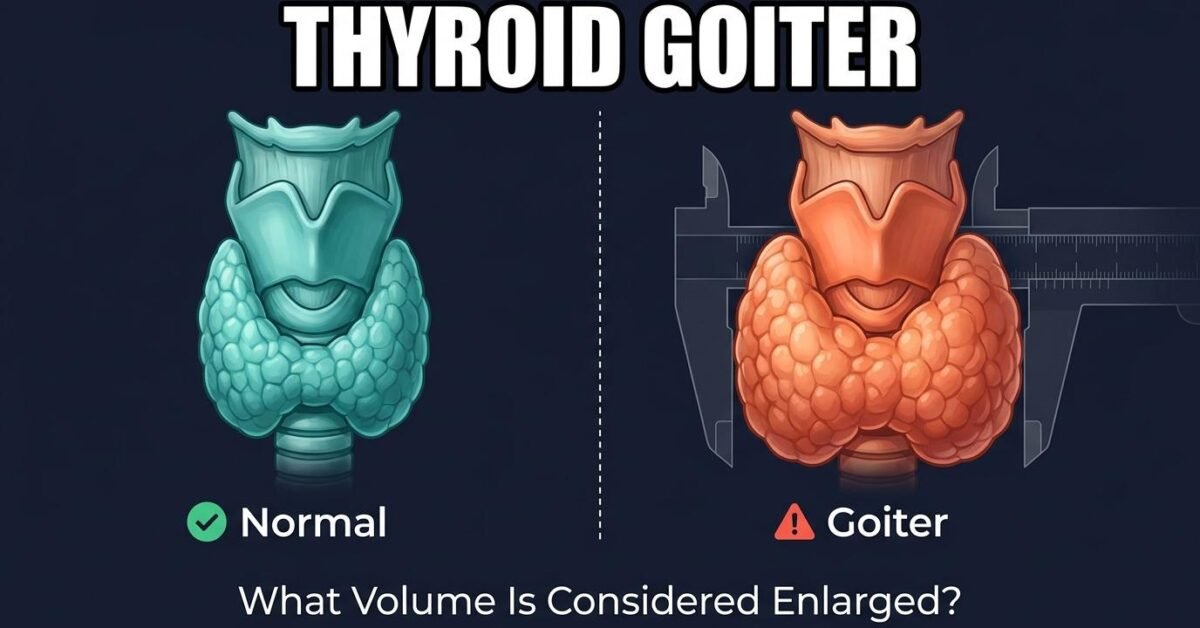
If your ultrasound shows a thyroid volume above normal range, your doctor may use the term goiter, which simply means an enlarged thyroid gland. This guide explains the volume thresholds, common causes, and when an enlarged thyroid needs treatment.
Volume Thresholds for Goiter
A thyroid gland is generally considered enlarged when its total volume exceeds established gender-specific upper limits:
| Gender | Normal upper limit | Borderline | Enlarged (goiter) |
|---|---|---|---|
| Female | Up to 15 mL | 15 to 20 mL | Over 20 mL |
| Male | Up to 18 mL | 18 to 25 mL | Over 25 mL |
These thresholds vary slightly between studies and geographic regions. In areas with iodine deficiency, average thyroid volumes are naturally higher, so local reference ranges may differ.
You can check your measurements with the thyroid volume calculator to see where your gland falls relative to these ranges.
Types of Goiter
Goiter is classified by its ultrasound appearance. A diffuse goiter means the entire gland is uniformly enlarged without distinct nodules. A nodular goiter contains one or more focal growths. A multinodular goiter has multiple nodules throughout the gland and is the most common form in iodine-sufficient populations.
Common Causes of Thyroid Enlargement
The most common cause of goiter worldwide is iodine deficiency, which affects approximately 2 billion people. In iodine-sufficient countries, the leading causes are autoimmune thyroid disorders. Hashimoto thyroiditis causes the immune system to attack thyroid tissue, often resulting in gradual enlargement. Graves disease stimulates excess thyroid hormone production and gland growth. Other causes include thyroid nodules, thyroiditis, and certain medications including lithium.
When Does Goiter Need Treatment?
Not all enlarged thyroids need treatment. Small diffuse goiters in euthyroid patients (normal thyroid function) are often monitored with periodic ultrasound. Treatment is typically considered when the goiter causes compressive symptoms such as difficulty swallowing or breathing, when thyroid function is abnormal, when cancer is suspected in a nodule, or when the goiter grows significantly on serial imaging.
If nodules are present within a goiter, each nodule should be evaluated individually using the TI-RADS scoring system to determine whether biopsy is needed.
Monitoring Thyroid Volume Over Time
Serial ultrasound measurements allow your doctor to track changes in thyroid volume over months or years. A volume increase of more than 20 percent between exams is generally considered significant growth. Consistent measurement technique is important, as small differences in probe placement or measurement can affect the calculated volume.
Frequently Asked Questions
What thyroid volume is considered goiter?
Total thyroid volume above approximately 20 mL in women or 25 mL in men is generally considered enlarged. Values between normal and these thresholds are borderline.
Can goiter go away on its own?
Some causes of goiter, such as pregnancy-related enlargement or transient thyroiditis, can resolve on their own. Goiters from iodine deficiency may shrink with iodine supplementation. Chronic goiters from autoimmune disease typically do not resolve spontaneously.
Is goiter the same as thyroid cancer?
No. Goiter means enlargement and is usually benign. However, nodules within a goiter can occasionally be malignant, which is why individual nodules are assessed with TI-RADS.
