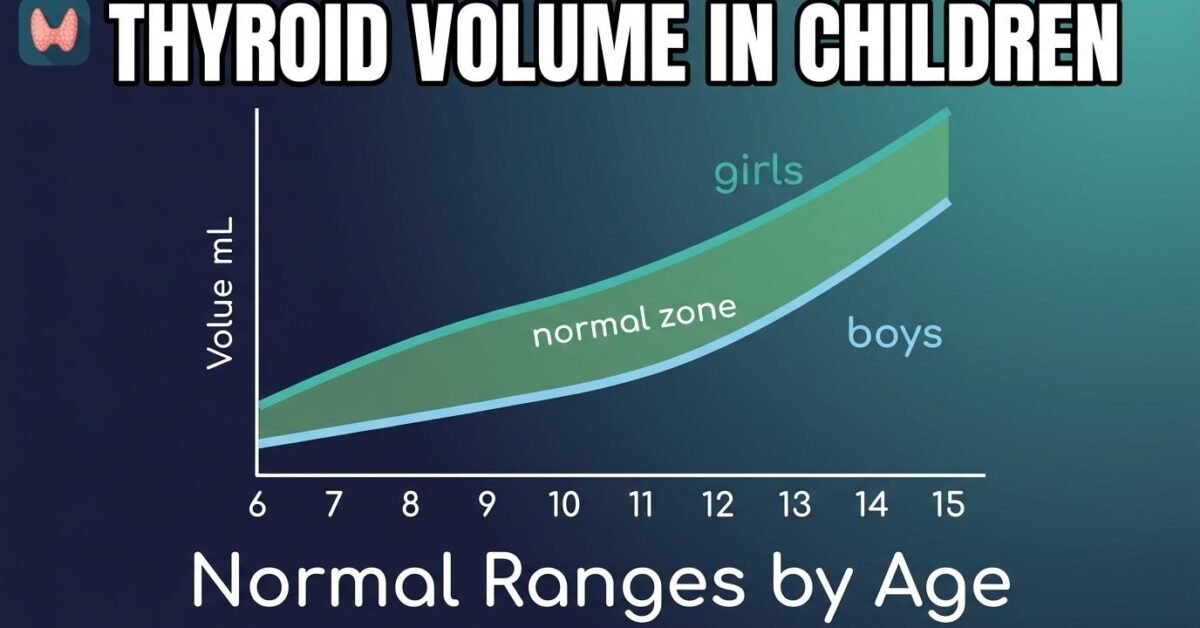
Thyroid volume in children changes significantly with age and body size. Adult reference ranges do not apply to pediatric patients, so age-specific standards are used instead. This guide covers the normal ranges for children, what influences pediatric thyroid size, and when a child’s thyroid is considered enlarged.
Why Pediatric Ranges Are Different
A child’s thyroid gland grows steadily from birth through adolescence. A 6-year-old with a thyroid volume of 4 mL is normal, but the same volume in a newborn would indicate significant enlargement. Using adult reference ranges for children leads to missed diagnoses and unnecessary concern, so age-specific charts are essential.
Normal Thyroid Volume by Age (WHO Data)
The World Health Organization and International Council for Control of Iodine Deficiency Disorders published reference ranges for children aged 6 to 15 years in iodine-sufficient populations:
| Age | Girls (upper limit mL) | Boys (upper limit mL) |
|---|---|---|
| 6 | 4.0 | 4.0 |
| 7 | 4.8 | 4.6 |
| 8 | 5.9 | 5.3 |
| 9 | 6.8 | 6.0 |
| 10 | 7.8 | 6.9 |
| 11 | 9.0 | 8.0 |
| 12 | 10.4 | 9.3 |
| 13 | 11.7 | 10.7 |
| 14 | 13.1 | 12.1 |
| 15 | 14.6 | 13.9 |
For children under 6, limited normative data exists. Studies in infants report mean thyroid volumes of approximately 0.3 to 0.7 mL in newborns and 0.8 to 1.0 mL between 2 and 36 months.
What Affects Thyroid Size in Children
Body surface area is the strongest predictor of thyroid volume in children, more so than age alone. Height, weight, and BMI all correlate positively with gland size. Iodine intake is the most important environmental factor, with iodine-deficient populations showing larger average thyroid volumes. Gender differences are minimal before puberty but become apparent during adolescence, with girls tending to develop slightly larger glands.
When a Child’s Thyroid Is Enlarged
A thyroid volume above the age- and gender-specific upper limit suggests enlargement. In iodine-sufficient regions, the most common causes in children are Hashimoto thyroiditis and Graves disease. In iodine-deficient areas, endemic goiter is the primary cause. Congenital hypothyroidism in infants may present with either an enlarged or absent thyroid, depending on the underlying cause.
Thyroid nodules in children are less common than in adults but carry a higher malignancy rate when present. Any nodule found during pediatric thyroid ultrasound should be evaluated with the TI-RADS system.
Calculating Pediatric Thyroid Volume
The same ellipsoid formula used in adults applies to children. The thyroid volume calculator computes the volume from lobe dimensions. Compare the result against the age-specific table above rather than adult ranges.
Frequently Asked Questions
What is a normal thyroid volume for a 10-year-old?
The upper limit of normal for a 10-year-old is approximately 7.8 mL for girls and 6.9 mL for boys, according to WHO reference data.
Can my child’s thyroid be too small?
Yes. An abnormally small thyroid (thyroid hypoplasia) can indicate congenital hypothyroidism or atrophy from autoimmune thyroiditis. It requires endocrine evaluation.
Should children with enlarged thyroids be worried about cancer?
Thyroid enlargement in children is most often benign (goiter or thyroiditis). However, any focal nodule within an enlarged gland should be assessed for cancer risk using TI-RADS scoring.
