Getting a TI-RADS 5 result on your thyroid ultrasound is understandably frightening. It is the highest risk category in the ACR TI-RADS system, and the word “highly suspicious” on a medical report can feel like a diagnosis. But TR5 is not a diagnosis of cancer. This article explains what the numbers actually say and what happens next.
The Short Answer: No
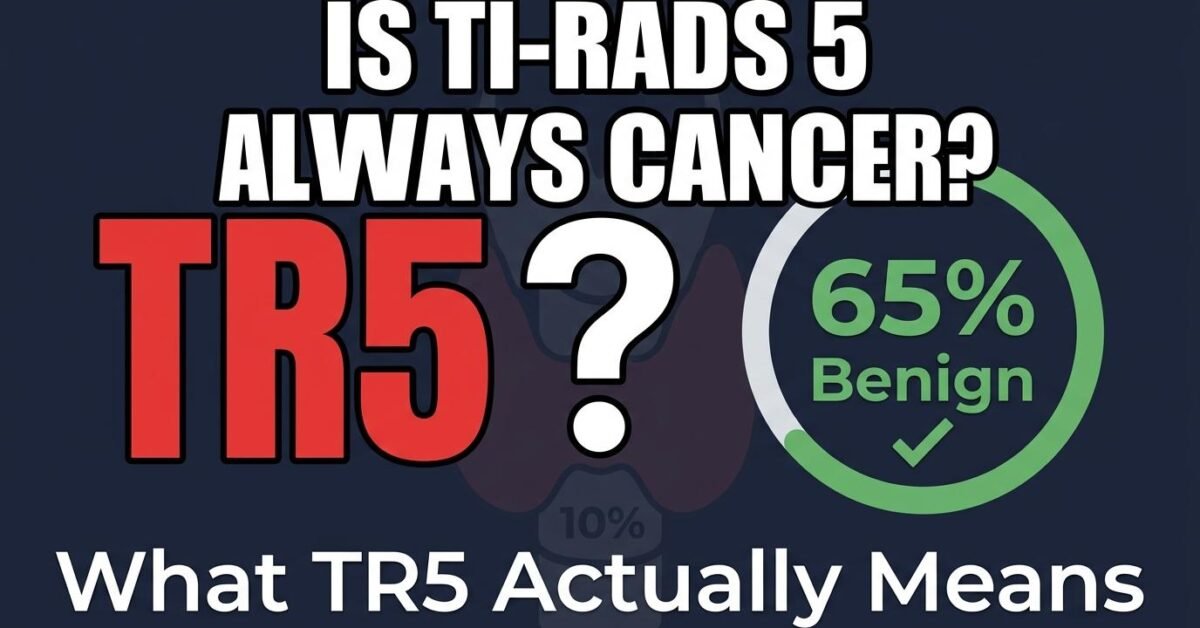
A TI-RADS 5 (TR5) thyroid nodule is not always cancer. The estimated malignancy risk for TR5 is approximately 35 percent. That means roughly two out of every three TR5 nodules are benign. The category identifies nodules that have enough suspicious ultrasound features to warrant prompt evaluation, but the majority still turn out to be non-cancerous after biopsy.
Why TR5 Sounds Worse Than It Often Is
The TI-RADS system is deliberately conservative. It is designed to catch cancers early, which means it intentionally casts a wide net. A nodule reaches TR5 by scoring 7 or more points across features like very hypoechoic echogenicity, taller-than-wide shape, irregular margins, or punctate echogenic foci. Each of these features is associated with cancer, but having several of them together still does not guarantee malignancy.
Many benign conditions can mimic suspicious ultrasound features. Hashimoto thyroiditis can cause hypoechoic nodules with irregular margins. Calcified colloid nodules can produce bright foci that look like microcalcifications. These false positives are expected and are the reason biopsy exists — to tell the difference.
What the Biopsy Tells You
For TR5 nodules 1.0 cm or larger, fine needle aspiration (FNA) biopsy is recommended. The biopsy samples cells from the nodule and a pathologist examines them under a microscope. The result is reported using the Bethesda classification system, which ranges from benign (Bethesda II) to malignant (Bethesda VI).
Most TR5 biopsies come back as one of three results: benign, indeterminate (Bethesda III or IV, meaning the cells are not clearly benign or malignant), or malignant. An indeterminate result may lead to molecular testing or repeat biopsy. A benign result is reassuring and usually means continued monitoring.
What If It Is Cancer?
If the biopsy confirms thyroid cancer, the most common type is papillary thyroid carcinoma, which has excellent treatment outcomes. The overall 5-year survival rate for papillary thyroid cancer exceeds 98 percent. Treatment typically involves surgery and, in some cases, radioactive iodine therapy. Many patients with early-stage papillary thyroid cancer live normal lifespans with appropriate treatment.
What to Do With a TR5 Result
Do not panic, but do not delay. Schedule the recommended biopsy promptly. Ask your doctor three questions: what is the exact size of the nodule, is biopsy recommended based on the size threshold, and when can it be scheduled. Use the TI-RADS calculator to confirm the category and see the size-based recommendation.
For a full explanation of the TR5 category, see our detailed TI-RADS 5 guide.
Frequently Asked Questions
What percentage of TR5 nodules are cancer?
Approximately 35 percent. The remaining 65 percent are benign. A biopsy is what determines which group a nodule falls into.
Should I be scared of a TR5 result?
TR5 warrants prompt evaluation, not panic. Most TR5 nodules are benign, and even when cancer is confirmed, thyroid cancer is among the most treatable cancers with excellent survival rates.
Can a TR5 nodule turn out to be benign?
Yes. About two thirds of TR5 nodules are benign after biopsy. The high TI-RADS score reflects suspicious ultrasound features, not a confirmed diagnosis.