If you have received a thyroid ultrasound report, it probably lists several numbers measured in centimeters. These measurements describe the size and shape of your thyroid gland. This guide explains what each measurement means, what is considered normal, and what your doctor looks for.
The Three Dimensions
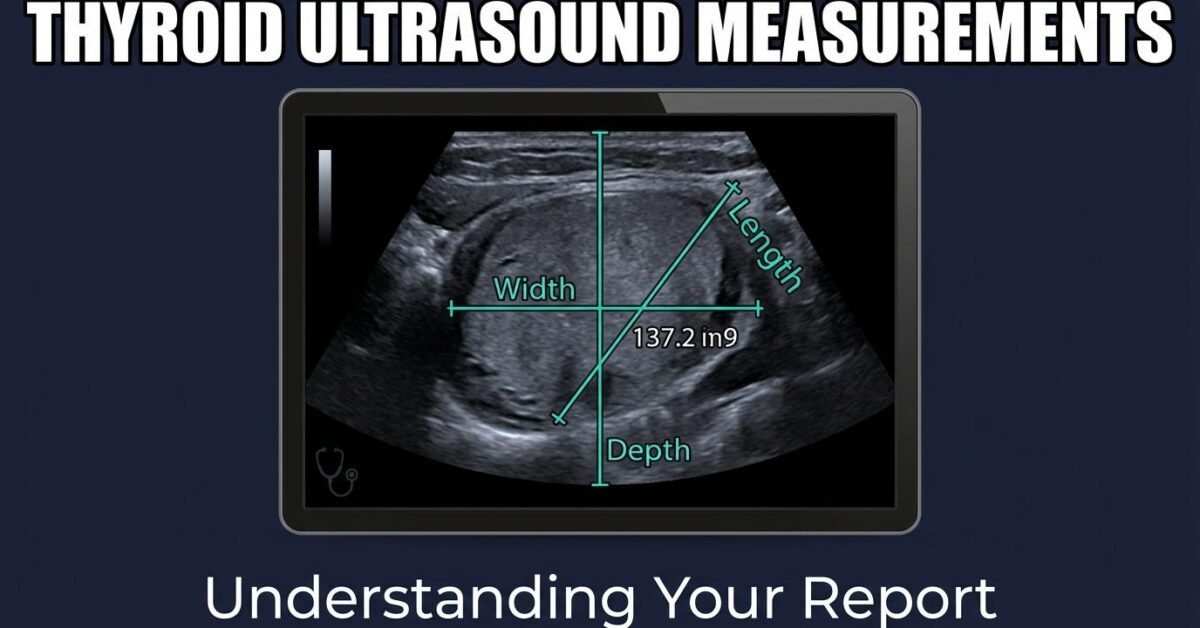
Each thyroid lobe is measured in three directions. Length is the craniocaudal dimension, measured from top to bottom of the lobe on a sagittal (lengthwise) view. Width is the mediolateral dimension, measured from side to side on a transverse (cross-sectional) view. Depth is the anteroposterior dimension, measured from front to back on a transverse view.
Normal adult lobe dimensions are approximately 40 to 60 mm in length, 13 to 18 mm in width, and 13 to 18 mm in depth.
From Dimensions to Volume
Your three lobe measurements are used to calculate thyroid volume using the ellipsoid formula. The calculator multiplies length times width times depth times 0.523 to estimate the volume in milliliters. This is done for each lobe separately, and the two volumes are added together for the total.
Enter your measurements into the thyroid volume calculator to see your results.
What the Isthmus Measurement Means
The isthmus is the thin bridge of thyroid tissue connecting the two lobes across the front of your trachea. Its thickness is usually reported as a single anteroposterior measurement. Normal isthmus thickness is typically less than 3 mm. A thickened isthmus may be noted but is not included in the standard volume calculation unless significantly enlarged.
Nodule Measurements
If your ultrasound found thyroid nodules, each nodule is measured separately from the overall gland dimensions. Nodule size is important because it helps determine whether a biopsy is recommended based on the nodule’s TI-RADS category. A TR4 nodule at 1.5 cm or larger, for example, typically prompts biopsy, while the same category at 1.2 cm is followed with ultrasound.
What Happens If Measurements Are Abnormal
If your thyroid volume is above normal, your doctor may evaluate for goiter, which has many possible causes ranging from iodine deficiency to autoimmune thyroid disease. If your volume is below normal, thyroid atrophy from chronic thyroiditis or prior treatment may be considered. Abnormal dimensions alone do not diagnose a condition. They are interpreted alongside your symptoms, blood tests, and the ultrasound appearance of the gland.
Questions to Ask Your Doctor
When reviewing your thyroid ultrasound report, consider asking: what is my total thyroid volume and is it within the normal range for my age and gender? Were any nodules found, and if so, what is their TI-RADS category? Do I need any follow-up scans or blood tests based on these results?
Frequently Asked Questions
What is a normal thyroid lobe size?
A normal adult thyroid lobe is approximately 4 to 6 cm long, 1.3 to 1.8 cm wide, and 1.3 to 1.8 cm deep, with a volume of roughly 5 to 12 mL per lobe depending on gender.
What does it mean if one lobe is bigger than the other?
Mild asymmetry is normal. The right lobe is slightly larger than the left in most people. Significant asymmetry may prompt further evaluation.
Are thyroid measurements the same as a TI-RADS score?
No. Thyroid measurements describe gland and nodule size. The TI-RADS score evaluates specific ultrasound features of a nodule to assess cancer risk. They are complementary but different assessments.
