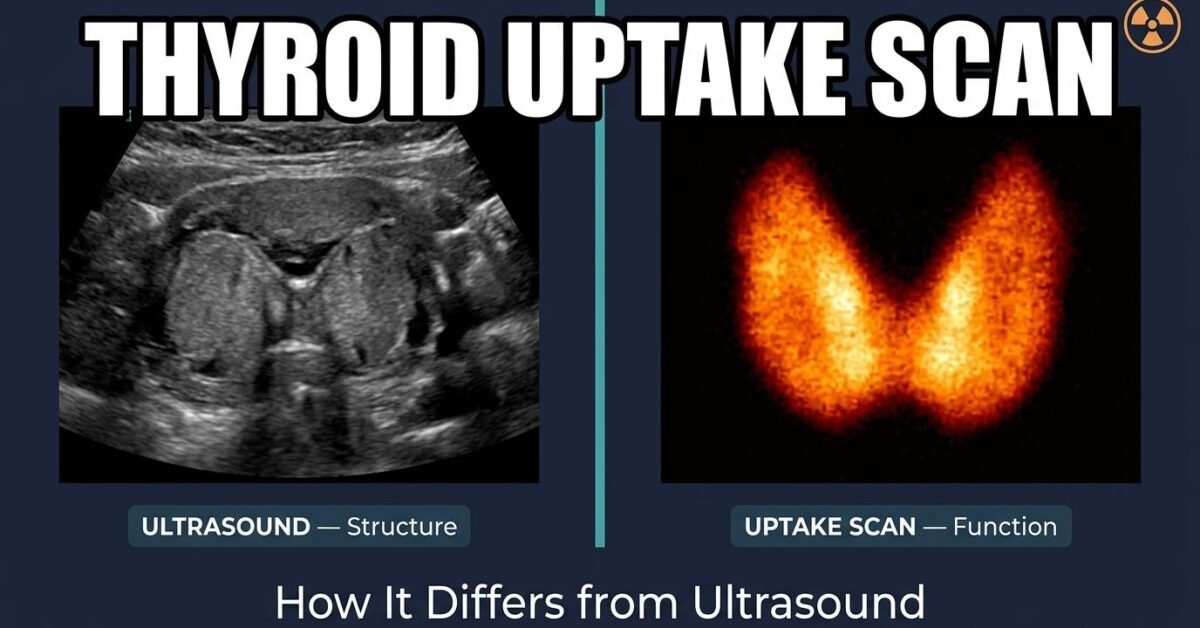
A thyroid uptake scan, also called a thyroid scan or radioactive iodine uptake test, answers a completely different question from an ultrasound. Where ultrasound shows what the gland looks like, an uptake scan shows what the gland is doing. This guide explains the difference and what the results mean.
Ultrasound vs Uptake Scan
| Thyroid ultrasound | Thyroid uptake scan | |
|---|---|---|
| Technology | High-frequency sound waves | Radioactive tracer (I-123 or Tc-99m) |
| What it shows | Structure, size, nodule features | Function, hormone activity |
| Radiation | None | Low dose |
| Duration | 15–30 minutes | Several hours to 24 hours |
| Preparation | None | Iodine restriction, some medications stopped |
| Main use | Nodule risk assessment, biopsy guidance | Hyperthyroidism workup, hot vs cold nodules |
The two are complementary rather than interchangeable. A patient with a nodule and suppressed TSH may have both.
How the Scan Works
The thyroid is the only tissue in the body that concentrates iodine, using it to manufacture thyroid hormone. A small dose of radioactive iodine or technetium is given by mouth or injection, and a gamma camera then measures how much the gland has absorbed and where.
Areas taking up more tracer than normal appear as bright or “hot” regions. Areas taking up less appear dark or “cold.”
Preparation
Unlike ultrasound, uptake scans require preparation:
- Iodine restriction for one to two weeks, avoiding seaweed, iodised salt, and iodine supplements
- Recent contrast imaging must be disclosed, as CT contrast contains iodine and can block uptake for weeks
- Certain medications may need pausing, including thyroid hormone replacement and antithyroid drugs
- Pregnancy and breastfeeding are contraindications
Hot Nodules
A hot nodule, sometimes called an autonomously functioning or toxic nodule, takes up more tracer than the surrounding gland. It is producing hormone independently of pituitary control.
The clinically important point is that hot nodules are almost never cancerous, with malignancy rates reported below 1 percent. They generally do not require biopsy. However, they can cause hyperthyroidism, and treatment focuses on that: antithyroid medication, radioactive iodine ablation, or surgery.
Cold Nodules
A cold nodule takes up less tracer than surrounding tissue, meaning it is not producing hormone. Most cold nodules are still benign, including cysts, colloid nodules, and adenomas, but the malignancy rate is meaningfully higher than for hot nodules.
A cold nodule is therefore evaluated the same way as any nodule found on ultrasound: by scoring its ultrasound features with TI-RADS and applying the size-based biopsy thresholds.
Uptake scanning is most useful when TSH is suppressed, since identifying an autonomously functioning nodule can spare an unnecessary FNA. In euthyroid or hypothyroid patients, scintigraphy adds little to ultrasound-based risk stratification and is not routinely indicated.
If your doctor orders both tests, they are not duplicating effort. The ultrasound assesses whether a nodule looks suspicious; the uptake scan assesses whether it is overproducing hormone. Both answers may be needed.
Which Test Do You Need?
- A lump or nodule found — ultrasound first, always
- Suppressed TSH with a nodule — uptake scan to check for a hot nodule
- Suspected Graves disease — uptake scan showing diffuse increased uptake
- Nodule surveillance over time — ultrasound
- Biopsy guidance — ultrasound
For the structural side of thyroid imaging, see our complete thyroid ultrasound guide.
Frequently Asked Questions
What is a thyroid uptake scan?
A thyroid uptake scan is a nuclear medicine test that measures how much radioactive iodine or technetium the thyroid absorbs. It assesses gland function and shows which areas are more or less active, unlike ultrasound which shows structure.
What is the difference between a thyroid scan and an ultrasound?
An ultrasound uses sound waves to show the gland’s structure, size, and nodules, with no radiation. A thyroid uptake scan uses a small radioactive tracer to show how actively different parts of the gland take up iodine, which reflects function rather than anatomy.
What does a hot nodule on the thyroid mean?
A hot nodule takes up more tracer than surrounding tissue, meaning it is producing thyroid hormone autonomously. Hot nodules are almost always benign, with malignancy rates under 1 percent, but they can cause hyperthyroidism.
What does a cold nodule mean?
A cold nodule takes up less tracer than surrounding tissue. Most cold nodules are still benign, but they carry a higher malignancy risk than hot nodules, so they are typically assessed further with ultrasound and possibly biopsy.
