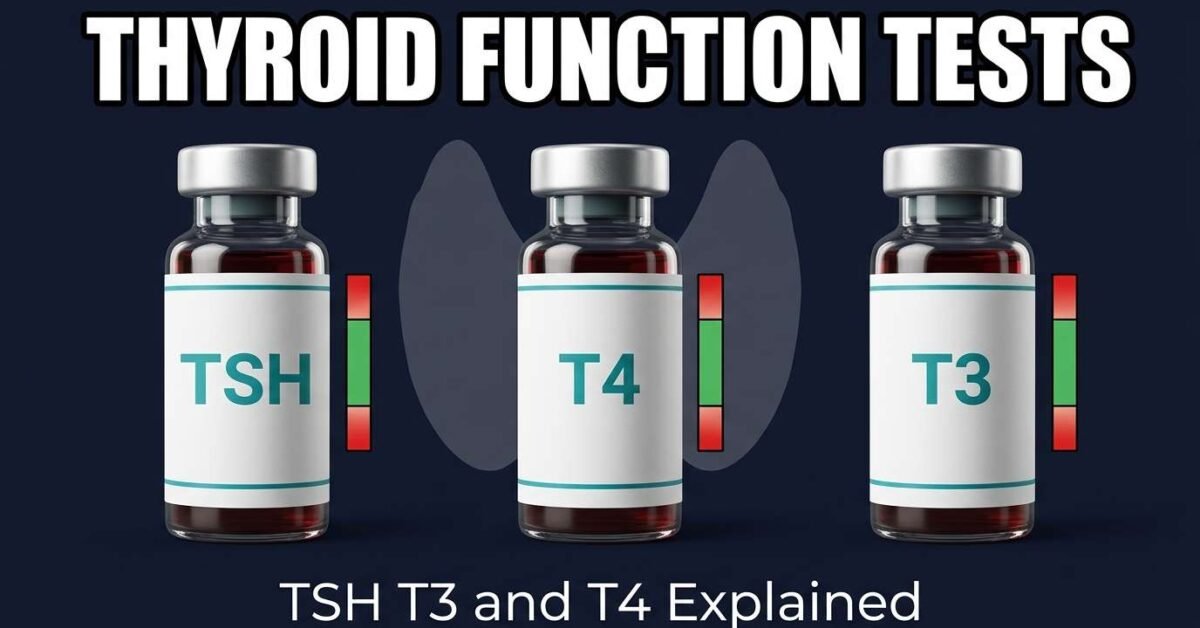
Thyroid function tests are blood tests that measure how well your thyroid gland is working. They do not detect nodules or diagnose cancer — that is the job of ultrasound and the TI-RADS scoring system. Instead, thyroid function tests tell your doctor whether the gland is producing the right amount of hormone, too much, or too little.
The Three Key Hormones
TSH — Thyroid-Stimulating Hormone
TSH is produced by the pituitary gland in the brain, not by the thyroid itself. It acts as a messenger, telling the thyroid how much hormone to make. TSH is the single most important screening test for thyroid function because it responds to even small changes in thyroid hormone levels before the hormones themselves move outside the normal range.
- High TSH — the pituitary is working harder to stimulate an underperforming thyroid, suggesting hypothyroidism
- Low TSH — the pituitary has pulled back because the thyroid is producing too much hormone, suggesting hyperthyroidism
- Normal TSH — thyroid function is likely adequate
Free T4 — Thyroxine
T4 is the main hormone the thyroid produces. It circulates in large quantities and serves as a reservoir that is converted into the more active T3 as needed. Free T4 measures only the unbound, biologically available portion. Low free T4 with high TSH confirms hypothyroidism. High free T4 with low TSH confirms hyperthyroidism.
Free T3 — Triiodothyronine
T3 is the biologically active thyroid hormone responsible for most metabolic effects. Most T3 is produced by conversion from T4 in the liver, kidneys, and other tissues rather than directly by the thyroid. T3 is measured less routinely than TSH and T4 but is important in suspected hyperthyroidism, where T3 may be elevated even when T4 is still normal, a condition called T3 thyrotoxicosis.
Normal Thyroid Function Test Ranges
| Test | Typical normal range | What abnormal values suggest |
|---|---|---|
| TSH | 0.4 – 4.0 mIU/L | High → hypothyroidism; Low → hyperthyroidism |
| Free T4 | 0.8 – 1.8 ng/dL | Low → hypothyroidism; High → hyperthyroidism |
| Free T3 | 2.3 – 4.2 pg/mL | High → hyperthyroidism (especially T3 thyrotoxicosis) |
Ranges vary between laboratories. Always interpret your results using the reference range printed on your specific report.
When Thyroid Function Tests Are Ordered
Common reasons include symptoms suggestive of thyroid dysfunction such as fatigue, weight changes, temperature sensitivity, or heart rate irregularities. They are also ordered routinely during pregnancy, before and after thyroid surgery, when monitoring thyroid medication, and alongside a thyroid ultrasound to provide a complete picture.
How Thyroid Function Tests Relate to TI-RADS
These are complementary, not competing, assessments. Ultrasound shows the gland’s structure — size, texture, and nodules. Blood tests show the gland’s function — how much hormone it is producing. A nodule found on ultrasound is scored with ACR TI-RADS to estimate malignancy risk, while thyroid function tests determine whether the gland is over- or underproducing hormone.
One specific intersection matters clinically: when a nodule is found and TSH is suppressed (low), a thyroid uptake scan may be ordered to check whether the nodule is autonomously producing hormone. A “hot” nodule on the uptake scan is almost never malignant and generally does not need biopsy. Read more in our thyroid uptake scan guide.
If you have had an ultrasound that found a nodule, thyroid function tests will likely be ordered alongside it. Normal blood results do not rule out cancer, and abnormal results do not confirm it. The two tests answer different questions and your doctor interprets them together.
What to Do Next
If your thyroid function tests are abnormal, your doctor will investigate further with additional blood work, imaging, or both. If a nodule is also present, use the TI-RADS calculator to understand its category and see whether biopsy is indicated based on size.
Frequently Asked Questions
What is a TSH test?
TSH (thyroid-stimulating hormone) is a blood test that measures how much TSH your pituitary gland is producing. It is the most sensitive screening test for thyroid function. High TSH suggests hypothyroidism (underactive thyroid), while low TSH suggests hyperthyroidism (overactive thyroid).
What are normal TSH levels?
Normal TSH levels typically range from approximately 0.4 to 4.0 mIU/L, though the exact range varies slightly between laboratories. Values above or below this range prompt further testing with free T4 and sometimes T3.
What is the difference between T3 and T4?
T4 (thyroxine) is the main hormone produced by the thyroid gland and circulates in large quantities. T3 (triiodothyronine) is the more biologically active form, mostly converted from T4 in peripheral tissues. Both are measured as free (unbound) hormones for clinical accuracy.
Do thyroid function tests show nodules or cancer?
No. Thyroid function tests measure hormone levels in the blood. They cannot detect nodules or diagnose cancer. Nodules are found on ultrasound and assessed with TI-RADS scoring. The two types of tests answer different questions and are often ordered together.
