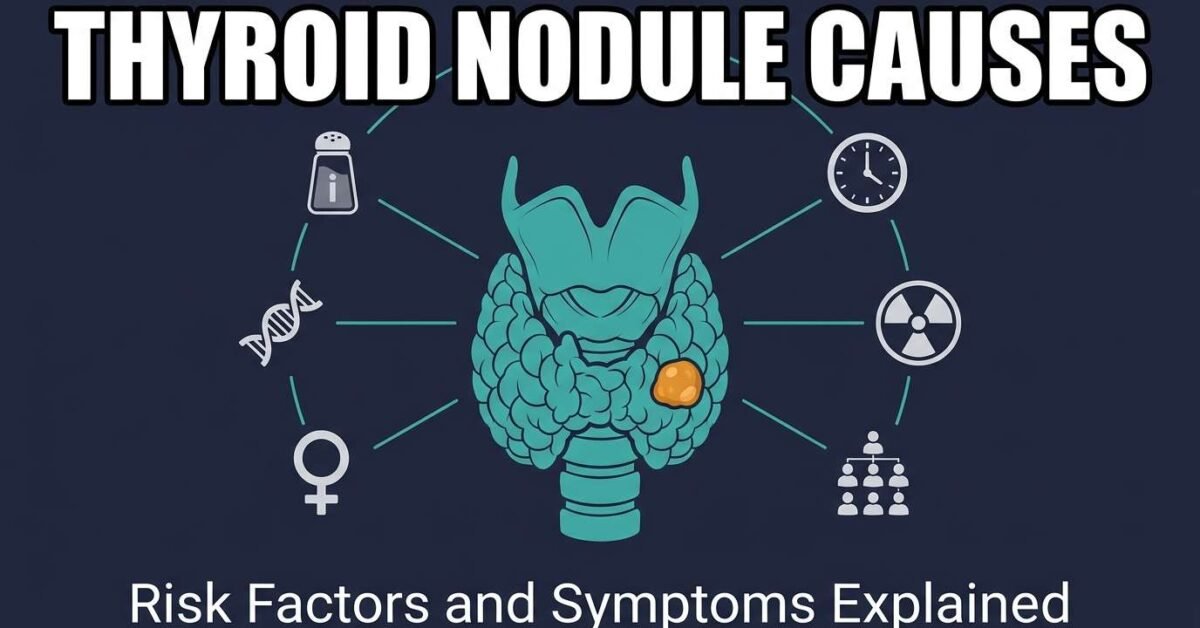
Thyroid nodules are one of the most common findings in medicine. Up to 65 percent of adults have at least one when examined with high-resolution ultrasound, and the vast majority cause no symptoms and are entirely benign. This guide explains why nodules form, what increases your risk, which symptoms to watch for, and when to see a doctor.
What Causes Thyroid Nodules
Thyroid nodules form for several reasons, and many arise without a single identifiable cause:
- Overgrowth of normal thyroid tissue (adenoma). The most common type. A segment of thyroid tissue grows faster than the surrounding gland, forming a distinct nodule. These are almost always benign.
- Colloid nodules. Collections of stored thyroid hormone (colloid) form within the gland, often appearing as cystic or spongiform nodules on ultrasound.
- Thyroid cysts. Fluid-filled sacs within the gland. Simple cysts are virtually never cancerous.
- Chronic inflammation (thyroiditis). Hashimoto thyroiditis causes long-term autoimmune inflammation that can produce nodules within a heterogeneous, inflamed gland.
- Multinodular goiter. The gland develops multiple nodules, often over years, sometimes associated with iodine deficiency or age.
- Thyroid cancer. Approximately 5 to 15 percent of thyroid nodules are malignant. Cancer nodules are assessed with the TI-RADS scoring system.
Risk Factors for Thyroid Nodules
Several factors increase the likelihood of developing thyroid nodules:
- Gender. Women are approximately four times more likely than men to develop thyroid nodules.
- Age. Prevalence increases with age, with the highest rates in people over 60.
- Iodine deficiency. Low iodine intake is the leading cause of nodular thyroid disease worldwide. In iodine-sufficient countries, this is less relevant.
- Radiation exposure. Prior radiation to the head or neck, particularly in childhood, significantly increases risk for both benign and malignant nodules.
- Family history. A first-degree relative with thyroid nodules, goiter, or thyroid cancer raises your baseline risk.
- Autoimmune thyroid disease. Both Hashimoto thyroiditis and Graves disease are associated with nodule formation.
Thyroid Nodule Symptoms
The majority of thyroid nodules produce no symptoms whatsoever. They are discovered incidentally during neck imaging for other reasons, physical examination, or self-examination.
When symptoms do occur, they typically involve:
- A visible or palpable lump in the front of the neck
- Difficulty swallowing (dysphagia) or a sensation of something in the throat
- Difficulty breathing, particularly when lying flat, if a large nodule compresses the trachea
- Hoarseness or voice changes, which can occur if a nodule presses on the recurrent laryngeal nerve
A small proportion of nodules produce excess thyroid hormone autonomously, causing symptoms of hyperthyroidism: rapid heartbeat, weight loss, heat intolerance, tremor, and anxiety. These are called toxic or hot nodules and are identified on a thyroid uptake scan.
When to See a Doctor
Consult a doctor if you notice a new lump in your neck, experience any of the symptoms above, or if a nodule is found on imaging performed for another reason. Early evaluation with ultrasound and, if indicated, TI-RADS scoring provides reassurance for benign nodules and timely workup for suspicious ones.
Finding out you have a thyroid nodule can feel alarming, but the numbers are strongly in your favour. The vast majority of nodules are benign, and even among those that are cancerous, thyroid cancer is one of the most treatable malignancies. Ask your doctor for the TI-RADS category and nodule size — those two numbers tell you what happens next.
What Happens After a Nodule Is Found
Once a nodule is detected, the standard pathway is ultrasound characterisation with TI-RADS scoring, possible biopsy based on category and size, and in most cases, reassurance and periodic monitoring. For a step-by-step walkthrough, see our guide: I have a thyroid nodule — what next?
Frequently Asked Questions
What causes thyroid nodules?
The most common causes are overgrowth of normal thyroid tissue (adenoma), fluid-filled cysts, chronic inflammation from Hashimoto thyroiditis, iodine deficiency, and in a small percentage of cases, thyroid cancer. Most nodules form without a clearly identifiable single cause.
Are thyroid nodules common?
Yes. Thyroid nodules are found in up to 65 percent of adults when high-resolution ultrasound is used. They are more common in women, older adults, and people with a history of radiation exposure or iodine deficiency.
What are the symptoms of a thyroid nodule?
Most thyroid nodules cause no symptoms at all and are discovered incidentally. Large nodules may cause a visible lump in the neck, difficulty swallowing, a sensation of pressure, or occasionally hoarseness. Nodules that produce excess thyroid hormone can cause symptoms of hyperthyroidism.
When should I worry about a thyroid nodule?
Seek evaluation if you notice a visible or palpable lump in the front of your neck, experience difficulty swallowing or breathing, develop persistent hoarseness, or if a nodule is found incidentally on another imaging study. Most nodules turn out to be benign.
