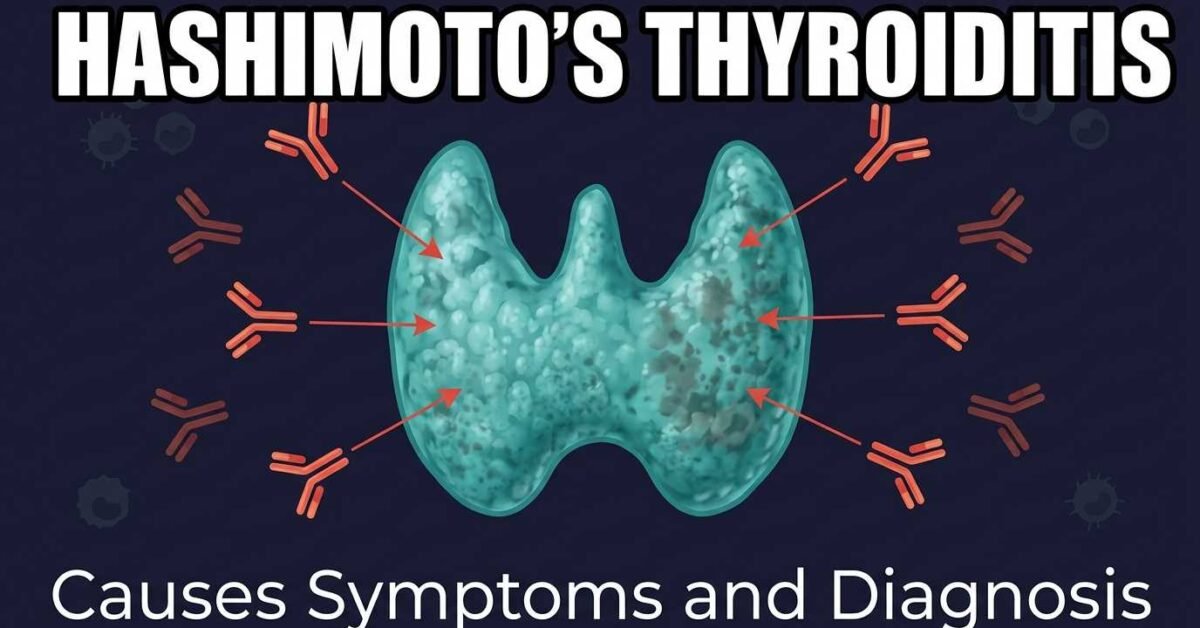
Hashimoto’s thyroiditis is a chronic autoimmune condition in which the immune system gradually attacks and damages the thyroid gland. It is the most common cause of hypothyroidism in countries with adequate iodine intake and one of the most frequently diagnosed autoimmune diseases overall.
What Causes Hashimoto’s Thyroiditis
In Hashimoto’s disease, the immune system produces antibodies against thyroid proteins, primarily thyroid peroxidase (TPO) and thyroglobulin. These antibodies trigger chronic lymphocytic infiltration of the gland, progressively destroying thyroid follicular cells and reducing the gland’s ability to produce T3 and T4.
The exact trigger is not fully understood. Genetic susceptibility plays a strong role, with the condition running in families and being more common in people with other autoimmune diseases. Environmental factors including excess iodine intake, viral infections, and certain medications may contribute in genetically predisposed individuals.
Hashimoto’s Thyroiditis Symptoms
Hashimoto’s develops gradually, often over years. In the early stages there may be no symptoms at all, or occasionally a brief period of hyperthyroidism (hashitoxicosis) as damaged cells release stored hormone. As destruction progresses, hypothyroid symptoms emerge:
- Fatigue and low energy
- Weight gain despite unchanged diet
- Cold intolerance
- Dry skin and brittle nails
- Constipation
- Hair thinning or loss
- Mental fogginess and difficulty concentrating
- Muscle aches and joint stiffness
- Depression
- A painless, gradually enlarging goiter
How Hashimoto’s Is Diagnosed
Three pieces of evidence confirm the diagnosis:
- Thyroid function tests: elevated TSH with low free T4 confirms hypothyroidism. See our TSH, T3, T4 guide.
- Anti-TPO antibodies: positive in approximately 90 percent of Hashimoto’s cases, confirming the autoimmune cause.
- Ultrasound: characteristically shows a heterogeneous, hypoechoic gland with a coarsened echotexture and sometimes pseudonodular changes. Read more in our abnormal thyroid ultrasound guide.
Hashimoto’s and Thyroid Nodules
Patients with Hashimoto’s develop thyroid nodules at a higher rate than the general population. The challenge is that the inflamed, heterogeneous background of a Hashimoto gland can make nodules harder to characterise on ultrasound. Features that would be clearly suspicious in a normal gland — such as hypoechogenicity — may overlap with the background inflammatory changes.
For this reason, any discrete nodule found within a Hashimoto gland should be scored individually with TI-RADS, using the same criteria and size thresholds as in any other patient. Use the TI-RADS calculator for each nodule identified.
Hashimoto’s thyroiditis is a lifelong condition but a very manageable one. Treatment with levothyroxine replaces the hormone your damaged gland can no longer produce sufficiently. Most patients on appropriate replacement therapy feel well and live entirely normal lives.
Treatment
Hashimoto’s itself has no cure, but the hypothyroidism it causes is treated effectively with daily levothyroxine (synthetic T4). The dose is adjusted based on TSH levels to restore normal function. Treatment is lifelong in most cases. There is no evidence that dietary changes, supplements, or alternative therapies alter the autoimmune process itself.
Source
Caturegli P, De Remigis A, Rose NR. Hashimoto thyroiditis: clinical and diagnostic criteria. Autoimmun Rev. 2014;13(4-5):391–397.
Frequently Asked Questions
What is Hashimoto’s thyroiditis?
Hashimoto’s thyroiditis is a chronic autoimmune condition in which the immune system attacks the thyroid gland, gradually damaging its ability to produce hormones. It is the most common cause of hypothyroidism in iodine-sufficient countries and affects women approximately seven times more often than men.
What are the symptoms of Hashimoto’s thyroiditis?
Early Hashimoto’s may cause no symptoms. As the gland becomes increasingly damaged, symptoms of hypothyroidism develop: fatigue, weight gain, cold intolerance, dry skin, constipation, hair thinning, and mental fogginess. Some patients also experience a painless goiter.
How is Hashimoto’s diagnosed?
Diagnosis is based on elevated TSH with low free T4 (confirming hypothyroidism) combined with positive anti-TPO antibodies (confirming autoimmune cause). Ultrasound typically shows a heterogeneous, hypoechoic gland. Not all three are required, but together they are definitive.
Can Hashimoto’s cause thyroid nodules?
Yes. Hashimoto’s thyroiditis is associated with thyroid nodules, and the nodules can sometimes be difficult to distinguish from cancer on ultrasound because the inflamed gland background creates a heterogeneous appearance. Any discrete nodule within a Hashimoto gland should be scored with TI-RADS individually.
