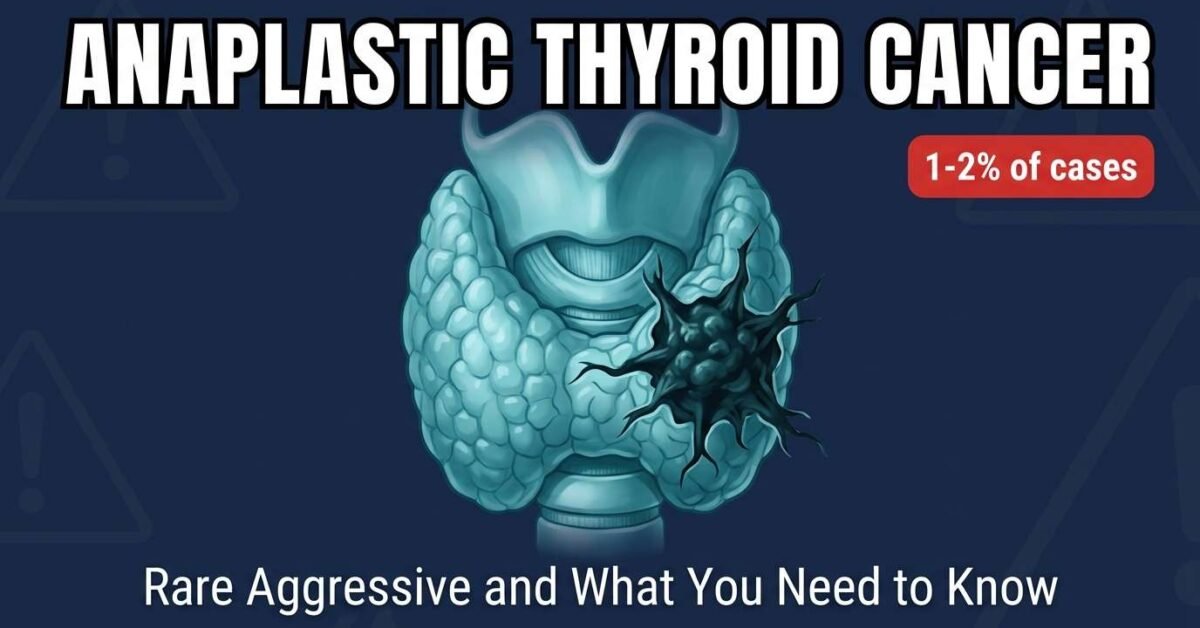
Anaplastic thyroid carcinoma (ATC) is the rarest but most aggressive form of thyroid cancer. It accounts for only 1 to 2 percent of all thyroid malignancies but carries a disproportionate share of thyroid cancer mortality. This article explains what it is, how it is diagnosed, and what treatment options exist, including emerging targeted therapies that are changing the outlook for some patients.
What Makes Anaplastic Cancer Different
The word “anaplastic” means undifferentiated — the cancer cells have lost the characteristics of normal thyroid cells. Unlike papillary and follicular thyroid cancers, which grow slowly and retain the ability to take up iodine, ATC grows rapidly, does not concentrate radioactive iodine, and does not produce thyroglobulin.
| Differentiated (PTC/FTC) | Anaplastic (ATC) | |
|---|---|---|
| Growth rate | Slow (months to years) | Rapid (weeks) |
| RAI responsive | Yes | No |
| Iodine uptake | Yes | No |
| Tumour marker | Thyroglobulin | None reliable |
| 5-year survival | >90% | ~5–10% |
Symptoms
ATC typically presents as a rapidly growing neck mass in an elderly patient, often over the course of just weeks. Because of its aggressive local invasion, symptoms frequently include:
- A hard, fixed, rapidly enlarging mass in the front of the neck
- Difficulty swallowing (dysphagia) from oesophageal compression
- Difficulty breathing (dyspnoea) from tracheal compression or invasion
- Hoarseness from recurrent laryngeal nerve involvement
- Pain in the neck, jaw, or ear
The rapid onset and aggressive symptoms distinguish ATC from the typically asymptomatic presentation of differentiated thyroid cancers.
Diagnosis
Diagnosis is usually made by fine needle aspiration or core needle biopsy showing undifferentiated cells. Imaging with CT of the neck and chest assesses the extent of local invasion and distant metastases. Molecular profiling is increasingly important because specific mutations guide targeted therapy.
Treatment
ATC treatment is multimodal and depends on whether the disease is resectable:
- Surgery — when the tumour can be completely removed, surgery combined with radiation and systemic therapy offers the best chance of disease control. Complete resection is possible in a minority of cases.
- External beam radiation — used for local control, often with concurrent chemotherapy
- Systemic therapy — traditional chemotherapy has shown limited benefit. The most significant advance has been targeted therapy with dabrafenib plus trametinib for tumours carrying the BRAF V600E mutation, present in approximately 25 to 45 percent of ATC cases. This combination achieved response rates of approximately 56 percent in clinical trials and received FDA approval for BRAF V600E-mutant ATC.
- Immunotherapy — checkpoint inhibitors are being studied and show promise in combination with targeted agents
If you or a family member has been diagnosed with ATC, ask about molecular profiling of the tumour, specifically testing for BRAF V600E and other actionable mutations. Targeted therapy for BRAF-mutant ATC represents a meaningful advance in a disease that previously had very limited treatment options. Consider referral to a high-volume thyroid cancer centre with experience in ATC management.
The Bigger Picture
ATC is the exception to the rule that thyroid cancer has an excellent prognosis. The papillary, follicular, and medullary types, which account for over 95 percent of thyroid cancers combined, are highly treatable with good to excellent survival rates. ATC’s rarity means that most patients who find a thyroid nodule and use the TI-RADS calculator will never encounter it.
Frequently Asked Questions
What is anaplastic thyroid cancer?
Anaplastic thyroid carcinoma (ATC) is a rare, aggressive, undifferentiated thyroid cancer that accounts for approximately 1 to 2 percent of all thyroid malignancies. Unlike papillary and follicular cancers, ATC grows rapidly, often invades surrounding structures, and does not respond to radioactive iodine.
How aggressive is anaplastic thyroid cancer?
ATC is the most aggressive thyroid cancer. It grows rapidly, often doubling in weeks, and frequently invades the trachea, oesophagus, and neck muscles. Median survival is approximately 3 to 6 months from diagnosis, though newer targeted therapies are improving outcomes in some patients.
Is there treatment for anaplastic thyroid cancer?
Treatment typically involves a combination of surgery (when feasible), external beam radiation, and systemic therapy. Recent advances include targeted therapy with dabrafenib plus trametinib for BRAF V600E-mutant ATC, which has shown meaningful survival improvements in clinical trials.
Who gets anaplastic thyroid cancer?
ATC typically occurs in patients over 60, often arising within a long-standing goiter or pre-existing differentiated thyroid cancer that has dedifferentiated. It is more common in regions with iodine deficiency and in patients with a history of radiation exposure.
