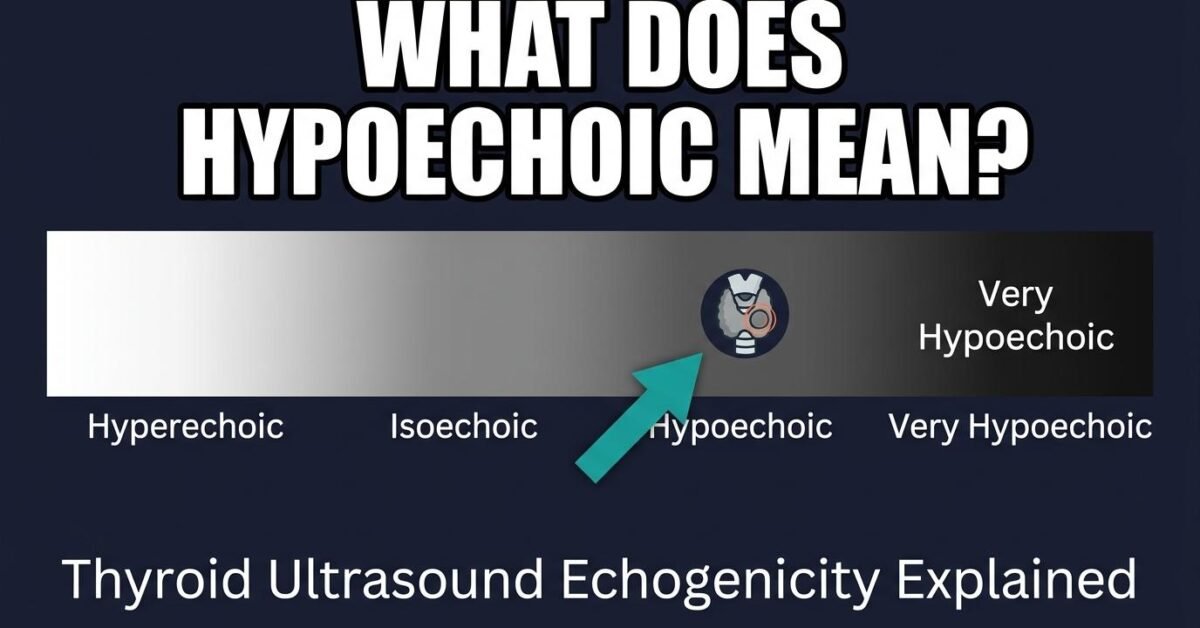
Seeing the word “hypoechoic” on your thyroid ultrasound report can be confusing. It sounds technical, but the concept is simple. This guide explains what it means, why radiologists care about it, and what it means for you.
The Simple Definition
Hypoechoic means darker than the surrounding tissue on an ultrasound image. The prefix “hypo” means less, and “echoic” refers to the echoes that create the ultrasound picture. A hypoechoic structure reflects fewer sound waves back to the probe, so it appears darker on screen.
On a thyroid ultrasound, “hypoechoic” means the nodule looks darker than the normal thyroid tissue around it.
The Echogenicity Scale
Ultrasound images show different shades of gray. Radiologists use specific terms to describe where a structure falls on this brightness scale:
- Anechoic — completely black, no echoes (pure fluid)
- Hypoechoic — darker than surrounding thyroid tissue
- Isoechoic — same brightness as surrounding tissue
- Hyperechoic — brighter than surrounding tissue
- Very hypoechoic — darker than the neck strap muscles (the most concerning)
Why Hypoechoic Matters for Thyroid Nodules
In the ACR TI-RADS scoring system, echogenicity is one of five features used to assess thyroid nodule risk. Darker nodules score higher because thyroid cancers tend to appear darker than normal thyroid tissue. A hypoechoic nodule earns 2 points, while a very hypoechoic nodule earns 3.
However, being hypoechoic alone does not mean a nodule is cancer. Many benign nodules are also hypoechoic. The TI-RADS system combines echogenicity with four other features to determine the overall risk category. A hypoechoic nodule with smooth margins, wider-than-tall shape, and no calcifications may score only TR3 (mildly suspicious), while the same echogenicity combined with irregular margins and punctate foci could push the score to TR5.
Enter your nodule’s features into the TI-RADS calculator to see the combined score. For a deeper explanation of how echogenicity affects scoring, see our hypoechoic thyroid nodule guide.
Hypoechoic vs Very Hypoechoic
The distinction between hypoechoic and very hypoechoic matters for scoring. Hypoechoic means darker than the thyroid tissue (2 points). Very hypoechoic means darker than the strap muscles in the neck (3 points). The comparison reference changes. Your radiologist makes this judgment by looking at the muscles just in front of the thyroid and comparing their brightness to the nodule.
Should You Worry About a Hypoechoic Nodule?
A hypoechoic finding on its own is not a reason to worry. It is one data point among five that determine overall risk. Most hypoechoic nodules are benign. What matters is the full TI-RADS category and the nodule’s size, which together determine whether biopsy, follow-up, or no action is recommended. Discuss the complete picture with your doctor.
Frequently Asked Questions
Does hypoechoic mean cancer?
No. Hypoechoic means darker than normal tissue on ultrasound. It is more common in cancers but also very common in benign nodules. The overall TI-RADS score, not echogenicity alone, determines risk.
What is the difference between hypoechoic and isoechoic?
Hypoechoic is darker than surrounding thyroid tissue and scores 2 TI-RADS points. Isoechoic matches the thyroid brightness and scores only 1 point.
Is very hypoechoic worse than hypoechoic?
Very hypoechoic carries a higher concern and scores 3 points instead of 2. It means the nodule is darker than the neck muscles, not just the thyroid tissue.