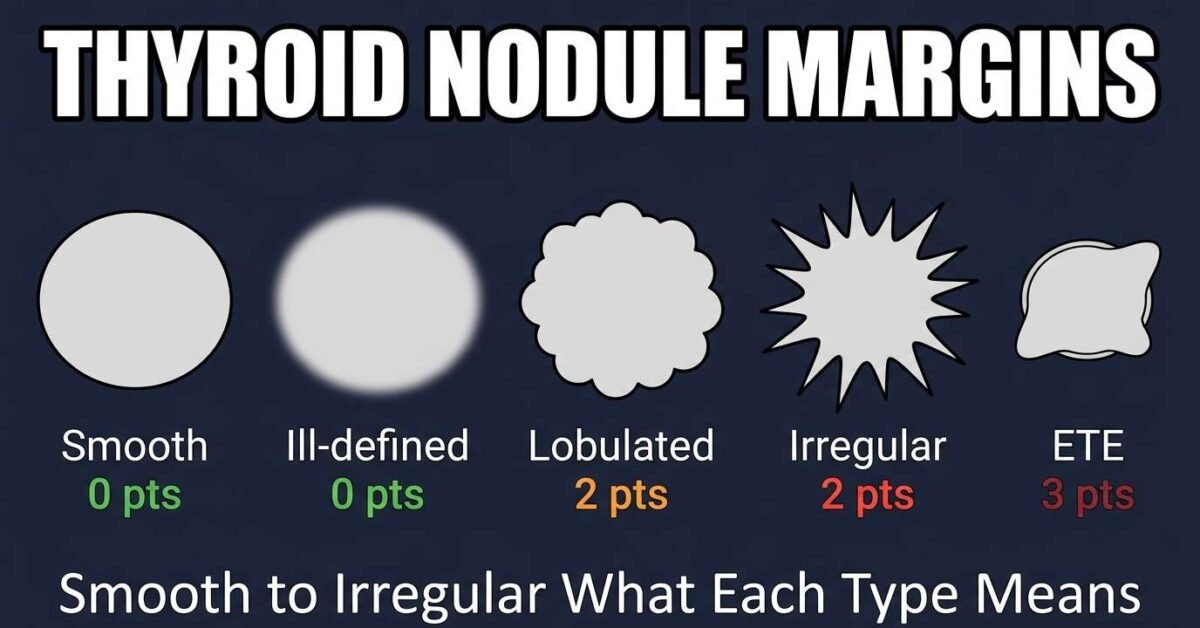
Margin is the fourth of five features scored in ACR TI-RADS. It describes the edges of a thyroid nodule: how well defined they are and whether they look smooth, bumpy, or jagged. Margins carry significant weight in the scoring system because the way a nodule interfaces with surrounding tissue reflects how it is growing.
Margin Types in ACR TI-RADS
| Margin type | Description | Points |
|---|---|---|
| Smooth | Even, well-defined border | 0 |
| Ill-defined | Border not clearly visualised | 0 |
| Lobulated or irregular | Bumpy, jagged, or spiculated edges | 2 |
| Extra-thyroidal extension | Growth beyond the thyroid capsule | 3 |
| Cannot be determined | Obscured by calcification or artefact | 0 |
Smooth Margins — 0 Points
Smooth margins are the most reassuring finding. The nodule has a clearly defined, even border with no irregularity. This is the most common margin type and is typical of benign nodules.
Ill-Defined Margins — 0 Points
An ill-defined margin means the border between the nodule and surrounding thyroid tissue is not sharply visualised. This can happen when the nodule’s echogenicity closely matches the surrounding gland, making the edge hard to delineate. Importantly, ill-defined is not the same as irregular. The ACR system scores ill-defined margins at 0 points because the finding usually reflects imaging limitations rather than abnormal growth.
Lobulated or Irregular Margins — 2 Points
An irregular margin means the edges of the nodule are jagged, angulated, or spiculated. Lobulated margins show rounded protrusions creating a bumpy contour. Both patterns suggest the nodule may be growing in a non-uniform, infiltrative fashion, which is more common in malignancy.
This finding scores 2 points and, when combined with other suspicious features, can push a nodule into higher TI-RADS categories. For example, a solid hypoechoic nodule (4 points) with irregular margins adds 2 more for a total of 6 — still TR4, but at the upper end.
Extra-Thyroidal Extension — 3 Points
Extrathyroidal extension means the nodule appears to extend beyond the thyroid capsule into surrounding structures such as the strap muscles, trachea, or recurrent laryngeal nerve. This is the most concerning margin finding, scoring 3 points, and typically indicates locally advanced disease that changes surgical planning.
Distinguish carefully between ill-defined and irregular margins. Ill-defined (0 points) is a visibility issue; irregular (2 points) is a growth-pattern issue. Overcalling ill-defined as irregular inflates scores unnecessarily. True extrathyroidal extension should show loss of the normal echogenic capsular line with tissue extending beyond it, not merely close abutment.
If your report says smooth or ill-defined margins, those are reassuring findings that add no points. If it says lobulated, irregular, or extrathyroidal extension, those contribute meaningfully to the score. The overall TI-RADS category is what determines the next step, not margins alone.
Margins in Context
Margins are scored alongside composition, echogenicity, shape, and echogenic foci. Enter all five features into the TI-RADS calculator to see the combined category and recommendation.
Frequently Asked Questions
What does irregular margin mean on a thyroid ultrasound?
An irregular margin means the edges of the nodule are jagged, spiculated, or microlobulated rather than smooth. This pattern scores 2 points in ACR TI-RADS and is associated with a higher risk of malignancy because it may indicate infiltrative growth into surrounding tissue.
Is an ill-defined thyroid nodule margin concerning?
Ill-defined margins score 0 points in ACR TI-RADS, the same as smooth margins. Ill-defined simply means the border is not sharply visualised, which often reflects the limitations of the ultrasound image rather than an abnormal growth pattern. It is not the same as irregular.
What does extrathyroidal extension mean?
Extrathyroidal extension means the nodule appears to be growing beyond the capsule of the thyroid gland into the surrounding neck tissues. It scores 3 points in TI-RADS and is the most concerning margin finding, suggesting locally advanced disease.
