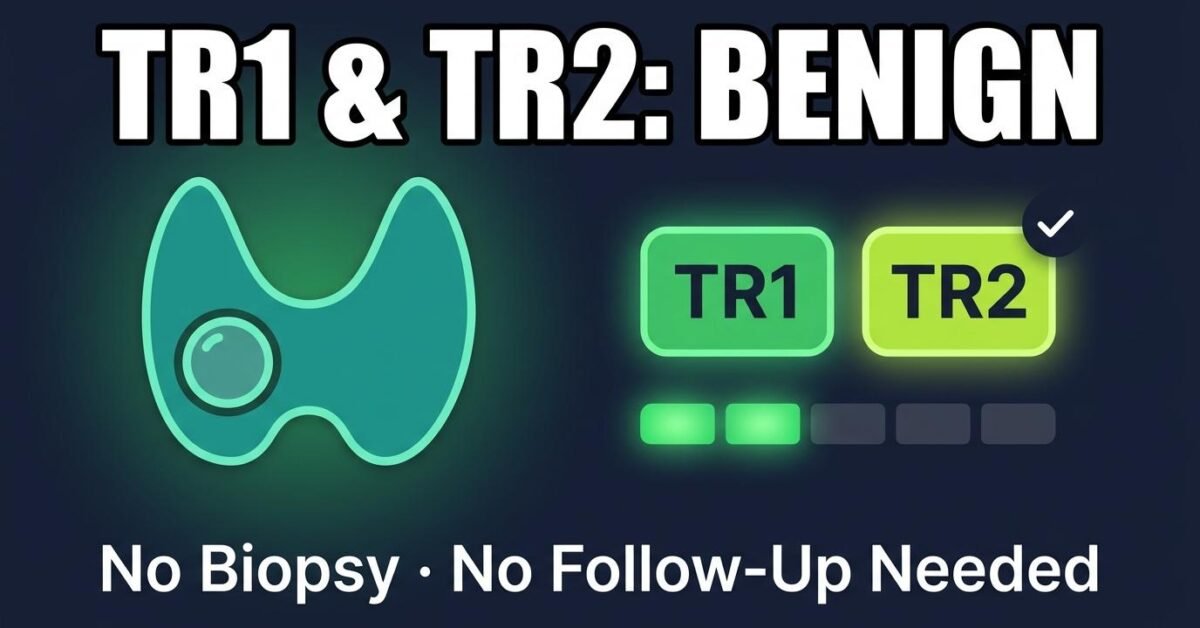
If your ultrasound report says TI-RADS 1 or TI-RADS 2, also written TR1 or TR2, that is the most reassuring result you can get. These categories mean the nodule looks benign or not suspicious, and neither needs a biopsy or routine follow-up. This guide explains what TR1 and TR2 mean and why you can usually breathe easy.
What TR1 and TR2 mean
The ACR TI-RADS system adds points across five ultrasound features. The lowest categories are:
- TR1 (0 points) — Benign. Typically a simple cyst or a spongiform nodule made of many tiny fluid spaces. Estimated malignancy risk is about 0.3 percent.
- TR2 (up to 2 points) — Not suspicious. Still considered benign for practical purposes, with an estimated malignancy risk around 1.5 percent.
Both categories describe nodules whose appearance strongly favors a non-cancerous cause.
Why no biopsy is needed
For both TR1 and TR2, the ACR guidelines recommend no fine needle aspiration and no routine follow-up ultrasound. The risk of cancer is so low that a biopsy would create more anxiety, cost, and false alarms than benefit. This is one of the main goals of TI-RADS: to safely avoid unnecessary procedures.
| Category | Points | Meaning | Est. malignancy | Action |
|---|---|---|---|---|
| TR1 | 0 | Benign | ~0.3% | None |
| TR2 | ≤2 | Not suspicious | ~1.5% | None |
You can confirm your own category using the TI-RADS calculator, and read how every level compares in the TI-RADS score guide.
Common benign nodule types
- Simple cysts — fluid-filled and anechoic (pure black on ultrasound). Almost never cancer.
- Spongiform nodules — a honeycomb of tiny cystic spaces, considered benign by TI-RADS.
- Colloid nodules — a common benign finding often seen with bright comet-tail artifacts.
For clinicians: Since TR1 and TR2 share identical management, the 0-versus-2-point distinction is academic. Reserve follow-up for cases where clinical factors override the imaging, and document the benign features clearly to prevent unnecessary downstream imaging.
When to still see your doctor
Even with a benign result, mention any new symptoms such as a rapidly growing lump, trouble swallowing, a hoarse voice, or a strong family history of thyroid cancer. These clinical factors sit outside what an ultrasound score can capture and may prompt your doctor to take a closer look regardless of category. If your nodule had scored 3 points it would instead be TR3, mildly suspicious.
Frequently asked questions
Is a TI-RADS 2 nodule benign?
TR2 is classified as not suspicious, with an estimated malignancy risk around 1.5 percent. It is treated as benign and needs no biopsy or follow-up.
Do TR1 or TR2 nodules need to be monitored?
Generally no. ACR TI-RADS recommends no routine follow-up for TR1 or TR2 unless your doctor has a specific clinical concern.
What is the difference between TR1 and TR2?
TR1 scored zero points and is benign, often a simple cyst or spongiform nodule. TR2 scored up to two points and is not suspicious. Both are managed the same way, with no action needed.
