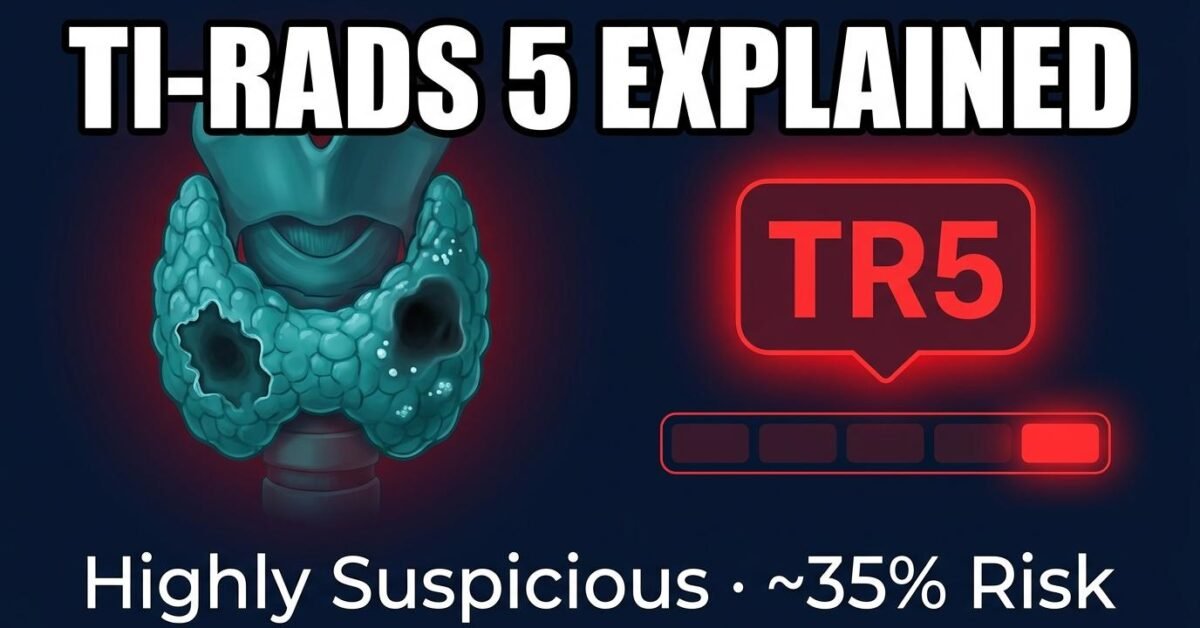
A TI-RADS 5 result, written TR5, is the highest category in the ACR TI-RADS system and means your thyroid nodule is highly suspicious on ultrasound. It is understandably the most worrying result to receive. This guide explains what the score means, what the actual numbers say, and what treatment involves.
What TI-RADS 5 Means
A nodule scoring 7 or more points across the five ultrasound features is classified as TR5. Reaching that total generally requires several suspicious features occurring together, such as a solid, very hypoechoic nodule that is also taller-than-wide, has irregular margins, or contains punctate echogenic foci.
TR5 Thyroid Nodule Cancer Percentage
The estimated malignancy risk for TR5 is approximately 35 percent. This is the highest of any TI-RADS category, but it also means roughly two out of every three TR5 nodules are benign.
| Category | Points | Suspicion | Malignancy risk |
|---|---|---|---|
| TR4 | 4–6 | Moderately suspicious | ~9.1% |
| TR5 | 7 or more | Highly suspicious | ~35% |
Benign conditions can and do produce TR5-scoring appearances. Hashimoto thyroiditis often creates hypoechoic nodules with irregular margins, and calcified colloid nodules can produce bright foci that resemble microcalcifications. Read more in is TI-RADS 5 always cancer.
ACR TI-RADS Category 5: Biopsy Thresholds
TR5 carries the lowest size thresholds of any category, reflecting the higher risk:
- 1.0 cm or larger — fine needle aspiration biopsy is recommended
- 0.5 to 0.9 cm — annual follow-up ultrasound for up to 5 years
- Under 0.5 cm — generally monitored, as sampling very small nodules is technically difficult
Confirm your nodule’s threshold with the TI-RADS calculator.
TR5 is the one category where prompt scheduling genuinely matters, so book the recommended biopsy without delay. At the same time, the majority of TR5 nodules are benign, and even when cancer is found, thyroid cancer is among the most treatable of all cancers.
For subcentimetre TR5 nodules, weigh FNA against active surveillance in light of patient age, comorbidity, and anxiety. Document which specific high-risk features drove the 7-plus score, as extrathyroidal extension and suspicious nodes materially change surgical planning.
TI-RADS 5 Thyroid Nodule Treatment
There is no treatment for TR5 as such, because it describes an ultrasound appearance rather than a confirmed diagnosis. What follows depends on the biopsy:
- Benign biopsy (Bethesda II) — surveillance ultrasound, no surgery. This is the outcome for most TR5 nodules.
- Indeterminate (Bethesda III or IV) — molecular testing, repeat FNA, or diagnostic lobectomy
- Suspicious or malignant (Bethesda V or VI) — surgery, either lobectomy or total thyroidectomy depending on size, location, and nodal status
Where thyroid cancer is confirmed, papillary thyroid carcinoma is the most common type and carries a 5-year survival rate above 98 percent. Some very small, low-risk papillary carcinomas are now managed with active surveillance rather than immediate surgery in selected patients.
See our Bethesda system guide for what each biopsy result means and our thyroid biopsy guide for what the procedure involves.
What to Ask Your Doctor
- What is the nodule’s exact size, and does it meet the 1 cm biopsy threshold?
- Which features produced the TR5 score?
- Were any neck lymph nodes abnormal on the scan?
- How soon can the biopsy be scheduled?
Frequently Asked Questions
What is the TR5 thyroid nodule cancer percentage?
The estimated malignancy risk for a TR5 thyroid nodule is approximately 35 percent. This means roughly 65 percent of TR5 nodules, about two in three, turn out to be benign after biopsy. Published series report ranges from about 25 to 45 percent.
What size TR5 nodule needs a biopsy?
Fine needle aspiration is recommended for TR5 nodules measuring 1.0 cm or larger. Nodules from 0.5 to 0.9 cm are followed with annual ultrasound for up to five years. Nodules under 0.5 cm are generally monitored rather than sampled.
What is the treatment for a TI-RADS 5 thyroid nodule?
TR5 is an imaging classification, so treatment depends on the biopsy result. A benign biopsy leads to surveillance. A malignant result typically leads to surgery, either lobectomy or total thyroidectomy. Papillary thyroid carcinoma, the most common type found, has a 5-year survival rate exceeding 98 percent.
Is TI-RADS 5 always cancer?
No. Despite being the highest category, approximately two thirds of TR5 nodules are benign. Benign conditions including Hashimoto thyroiditis and calcified colloid nodules can produce suspicious ultrasound features. Only biopsy determines the diagnosis.
