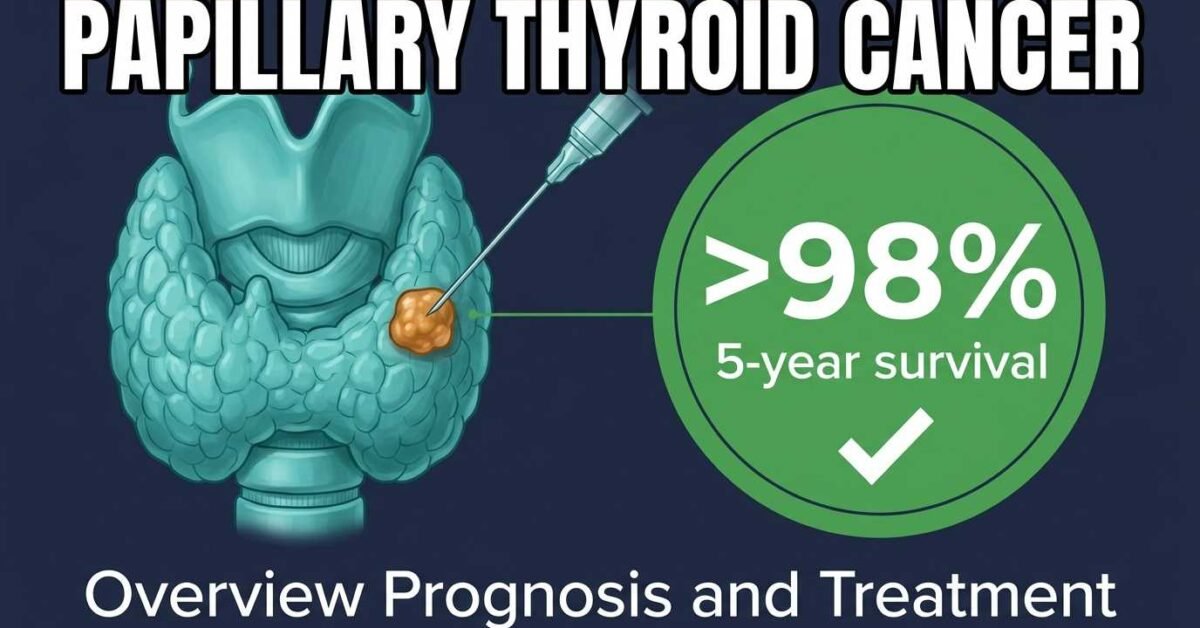
Papillary thyroid carcinoma (PTC) is the most common type of thyroid cancer, accounting for approximately 80 percent of all thyroid malignancies. If you have been told you have papillary thyroid cancer, the most important fact to know is that it carries one of the best prognoses of any cancer, with a 5-year survival rate exceeding 98 percent.
What Papillary Thyroid Cancer Is
PTC arises from the follicular cells that make up most of the thyroid gland. Under the microscope, it has distinctive nuclear features: nuclear grooves, intranuclear pseudoinclusions, and pale, “ground glass” chromatin. These features are what the pathologist looks for in a biopsy sample to make the diagnosis.
How Papillary Thyroid Cancer Is Found
Most PTCs are found in one of three ways: a nodule detected on physical examination, a nodule found incidentally on imaging performed for another reason, or during investigation of an enlarged cervical lymph node. Symptoms such as voice changes or difficulty swallowing are uncommon at presentation.
On ultrasound, PTC typically appears as a solid, hypoechoic nodule that may be taller-than-wide with irregular margins and punctate echogenic foci (microcalcifications). These features score highly in the TI-RADS system, usually reaching TR4 or TR5.
Prognosis and Survival
| Stage | 5-year survival |
|---|---|
| Localised (confined to thyroid) | ~100% |
| Regional (spread to lymph nodes) | ~98% |
| Distant (spread to lungs/bone) | ~75–85% |
| Overall | >98% |
Lymph node involvement is common (approximately 30 to 40 percent at diagnosis) but has minimal impact on survival in patients under 55. The excellent prognosis reflects PTC’s typically slow growth, responsiveness to treatment, and sensitivity to radioactive iodine.
Treatment of Papillary Thyroid Cancer
- Surgery — lobectomy (removal of one lobe) for small, low-risk tumours or total thyroidectomy for larger, higher-risk, or bilateral tumours. Lymph node dissection is performed when nodes are involved.
- Radioactive iodine (RAI) — may be given after total thyroidectomy to destroy residual thyroid tissue and microscopic cancer deposits. Not all patients require it.
- TSH suppression — levothyroxine is dosed to keep TSH low, reducing stimulation of any remaining thyroid cancer cells.
- Active surveillance — for very small papillary microcarcinomas (<1 cm) without aggressive features, some centres now offer monitoring instead of immediate surgery.
Monitoring After Treatment
After surgery, patients are monitored with periodic thyroglobulin blood tests and neck ultrasound. An undetectable thyroglobulin level after total thyroidectomy is the goal and indicates no evidence of residual disease.
A papillary thyroid cancer diagnosis is understandably frightening, but the numbers are strongly reassuring. This is among the most curable cancers in medicine. The large majority of patients are treated successfully and live full, normal lives.
Related Reading
Understand how the nodule was scored before biopsy with the TI-RADS calculator, and see what biopsy results mean in our Bethesda system guide. Compare with other thyroid cancer types: follicular, medullary.
Frequently Asked Questions
What is papillary thyroid cancer?
Papillary thyroid carcinoma (PTC) is the most common type of thyroid cancer, accounting for approximately 80 percent of all thyroid malignancies. It arises from thyroid follicular cells and is characterised by distinctive nuclear features including grooves and pseudoinclusions visible under the microscope.
What is the survival rate for papillary thyroid cancer?
The 5-year survival rate for papillary thyroid cancer exceeds 98 percent overall and approaches 100 percent for localised disease. It has one of the best prognoses of any cancer in medicine, particularly when diagnosed at an early stage.
How is papillary thyroid cancer treated?
Treatment typically involves surgery (lobectomy or total thyroidectomy depending on tumour size and features), followed by radioactive iodine therapy in some cases and lifelong thyroid hormone replacement. Small, low-risk papillary cancers may be managed with active surveillance in selected patients.
Does papillary thyroid cancer spread?
Papillary thyroid cancer commonly spreads to cervical lymph nodes (approximately 30 to 40 percent of cases at diagnosis), but this does not significantly worsen the prognosis. Distant metastasis to lungs or bone is uncommon and occurs in roughly 2 to 5 percent of cases.
