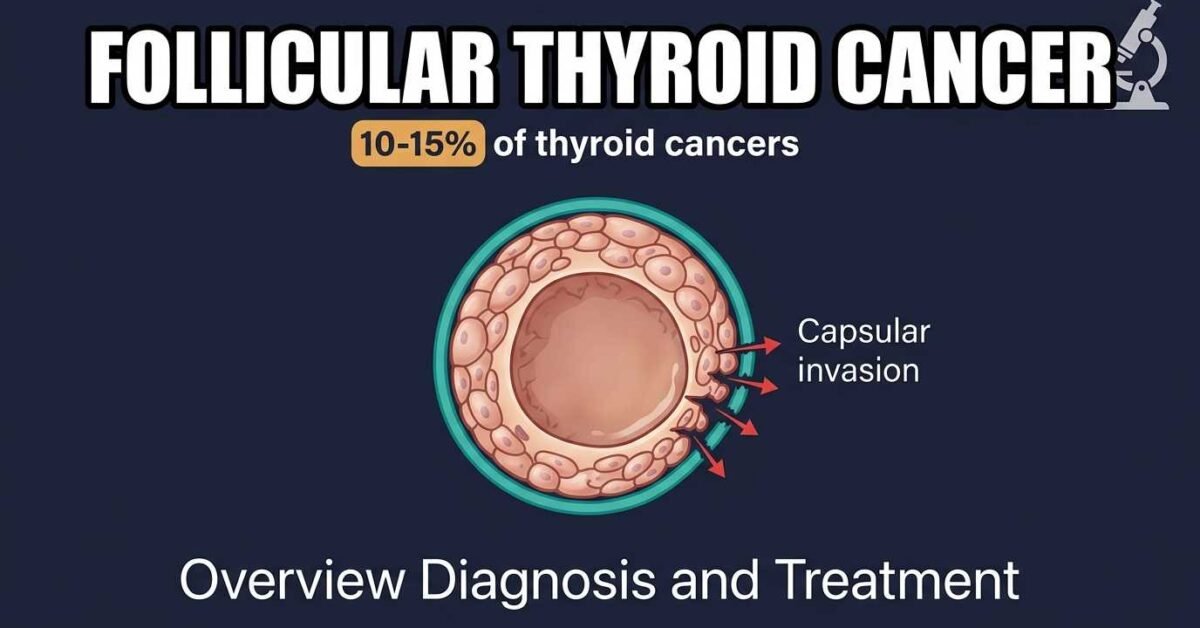
Follicular thyroid carcinoma (FTC) is the second most common type of thyroid cancer after papillary, accounting for approximately 10 to 15 percent of thyroid malignancies. It shares the same cell of origin as papillary cancer — the thyroid follicular cell — but behaves differently in important ways.
How Follicular Cancer Differs From Papillary
| Papillary (PTC) | Follicular (FTC) | |
|---|---|---|
| Frequency | ~80% of thyroid cancers | ~10–15% |
| Spread pattern | Lymph nodes (30–40%) | Bloodstream → lungs, bone |
| FNA diagnosis | Yes (distinctive nuclear features) | No (requires surgical specimen) |
| 5-year survival | >98% | ~90–95% |
| RAI responsive | Yes | Yes |
The Diagnostic Challenge
Follicular thyroid cancer presents a unique diagnostic challenge. On fine needle aspiration, follicular carcinoma and follicular adenoma (a benign tumour) look identical because both show follicular-patterned cells. The difference between them is capsular or vascular invasion, which can only be assessed by examining the intact tumour within its capsule.
This is why a biopsy showing follicular cells returns a Bethesda Category IV result — “follicular neoplasm” — rather than a definitive benign or malignant classification. The next step is either molecular testing to refine the risk or diagnostic surgery to remove the lobe for definitive examination.
Types of Follicular Thyroid Carcinoma
- Minimally invasive FTC — limited capsular invasion only, excellent prognosis, often cured with lobectomy alone
- Encapsulated angioinvasive FTC — capsular invasion plus vascular invasion, intermediate prognosis depending on the number of invaded vessels
- Widely invasive FTC — extensive invasion through the capsule and into blood vessels, higher risk of distant metastasis
Ultrasound Appearance
On ultrasound, follicular carcinomas often appear as solid, isoechoic or hypoechoic nodules that may be well-circumscribed with a peripheral halo. They can look deceptively benign. The TI-RADS score may be only TR3 or TR4, which is why size thresholds remain important. Score your nodule with the TI-RADS calculator.
Treatment
- Surgery — lobectomy for minimally invasive FTC; total thyroidectomy for widely invasive or when RAI is planned
- Radioactive iodine — follicular cancers are generally iodine-avid, making RAI effective for treating residual or metastatic disease
- TSH suppression — levothyroxine dosed to suppress TSH, reducing growth stimulus
- Monitoring — serial thyroglobulin and neck ultrasound
If your biopsy returned Bethesda IV (follicular neoplasm), that does not mean you have cancer. Most follicular neoplasms turn out to be benign adenomas after surgical examination. The biopsy result means cytology cannot make the distinction, not that cancer is probable.
Frequently Asked Questions
What is follicular thyroid cancer?
Follicular thyroid carcinoma (FTC) is the second most common type of thyroid cancer, accounting for approximately 10 to 15 percent of cases. It arises from thyroid follicular cells, the same cell type as papillary cancer, but has different microscopic and clinical characteristics.
How is follicular thyroid cancer different from papillary?
The key differences are how it spreads and how it is diagnosed. Follicular cancer tends to spread via the bloodstream to lungs and bone, while papillary cancer preferentially spreads to lymph nodes. Follicular cancer also cannot be diagnosed by fine needle aspiration alone because the diagnosis requires demonstrating capsular or vascular invasion, which needs the intact tissue architecture of a surgical specimen.
Why can’t FNA diagnose follicular thyroid cancer?
FNA collects individual cells, but the distinction between a benign follicular adenoma and a follicular carcinoma rests on whether tumour cells have invaded through the capsule or into blood vessels. This can only be assessed by examining the intact tissue, which requires surgical removal of the nodule or lobe.
What is the prognosis for follicular thyroid cancer?
The overall 5-year survival rate for follicular thyroid cancer is approximately 90 to 95 percent. Prognosis depends heavily on the degree of invasion: minimally invasive FTC has an excellent outcome, while widely invasive FTC with vascular invasion carries a higher risk of distant metastasis.
