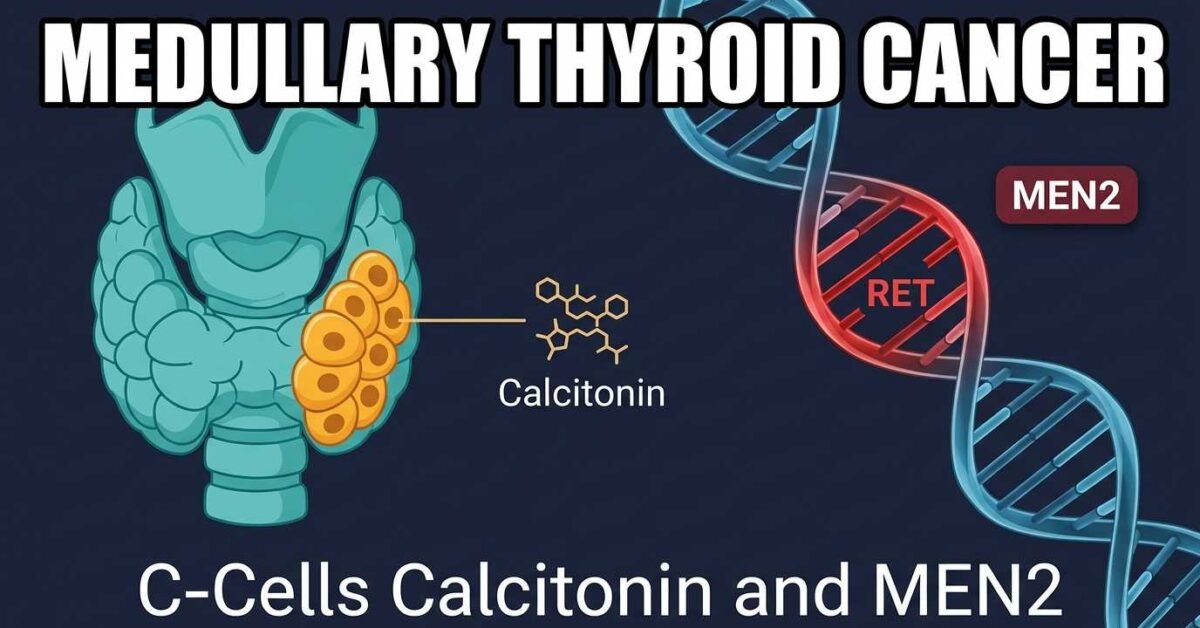
Medullary thyroid carcinoma (MTC) is fundamentally different from the more common papillary and follicular thyroid cancers because it arises from a different cell type: the parafollicular C-cell. This distinction matters because MTC behaves differently, does not respond to radioactive iodine, is monitored with a different tumour marker (calcitonin), and has a significant hereditary component.
What Makes Medullary Cancer Different
| Papillary / Follicular | Medullary (MTC) | |
|---|---|---|
| Cell of origin | Follicular cells | Parafollicular C-cells |
| Tumour marker | Thyroglobulin | Calcitonin |
| RAI responsive | Yes | No |
| Hereditary | Rare | ~25% (MEN2) |
| Frequency | ~90–95% combined | ~3–5% |
Hereditary MTC and MEN2 Syndrome
Approximately 25 percent of MTC cases are hereditary, caused by germline mutations in the RET proto-oncogene. These mutations cause MEN2, which has two main subtypes:
- MEN2A — MTC, pheochromocytoma (adrenal gland tumour), and hyperparathyroidism
- MEN2B — MTC, pheochromocytoma, mucosal neuromas, and a Marfanoid body habitus; typically more aggressive
Genetic testing for RET mutations is recommended for all patients diagnosed with MTC, regardless of family history, because identifying a hereditary case has implications for family screening and surgical timing for at-risk relatives.
Diagnosis
- Serum calcitonin: elevated, often markedly (>100 pg/mL is strongly suggestive). See our calcitonin test guide.
- Serum CEA (carcinoembryonic antigen): often co-elevated and used alongside calcitonin for monitoring
- FNA biopsy: cytology showing medullary carcinoma cells, often with amyloid stroma
- Ultrasound: may show a solid, hypoechoic nodule, sometimes with calcifications. Scored with TI-RADS like any nodule.
- RET genetic testing: performed on all MTC patients
Treatment
Treatment differs from differentiated thyroid cancer because MTC does not take up radioactive iodine:
- Surgery — total thyroidectomy with central lymph node dissection is the standard initial treatment. Lateral neck dissection is added when lateral nodes are involved.
- No radioactive iodine — C-cells do not concentrate iodine, so RAI is ineffective
- Targeted therapy — for advanced or metastatic MTC, tyrosine kinase inhibitors (vandetanib, cabozantinib, selpercatinib for RET-mutant disease) are available
- External beam radiation — used selectively for local control when surgical margins are involved
Monitoring
After surgery, serial calcitonin and CEA levels are monitored. A detectable or rising calcitonin after total thyroidectomy suggests residual or recurrent disease and triggers imaging. Thyroglobulin is not used for MTC monitoring because C-cells do not produce it.
If you or a family member has been diagnosed with MTC, ask about RET genetic testing. Identifying a hereditary mutation allows screening of family members and potentially preventive surgery before cancer develops. This is one of the areas in medicine where genetic testing has the most direct and actionable impact.
Frequently Asked Questions
What is medullary thyroid cancer?
Medullary thyroid carcinoma (MTC) is a thyroid cancer that arises from the parafollicular C-cells rather than the follicular cells. It accounts for approximately 3 to 5 percent of all thyroid cancers and produces calcitonin, which serves as its tumour marker.
Is medullary thyroid cancer hereditary?
Approximately 25 percent of MTC cases are hereditary, associated with MEN2 (Multiple Endocrine Neoplasia type 2) syndrome caused by mutations in the RET proto-oncogene. The remaining 75 percent are sporadic. Genetic testing for RET mutations is recommended for all patients diagnosed with MTC.
How is medullary thyroid cancer diagnosed?
Diagnosis is supported by elevated serum calcitonin and confirmed by FNA biopsy showing medullary carcinoma cytology. Unlike papillary and follicular cancers, MTC does not respond to radioactive iodine. Genetic testing for RET mutations is performed alongside.
What is the survival rate for medullary thyroid cancer?
The overall 10-year survival rate for MTC is approximately 75 percent, but this varies significantly by stage. Localised MTC has a 10-year survival above 95 percent, while distant metastatic disease is considerably lower. Early detection through calcitonin screening and genetic testing improves outcomes.
