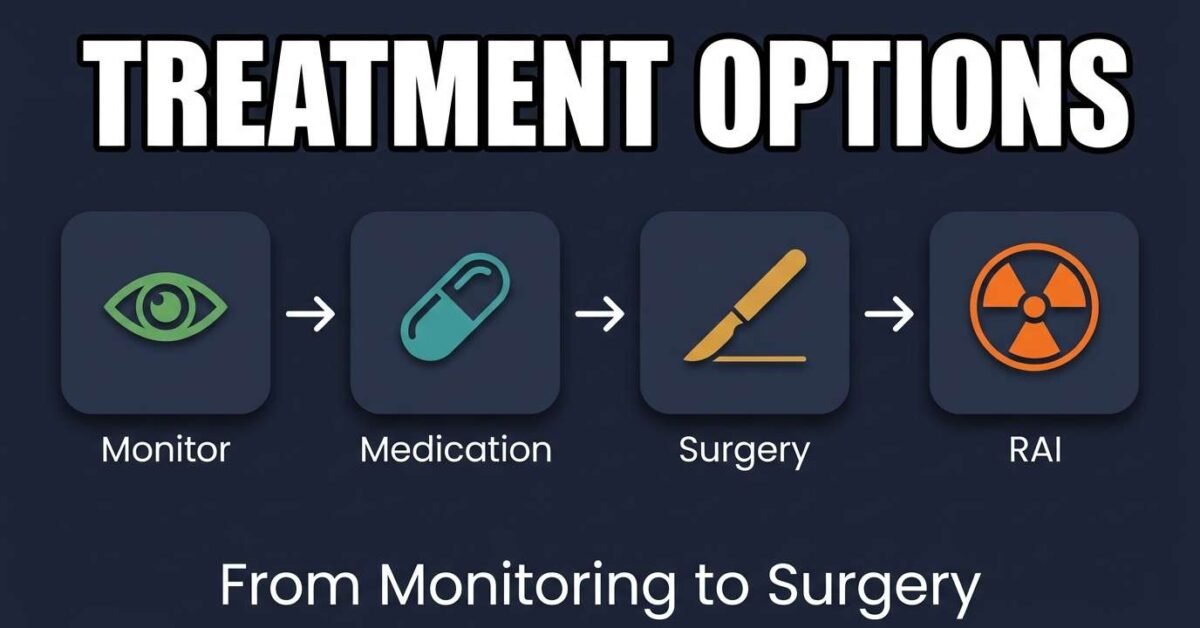
The treatment for a thyroid nodule depends entirely on what the nodule is and what it is doing. A benign, asymptomatic nodule may need nothing at all. A confirmed cancer typically needs surgery. This guide covers the full range of treatment options from least to most invasive.
Option 1: No Treatment (Observation)
This is the most common outcome. Nodules scored TR1 or TR2 on TI-RADS, or those below the size threshold for their category, require neither biopsy nor treatment. Even after a benign biopsy, the standard is periodic ultrasound monitoring rather than intervention.
Option 2: Active Surveillance
For small, confirmed papillary thyroid microcarcinomas (under 1 cm) without aggressive features, some centres now offer active surveillance instead of immediate surgery. The nodule is monitored with regular ultrasound, and surgery is performed only if growth or other changes occur. This approach is supported by large studies from Japan and is gaining acceptance internationally.
Option 3: Medication
Levothyroxine suppression therapy, aimed at lowering TSH to reduce growth stimulus, was historically used for benign nodules but is no longer recommended for most patients because the evidence for benefit is limited and the risks of iatrogenic hyperthyroidism outweigh it.
For toxic (hyperfunctioning) nodules, anti-thyroid medications such as methimazole can control hyperthyroidism, though they do not eliminate the nodule and are usually a bridge to definitive treatment.
Option 4: Radioactive Iodine (RAI)
Radioactive iodine therapy is used in two settings: to treat toxic nodules causing hyperthyroidism, and after total thyroidectomy for differentiated thyroid cancer to destroy residual thyroid tissue. It is not effective for medullary or anaplastic cancers.
Option 5: Thermal or Ethanol Ablation
Minimally invasive ablation techniques are emerging options for select benign nodules causing symptoms:
- Radiofrequency ablation (RFA) — a needle electrode delivers heat to shrink the nodule
- Laser ablation — fibre-optic laser delivers targeted heat
- Ethanol ablation — injection of alcohol into cystic nodules, causing them to shrink
These are typically reserved for benign nodules causing compressive symptoms or cosmetic concern in patients who prefer to avoid surgery.
Option 6: Surgery
Surgery is the definitive treatment when needed. The two main options are lobectomy (removal of one lobe) and total thyroidectomy (removal of the entire gland). Indications include confirmed malignancy, unresolved indeterminate cytology, large symptomatic nodules, and toxic nodules unresponsive to other treatment.
How the Decision Is Made
| Situation | Typical treatment |
|---|---|
| Benign, asymptomatic nodule | Observation with periodic ultrasound |
| Benign, symptomatic (large) | Surgery or ablation |
| Indeterminate biopsy (Bethesda III/IV) | Molecular testing, repeat FNA, or diagnostic lobectomy |
| Malignant (Bethesda V/VI) | Surgery ± RAI |
| Toxic nodule (hyperthyroidism) | Anti-thyroid meds → RAI or surgery |
| Papillary microcarcinoma, low risk | Active surveillance or lobectomy |
The first step before any treatment discussion is knowing your Bethesda category (if biopsied) or your TI-RADS score (if not yet biopsied). These determine which of the options above applies to your situation.
Frequently Asked Questions
Do all thyroid nodules need treatment?
No. The majority of thyroid nodules are benign and require no treatment. They are either left alone entirely or monitored with periodic ultrasound. Treatment is considered when a nodule is malignant, causes compressive symptoms, or produces excess thyroid hormone.
What is the treatment for a benign thyroid nodule?
Most benign nodules are simply monitored with periodic ultrasound. If a benign nodule grows large enough to cause difficulty swallowing or breathing, or is cosmetically bothersome, options include surgery, ethanol ablation, or thermal ablation.
When is surgery needed for a thyroid nodule?
Surgery is typically recommended when biopsy confirms malignancy, when cytology is indeterminate and molecular testing cannot resolve it, when a large benign nodule causes compressive symptoms, or when a toxic nodule causes hyperthyroidism unresponsive to medication.
