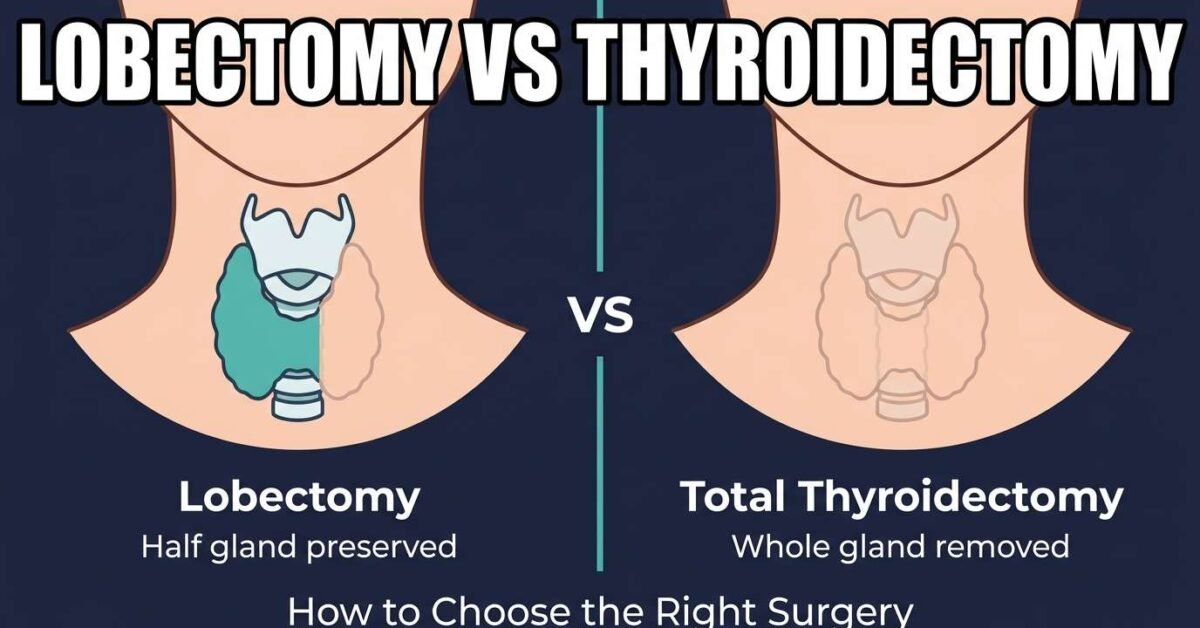
If thyroid surgery has been recommended, the next question is usually: do they take the whole gland or just one side? The answer depends on the diagnosis, the tumour’s characteristics, and the patient’s preferences. This guide compares the two approaches.
What Each Surgery Involves
| Lobectomy (hemithyroidectomy) | Total thyroidectomy | |
|---|---|---|
| What is removed | One thyroid lobe ± isthmus | Both lobes + isthmus |
| Hormone status after | 50–70% remain euthyroid | 100% need levothyroxine |
| RAI eligibility | Not applicable (residual gland present) | Yes, if indicated |
| Thyroglobulin monitoring | Limited value (residual gland produces Tg) | Yes — undetectable Tg is the target |
| Complication risk | Lower (one recurrent laryngeal nerve, no hypoparathyroidism) | Higher (both nerves, parathyroid gland risk) |
| Typical duration | 1–2 hours | 2–3 hours |
When Lobectomy Is Recommended
- Small, low-risk differentiated thyroid cancer (under 4 cm, confined to one lobe, no extrathyroidal extension, no nodal metastases)
- Diagnostic surgery for an indeterminate Bethesda III or IV biopsy result
- Benign nodule causing compressive symptoms confined to one side
- Toxic adenoma in one lobe
When Total Thyroidectomy Is Recommended
- Thyroid cancer larger than 4 cm
- Bilateral disease (cancer or nodules in both lobes)
- Extrathyroidal extension or lymph node involvement
- When radioactive iodine therapy is planned after surgery
- Graves disease unresponsive to medication
- Medullary thyroid cancer (total thyroidectomy is standard regardless of size)
Pros and Cons
Lobectomy’s advantage is preserving natural hormone production in a majority of patients, avoiding lifelong medication, and carrying lower surgical risks. Its limitation is that if final pathology reveals a cancer needing RAI or full removal, a second surgery (completion thyroidectomy) may be required.
Total thyroidectomy’s advantage is that it is definitive — no second surgery, enables RAI when indicated, and allows clean thyroglobulin monitoring. Its disadvantage is mandatory lifelong levothyroxine and a higher risk of surgical complications including hypoparathyroidism and bilateral nerve injury.
Ask your surgeon which approach they recommend and why, what the risk of completion thyroidectomy would be with lobectomy, and what your specific cancer’s features are. The 2015 American Thyroid Association guidelines expanded the role of lobectomy for low-risk cancers, so the trend in thyroid surgery is toward less extensive operations when clinically appropriate.
After Surgery
After lobectomy, thyroid function tests are checked at 6 to 8 weeks to determine whether levothyroxine supplementation is needed. After total thyroidectomy, levothyroxine is started immediately and TSH is monitored to find the correct dose. Calcium levels are monitored closely after total thyroidectomy because the parathyroid glands, which sit behind the thyroid, can be temporarily affected.
Frequently Asked Questions
What is the difference between lobectomy and thyroidectomy?
A lobectomy removes one lobe of the thyroid gland, preserving the other. A total thyroidectomy removes the entire gland. Lobectomy preserves some natural hormone production; total thyroidectomy requires lifelong thyroid hormone replacement.
When is lobectomy preferred over total thyroidectomy?
Lobectomy is generally preferred for small, low-risk thyroid cancers confined to one lobe (under 4 cm), for diagnostic purposes when biopsy is indeterminate, and for benign nodules causing symptoms on one side only.
Do I need to take thyroid medication after lobectomy?
Approximately 50 to 70 percent of patients after lobectomy produce sufficient hormone from the remaining lobe and do not need daily medication. The remainder require levothyroxine supplementation.
What is the recovery time for thyroid surgery?
Most patients go home the same day or the day after surgery. Full recovery takes approximately 2 to 3 weeks for lobectomy and 3 to 4 weeks for total thyroidectomy. Most people return to desk work within 1 to 2 weeks.
