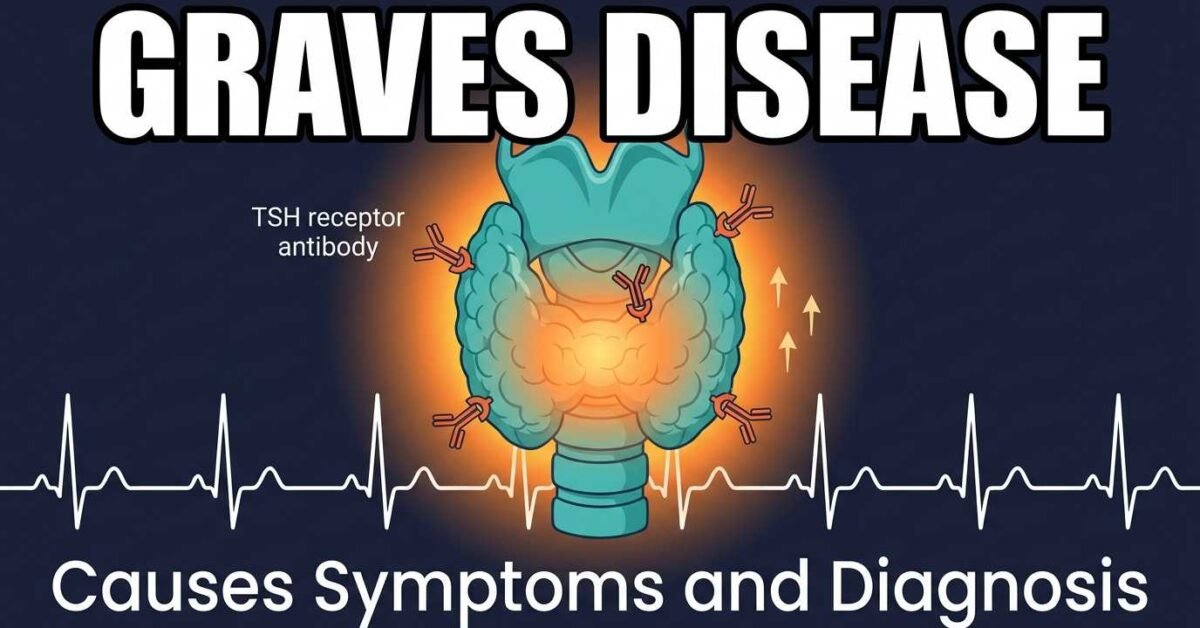
Graves disease is an autoimmune condition that causes the thyroid to overproduce hormones, resulting in hyperthyroidism. It is the most common cause of hyperthyroidism in the developed world and predominantly affects women, with a peak onset between ages 20 and 40.
What Causes Graves Disease
In Graves disease, the immune system produces thyroid-stimulating immunoglobulins (TSI), also called TSH receptor antibodies (TRAb). These antibodies bind to TSH receptors on thyroid cells and mimic the action of TSH, stimulating the gland to produce excess T3 and T4 without the normal feedback control from the pituitary.
The result is a thyroid that runs continuously at full output regardless of the body’s actual hormone needs.
Graves Disease Symptoms
Symptoms reflect the body running in overdrive:
- Rapid or irregular heartbeat (palpitations)
- Unintentional weight loss despite increased appetite
- Heat intolerance and excessive sweating
- Tremor in the hands and fingers
- Anxiety, irritability, and difficulty sleeping
- Frequent bowel movements
- Muscle weakness, particularly in the thighs and upper arms
- Diffuse thyroid enlargement (goiter)
Graves Eye Disease
Approximately 25 to 50 percent of Graves patients develop Graves ophthalmopathy, an inflammatory condition affecting the muscles and tissues behind the eyes. Symptoms include eye bulging (exophthalmos), gritty or dry-feeling eyes, double vision, and light sensitivity. Eye disease can precede, coincide with, or follow the thyroid dysfunction.
Graves Disease vs Hashimoto’s Thyroiditis
| Graves disease | Hashimoto’s thyroiditis | |
|---|---|---|
| Effect on thyroid | Stimulation → hyperthyroidism | Destruction → hypothyroidism |
| Key antibody | TSH receptor antibodies (TRAb/TSI) | Anti-TPO antibodies |
| Thyroid size | Diffusely enlarged, smooth | Enlarged or atrophic, heterogeneous |
| Uptake scan | Diffuse increased uptake | Normal or decreased |
| Treatment | Anti-thyroid drugs, RAI, or surgery | Levothyroxine replacement |
Read our detailed Hashimoto’s thyroiditis guide for the comparison from the other side.
How Graves Disease Is Diagnosed
- Blood tests: suppressed TSH with elevated free T4 and/or free T3 confirms hyperthyroidism. Positive TRAb confirms the autoimmune cause.
- Thyroid uptake scan: shows diffuse increased uptake throughout the gland, distinguishing Graves from thyroiditis or toxic nodules.
- Ultrasound: diffusely enlarged gland with markedly increased vascularity on Doppler, sometimes called “thyroid inferno.”
Graves disease is highly treatable. Most patients achieve remission or stable control with medication, radioactive iodine, or surgery. If you also have thyroid nodules, each nodule should be assessed separately with the TI-RADS calculator.
Treatment Options
- Anti-thyroid medications (methimazole, propylthiouracil) — block hormone production; often the first-line treatment
- Radioactive iodine therapy — destroys overactive thyroid tissue; definitive but usually causes hypothyroidism requiring lifelong replacement
- Surgery (thyroidectomy) — removes the gland; used when medication fails, RAI is contraindicated, or a large goiter causes compressive symptoms
Frequently Asked Questions
What is Graves disease?
Graves disease is an autoimmune condition in which antibodies stimulate the thyroid to overproduce hormones, causing hyperthyroidism. It is the most common cause of hyperthyroidism, particularly in women aged 20 to 40, and can also affect the eyes and skin.
What is the difference between Graves disease and Hashimoto’s?
Both are autoimmune thyroid conditions, but they have opposite effects. Graves disease stimulates the thyroid, causing hyperthyroidism. Hashimoto’s destroys thyroid tissue, causing hypothyroidism. Graves involves TSH receptor antibodies; Hashimoto’s involves anti-TPO antibodies.
How is Graves disease diagnosed?
Diagnosis requires suppressed TSH with elevated free T4 and/or T3 (confirming hyperthyroidism), plus positive TSH receptor antibodies (TRAb). A thyroid uptake scan showing diffuse increased uptake further supports the diagnosis.
Can Graves disease cause thyroid nodules?
Graves disease itself causes diffuse gland enlargement rather than focal nodules. However, nodules can coexist with Graves disease. Any discrete nodule found in a Graves patient should be assessed with TI-RADS individually, and a suppressed TSH may warrant an uptake scan to distinguish hot from cold nodules.
