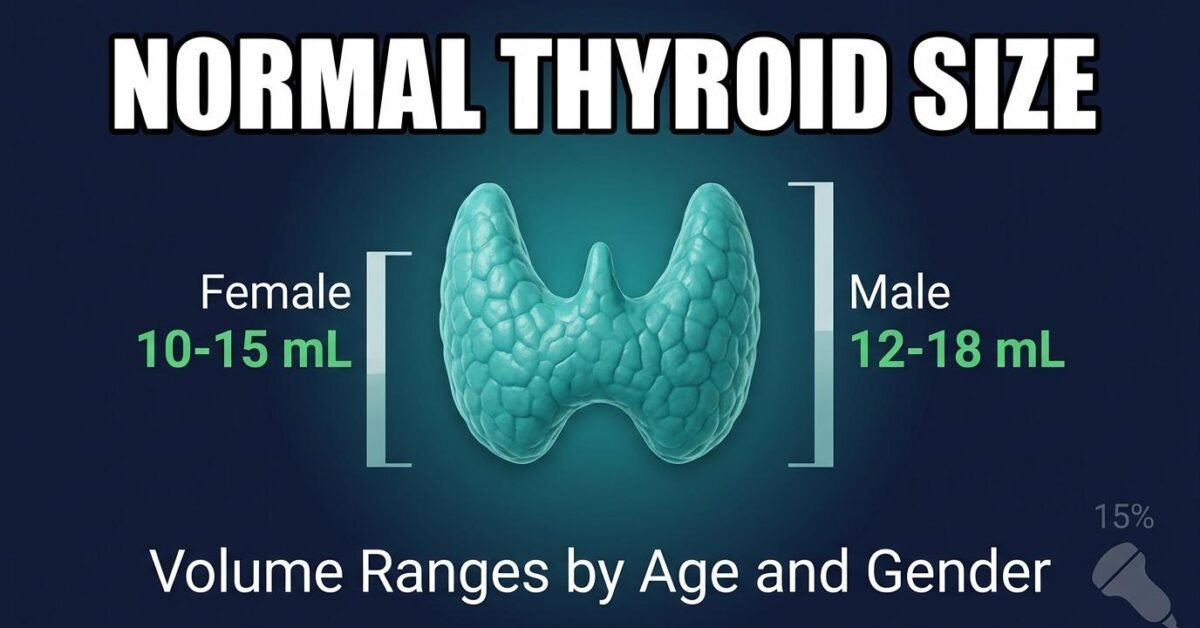
If your ultrasound report lists thyroid measurements, you are probably wondering what counts as normal. Thyroid size is described two ways: as three linear dimensions per lobe in centimetres, and as a calculated volume in millilitres. This guide covers both, with reference tables for adults and children.
Normal Thyroid Dimensions
Each thyroid lobe is measured in three directions on ultrasound. Here are the standard adult reference ranges:
| Measurement | Plane | Normal range (cm) | Normal range (mm) |
|---|---|---|---|
| Length (craniocaudal) | Sagittal | 4.0 – 6.0 cm | 40 – 60 mm |
| Width (mediolateral) | Transverse | 1.3 – 1.8 cm | 13 – 18 mm |
| Depth (anteroposterior) | Transverse | 1.3 – 1.8 cm | 13 – 18 mm |
| Isthmus thickness | Transverse | < 0.3 cm | < 3 mm |
The whole gland normally weighs between 15 and 25 grams in adults.
Normal Thyroid Size by Volume
Linear dimensions are converted to volume using the ellipsoid formula: length × width × depth × 0.523 for each lobe, summed for the total. Volume is the more useful measure clinically because it captures the gland’s overall size in a single figure.
| Group | Normal total volume | Per lobe | Borderline | Enlarged |
|---|---|---|---|---|
| Adult female | Up to 15 mL | 5 – 10 mL | 15 – 20 mL | Over 20 mL |
| Adult male | Up to 18 mL | 7 – 12 mL | 18 – 25 mL | Over 25 mL |
Enter your own measurements into the thyroid volume calculator to see where your gland falls relative to these ranges.
Average Thyroid Size in Children
Adult reference ranges do not apply to children. Thyroid volume grows in proportion to body surface area throughout childhood, so age-specific standards are used instead. These WHO reference values give the upper limit of normal:
| Age | Girls (upper limit) | Boys (upper limit) |
|---|---|---|
| 6 years | 4.0 mL | 4.0 mL |
| 8 years | 5.9 mL | 5.3 mL |
| 10 years | 7.8 mL | 6.9 mL |
| 12 years | 10.4 mL | 9.3 mL |
| 14 years | 13.1 mL | 12.1 mL |
| 15 years | 14.6 mL | 13.9 mL |
Newborns have a thyroid volume of roughly 0.3 to 0.7 mL. See our full guide to thyroid volume in children.
What Affects Normal Thyroid Size
Several factors shift where an individual falls within, or outside, these ranges:
- Body size. Height, weight, and body surface area all correlate positively with thyroid volume. Larger people have larger glands.
- Iodine intake. This is the strongest environmental influence. Populations with iodine-deficient diets have substantially larger average thyroid volumes.
- Age. Volume rises gradually through adulthood.
- Sex. Men have larger glands than women on average, which is why reference ranges are gender-specific.
- Pregnancy. Thyroid volume commonly increases by 10 to 15 percent during pregnancy and usually returns toward baseline afterward.
Normal Thyroid vs Enlarged
A gland exceeding the upper limit for its gender is described as enlarged, and clinically significant enlargement is called goiter. Common causes include iodine deficiency, Hashimoto thyroiditis, Graves disease, and multinodular change.
Enlargement alone is not a diagnosis. It is interpreted alongside thyroid function tests, antibody levels, and the gland’s ultrasound appearance. Read more in our guide to what volume is considered enlarged.
Normal Thyroid Ultrasound Appearance
Beyond size, a normal thyroid gland appears homogeneous with a fine, uniform echotexture that is slightly hyperechoic relative to the adjacent strap muscles. The capsule is smooth and well defined. A heterogeneous or coarsened echotexture, even at normal size, may suggest chronic thyroiditis.
Related Tools and Guides
Calculate your gland size with the thyroid volume calculator, learn the maths behind it in our ellipsoid formula guide, or read how to interpret the rest of your report in thyroid ultrasound measurements explained.
Frequently Asked Questions
What is the normal thyroid size?
A normal adult thyroid lobe measures approximately 4 to 6 cm in length, 1.3 to 1.8 cm in width, and 1.3 to 1.8 cm in depth. Total thyroid volume is up to about 15 mL in women and 18 mL in men, with the isthmus normally under 3 mm thick.
What are normal thyroid measurements on ultrasound?
Each lobe is measured in three dimensions. Normal values are roughly 40 to 60 mm craniocaudal (length), 13 to 18 mm mediolateral (width), and 13 to 18 mm anteroposterior (depth). These convert to a per-lobe volume of about 5 to 10 mL in women and 7 to 12 mL in men.
What size is a normal thyroid gland in cm?
Each thyroid lobe is normally 4 to 6 cm long and 1.3 to 1.8 cm in both width and depth. The isthmus connecting the two lobes is normally less than 0.3 cm thick. The whole gland typically weighs 15 to 25 grams in adults.
Is one thyroid lobe normally bigger than the other?
Yes. Mild asymmetry is entirely normal, and the right lobe is slightly larger than the left in most people. Marked asymmetry, or right thyroid lobe enlargement well beyond the left, may prompt closer evaluation.
Does normal thyroid size change with age?
Yes. Thyroid volume increases through childhood and adolescence in proportion to body surface area, then rises gradually through adulthood. Children have age-specific reference ranges that differ substantially from adult values.
What is a normal thyroid volume for a woman my age?
For adult women in iodine-sufficient regions, normal total thyroid volume is approximately 10 to 15 mL, with each lobe typically measuring 5 to 10 mL. Volume increases slightly with age and body size but these ranges cover most healthy adult women.
My doctor said my thyroid is slightly enlarged, what volume does that mean?
For women, a total thyroid volume between 15 and 20 mL is considered borderline enlarged. Above 20 mL is generally considered enlarged (goiter). For men, borderline is 18 to 25 mL, and above 25 mL is enlarged. Enter your measurements in the thyroid volume calculator to see exactly where your gland falls.
How many milliliters is considered a goiter?
A thyroid gland is generally considered a goiter when the total volume exceeds approximately 20 mL in women or 25 mL in men. These thresholds vary slightly between studies and geographic regions based on local iodine intake.
