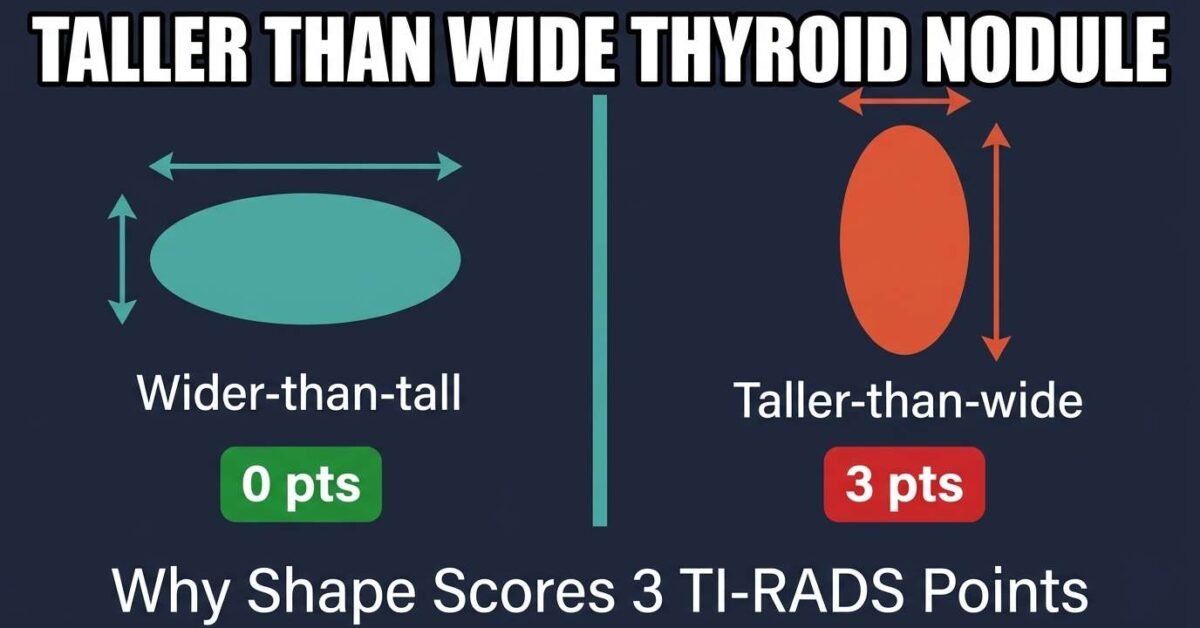
Shape is the third of five features scored in the ACR TI-RADS system, and it is the simplest: there are only two options. A taller-than-wide thyroid nodule grows vertically rather than horizontally on a transverse ultrasound view. This single finding scores 3 points, one of the highest values any individual feature can carry.
What Taller-Than-Wide Means
On a transverse ultrasound image, most thyroid nodules are oriented horizontally, meaning their side-to-side dimension is larger than their front-to-back dimension. This is described as wider-than-tall and scores 0 points because it reflects normal growth along tissue planes.
A taller-than-wide nodule is the opposite: its anteroposterior (front-to-back) dimension exceeds its mediolateral (side-to-side) dimension on the transverse view. This vertical orientation suggests the nodule is growing across tissue planes rather than along them, a pattern more commonly seen in malignant lesions.
Why Shape Scores 3 Points
Taller-than-wide orientation is a strong independent predictor of malignancy, with reported odds ratios ranging from 7 to 11 in multiple studies. It scores 3 points in ACR TI-RADS, making it one of the highest-scoring individual features, equivalent to very hypoechoic echogenicity, extrathyroidal extension, and punctate echogenic foci.
This means that a nodule with taller-than-wide shape, even if every other feature is reassuring (solid at 2 points plus taller-than-wide at 3 points = 5 = TR4), immediately reaches the moderately suspicious category.
| Shape | TI-RADS Points | Significance |
|---|---|---|
| Wider-than-tall | 0 | Normal growth orientation |
| Taller-than-wide | 3 | Suspicious, growth across tissue planes |
How Shape Is Assessed
The determination is made on the transverse (axial) view only. The radiologist compares the anteroposterior dimension to the mediolateral dimension. If the AP measurement exceeds the ML measurement, the nodule is taller-than-wide.
This assessment should not be confused with the nodule’s craniocaudal (longitudinal) dimension, which describes length and is used for size thresholds but not for shape scoring.
Shape assessment must be made on a true transverse plane. Oblique imaging can artificially alter the AP-to-ML ratio. For nodules where the ratio is borderline (nearly equal dimensions), document the measurement and consider serial comparison rather than definitively calling it taller-than-wide.
If your report says the nodule is wider-than-tall, that is the normal orientation and adds no points to the score. If it says taller-than-wide, that adds 3 points but does not mean cancer by itself. The total across all five features is what determines your category.
How Shape Combines With Other Features
Shape is scored alongside composition, echogenicity, margins, and echogenic foci. Enter all five into the TI-RADS calculator to see the category and biopsy recommendation.
See every feature and its point value on the TI-RADS chart, or explore worked examples on the examples page.
Frequently Asked Questions
What does taller than wide mean for a thyroid nodule?
It means the nodule’s vertical dimension (anteroposterior) exceeds its horizontal dimension (mediolateral) on a transverse ultrasound view. This orientation suggests the nodule is growing across tissue planes rather than along them, which is more common in malignant nodules.
How many TI-RADS points does taller-than-wide score?
Taller-than-wide shape scores 3 points in ACR TI-RADS, tied for the highest single-feature score along with very hypoechoic echogenicity, extrathyroidal extension, and punctate echogenic foci.
Is a wider-than-tall thyroid nodule normal?
Yes. Wider-than-tall is the default orientation for most thyroid nodules and scores 0 TI-RADS points. It simply means the nodule is growing horizontally along the tissue plane, which is the typical growth pattern for benign nodules.
