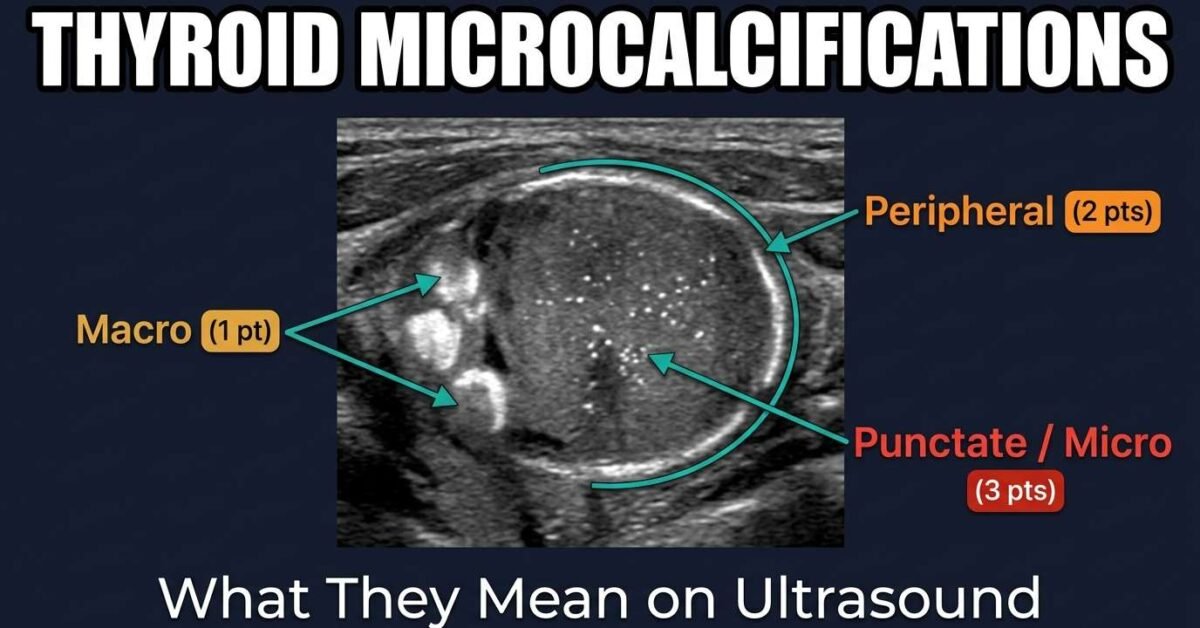
Echogenic foci are the fifth and final feature scored in ACR TI-RADS. Among the different types, thyroid microcalcifications — formally called punctate echogenic foci — carry the highest point value and the strongest association with malignancy. This guide explains what they are, how they differ from other calcifications, and what they mean for your score.
Types of Echogenic Foci in Thyroid Nodules
| Type | Appearance | TI-RADS Points | Clinical significance |
|---|---|---|---|
| None or large comet-tail artifacts | No bright foci, or V-shaped reverberations behind colloid | 0 | Benign indicator |
| Macrocalcifications | Large bright deposits with posterior acoustic shadowing | 1 | Common in benign and malignant nodules |
| Peripheral (rim) calcifications | Bright ring around the nodule edge | 2 | Sometimes seen in long-standing nodules |
| Punctate echogenic foci | Tiny bright dots without shadowing | 3 | Associated with papillary thyroid carcinoma |
Unlike the other four TI-RADS features where you choose one option, echogenic foci allows multiple selections. If a nodule has both macrocalcifications and punctate echogenic foci, both are counted.
What Thyroid Microcalcifications Mean
Punctate echogenic foci represent tiny calcium deposits, typically less than 1 mm, scattered within the nodule. In papillary thyroid carcinoma, these correspond histologically to psammoma bodies, which are laminated calcium concretions formed within the tumour. This is why punctate foci carry the strongest malignancy association among all echogenic foci types.
However, not every tiny bright dot is a true microcalcification. Small hyperechoic foci can also represent the back wall of tiny colloid cysts, inspissated colloid, or dense fibrous tissue. The distinction can be challenging on ultrasound.
Macrocalcifications vs Microcalcifications
The key visual difference is shadowing. Macrocalcifications are large enough to block the ultrasound beam, producing a dark acoustic shadow behind them. Punctate echogenic foci do not shadow because they are too small. This is the primary criterion for distinguishing the two on imaging.
The clinical difference is scoring: macrocalcifications score 1 point because they occur frequently in benign nodules, while punctate echogenic foci score 3 points because of their association with papillary cancer.
Comet-Tail Artifacts: The Benign Indicator
A comet-tail artifact is a specific type of reverberation artefact seen behind colloid crystals within microcystic spaces. It appears as a V-shaped or triangular bright tail extending from a bright focus. Large comet-tail artifacts are benign indicators and score 0 points. They should not be confused with punctate echogenic foci, which appear as isolated dots without a trailing tail.
The ACR distinguishes between large comet-tail artifacts (benign, 0 points) and small comet-tail artifacts (which may represent colloid rather than calcium but are harder to distinguish from true punctate foci). When in doubt, the ACR recommends scoring as punctate echogenic foci rather than underscoring. However, consider the overall nodule context: isolated punctate foci in an otherwise clearly benign spongiform nodule may warrant reassessment.
If your report mentions microcalcifications or punctate echogenic foci, those add 3 points to your TI-RADS score. This is significant but does not mean cancer on its own. The total across all five features determines your category and whether biopsy is recommended based on size.
Scoring Echogenic Foci in Context
Echogenic foci are scored alongside composition, echogenicity, shape, and margins. Enter all five features into the TI-RADS calculator to see the combined result, or view the complete point table on the TI-RADS chart.
Frequently Asked Questions
What are microcalcifications in a thyroid nodule?
Microcalcifications are tiny calcium deposits within a thyroid nodule that appear as punctate echogenic foci (small bright dots) on ultrasound without posterior shadowing. They are associated with psammoma bodies found in papillary thyroid carcinoma and score 3 points in ACR TI-RADS.
Are thyroid microcalcifications always cancer?
No. While microcalcifications are the echogenic foci type most strongly associated with malignancy, they also occur in benign conditions. The presence of punctate echogenic foci raises the TI-RADS score but does not diagnose cancer on its own.
What is the difference between microcalcifications and macrocalcifications in the thyroid?
Microcalcifications (punctate echogenic foci) are tiny bright dots without acoustic shadowing and score 3 TI-RADS points. Macrocalcifications are large bright deposits that cast a dark shadow behind them and score only 1 point because they occur commonly in both benign and malignant nodules.
