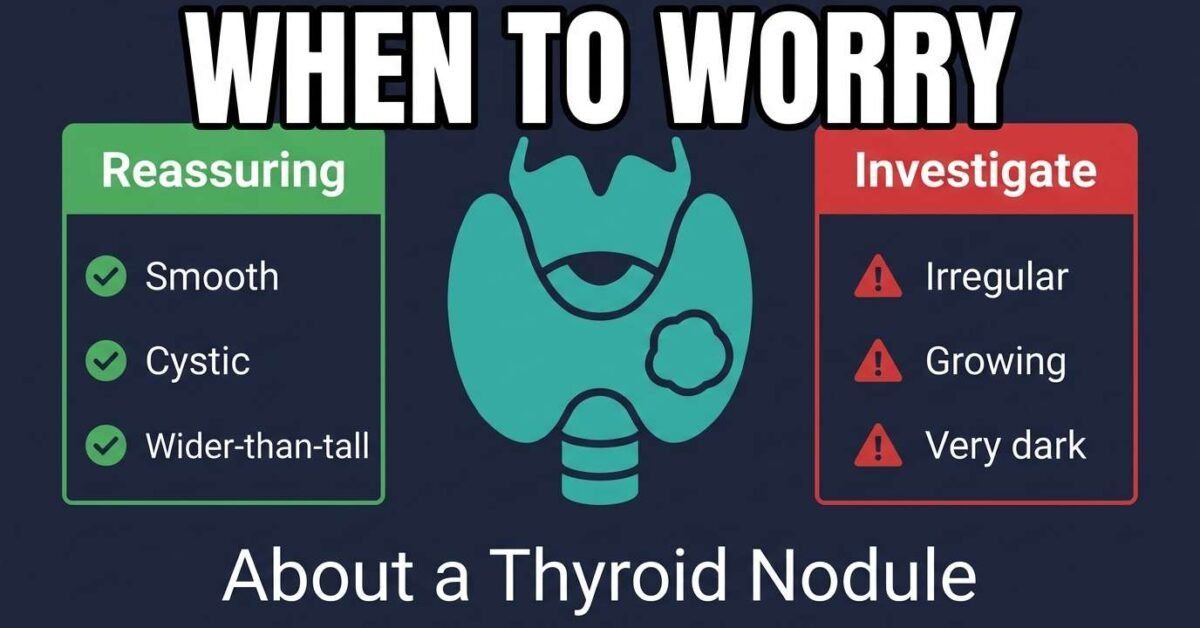
Finding out you have a thyroid nodule is common. Knowing when to actually worry about one is the harder question. This guide separates the genuinely concerning signs from the vast majority of findings that are entirely harmless.
The Default Answer: Probably Not
Thyroid nodules are found in up to 65 percent of adults on high-resolution ultrasound. The overwhelming majority are benign and will never cause any problem. If you have a nodule, the odds are strongly in your favour before any testing even begins.
Reassuring Signs
Certain findings on ultrasound are actively reassuring:
- Purely cystic — fluid-filled nodules are virtually never cancerous
- Spongiform pattern — honeycomb appearance of benign colloid
- Comet-tail artifacts — bright tails behind colloid crystals, a benign indicator
- Isoechoic or hyperechoic — same brightness or brighter than the gland
- Smooth, well-defined margins — clean edges with no irregularity
- Wider-than-tall shape — normal growth orientation
- TI-RADS TR1 or TR2 — categories that require no biopsy and no follow-up at any size
Signs That Warrant Investigation
These features, scored in the ACR TI-RADS system, are associated with higher malignancy risk:
- Very hypoechoic — darker than the strap muscles (3 points)
- Taller-than-wide — vertical growth orientation (3 points)
- Irregular margins — jagged or spiculated edges (2 points)
- Punctate echogenic foci — microcalcifications (3 points)
- Extrathyroidal extension — growth beyond the gland capsule (3 points)
The more features present and the higher the point total, the higher the TI-RADS category. Use the TI-RADS calculator to see your specific result.
Clinical Warning Signs
Beyond ultrasound features, certain clinical findings prompt closer attention:
- A rapidly growing mass — particularly if hard and fixed to surrounding tissues
- Persistent hoarseness — suggesting recurrent laryngeal nerve involvement
- Difficulty swallowing or breathing — suggesting compression or invasion
- Enlarged, firm neck lymph nodes — suggesting possible metastatic spread
- Prior radiation to the head or neck — a known risk factor
- Family history — particularly of medullary thyroid cancer or MEN2 syndrome
When Size Matters
Size alone does not determine whether a nodule is cancerous, but it determines when to act. A TR5 nodule at 1.0 cm warrants biopsy; the same features at 0.4 cm are typically monitored. A TR2 nodule at 4.0 cm needs no biopsy at all. Category and size always work together.
If you are reading this at 2 AM after finding out about a thyroid nodule, here is the shortest version: most nodules are benign, most that are biopsied are benign, and most thyroid cancers are highly treatable. Get the TI-RADS category and size from your doctor, and the pathway becomes clear.
What to Do
Get the ultrasound report, find the TI-RADS category and nodule size, and check them against the TI-RADS calculator. Then read our step-by-step guide: I have a thyroid nodule — what next?
Frequently Asked Questions
Should I worry about a thyroid nodule?
In most cases, no. Thyroid nodules are extremely common, found in up to 65 percent of adults, and the vast majority are benign. Worry is warranted only when specific risk factors or ultrasound features are present, which is exactly what TI-RADS is designed to assess.
What are the warning signs of a cancerous thyroid nodule?
Ultrasound features that raise concern include very hypoechoic echogenicity, taller-than-wide shape, irregular margins, microcalcifications, and extrathyroidal extension. Clinical warning signs include a rapidly growing or hard fixed mass, persistent hoarseness, and abnormal neck lymph nodes.
Can a small thyroid nodule be cancer?
Yes, but it is uncommon and usually carries an excellent prognosis. Small cancers (under 1 cm) are called microcarcinomas and are overwhelmingly papillary type with near-100 percent survival rates. Many subcentimetre cancers are now managed with active surveillance rather than immediate surgery.
