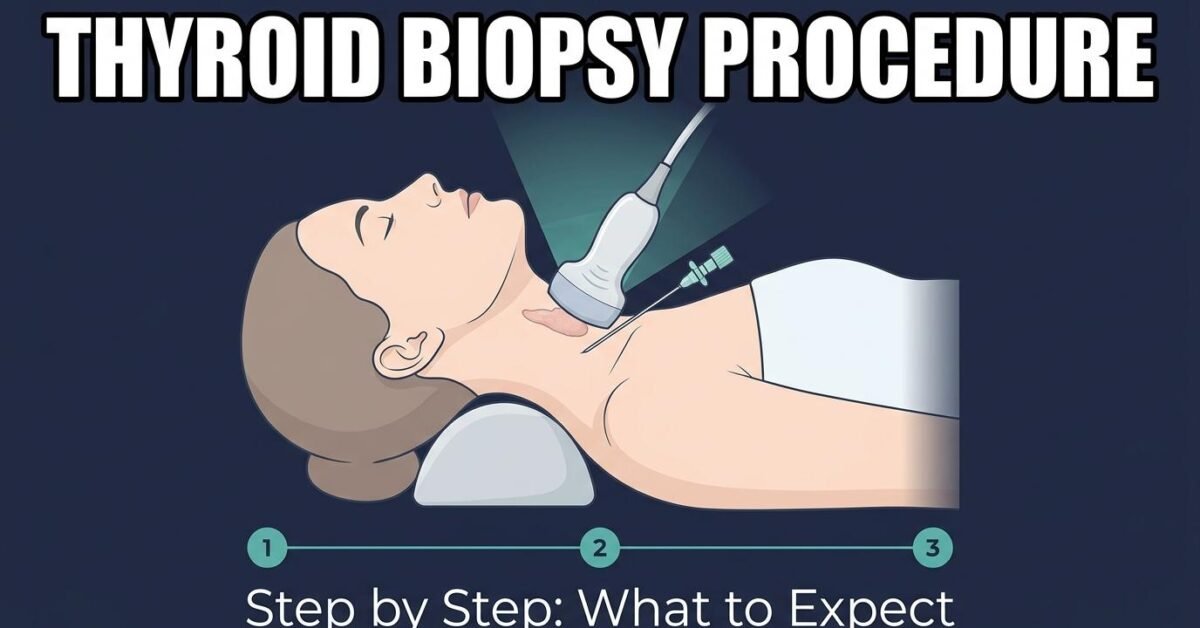
A thyroid biopsy sounds more daunting than it is. Fine needle aspiration is one of the quickest and least invasive diagnostic procedures in medicine, performed in an outpatient clinic with a needle thinner than the one used to draw blood. This guide walks through exactly what happens, from preparation through recovery.
Before the Procedure
Preparation is minimal. You do not need to fast, and you can take your usual medications. The one thing worth flagging in advance is blood-thinning medication. Tell your doctor if you take warfarin, apixaban, rivaroxaban, clopidogrel, or regular aspirin, as they may want to time the procedure around your dosing or check clotting values.
Wear a top with an open or low neckline so the neck is easily accessible, and remove necklaces before you arrive.
The Procedure, Step by Step
1. Positioning
You lie on your back on an examination table with a pillow or rolled towel placed under your shoulders. This tilts the head back and brings the thyroid closer to the skin surface, improving both ultrasound visibility and needle access.
2. Ultrasound Localization
The radiologist or endocrinologist scans your neck to locate the target nodule, confirm its size, and plan a needle path that avoids blood vessels, the trachea, and other structures. Gel is applied to the skin for the ultrasound probe.
3. Skin Cleaning and Anesthetic
The skin is cleaned with antiseptic solution. Local anesthetic may then be injected into the skin. Practice varies here: some centers routinely use lidocaine, while others omit it on the reasoning that the anesthetic injection itself stings about as much as the fine biopsy needle would.
4. The Needle Passes
Using real-time ultrasound to watch the needle tip, the operator advances a fine needle, typically 25 to 27 gauge, into the nodule. The needle is moved gently back and forth within the nodule for a few seconds while cells enter it by capillary action or light suction.
This is repeated for two to five passes, sampling different regions of the nodule. Each pass takes only seconds. You will be asked not to swallow, talk, or cough while the needle is in place.
5. Sample Handling
After each pass, the collected material is expressed onto glass slides and either air-dried or fixed in alcohol, or rinsed into a liquid-based preservative. Some centers have a cytotechnologist present to check immediately whether enough cells were obtained, which reduces the chance of a non-diagnostic result.
6. Finishing Up
Light pressure is applied to the puncture site for a few minutes, then a small bandage is placed. Total time from walking in to walking out is usually 20 to 30 minutes, with the needle portion accounting for only a small fraction of that.
Does It Hurt?
Most people describe the sensation as pressure and brief stinging rather than sharp pain, comparable to or milder than a routine blood draw. The needle used for thyroid FNA is notably thinner than a standard blood-draw needle. Anxiety about the procedure is generally worse than the procedure itself.
The instruction not to swallow during the needle passes is the part most people find awkward. It only lasts a few seconds per pass. Breathing normally through your mouth makes it easier to resist the urge to swallow.
After the Procedure
You can eat, drink, drive, and return to work immediately. Common minor effects include:
- Mild neck soreness or a bruised feeling for one to three days
- A small bruise at the needle site
- Occasional mild discomfort when swallowing for a day
An over-the-counter pain reliever and an ice pack are usually all that is needed. Serious complications are rare, affecting well under 1 percent of procedures, but contact your doctor promptly if you develop rapid neck swelling, difficulty breathing, fever, or severe pain.
Getting Your Results
Results are typically available within 3 to 10 business days. Your report will assign a Bethesda category from I to VI, which determines what happens next. About 60 to 70 percent of thyroid biopsies return a benign Category II result.
For the broader picture on who needs a biopsy and why, see our guides on when a thyroid nodule needs a biopsy and the complete thyroid biopsy overview.
Frequently Asked Questions
How is a biopsy done on a thyroid?
A thin needle is inserted through the skin of the neck into the thyroid nodule under real-time ultrasound guidance. Cells are drawn into the needle, usually across two to five separate passes, then transferred to slides or preservative for microscopic examination.
Do I need to fast before a thyroid biopsy?
No. Fasting is not required for thyroid FNA because no sedation is used. You can eat and drink normally beforehand and take your usual medications unless your doctor specifically advises otherwise.
Can I drive home after a thyroid biopsy?
Yes. Because thyroid FNA uses only local anesthetic, if any, you can drive yourself home and return to normal activities the same day.
How many needle passes are taken during a thyroid biopsy?
Typically two to five passes are made from different areas of the nodule to ensure enough cells are collected. Each individual pass lasts only a few seconds.
