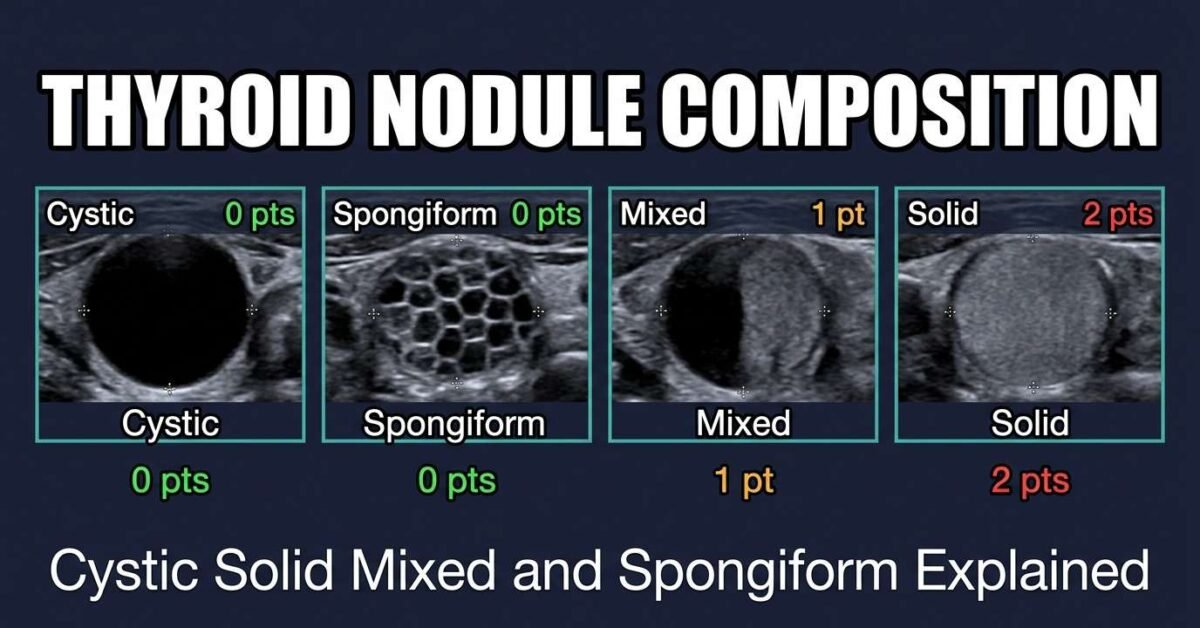
Composition is the first of five features scored in the ACR TI-RADS system. It describes what a thyroid nodule is made of: fluid, tissue, a mixture of both, or a sponge-like pattern of tiny cysts. Understanding composition is the starting point for interpreting your ultrasound report.
The Four Composition Types
Cystic or Almost Completely Cystic — 0 Points
A cystic nodule is filled with fluid and appears black (anechoic) on ultrasound. It may contain thin internal septations or a few small tissue projections. Purely cystic nodules are virtually never malignant and carry the lowest possible score for this feature. They are most commonly simple colloid cysts.
Spongiform — 0 Points
A spongiform thyroid nodule is made up of many tiny cystic spaces packed together, giving it a honeycomb or sponge-like appearance on ultrasound. When this pattern occupies more than 50 percent of the nodule, it scores 0 points and is considered a benign finding. Spongiform nodules are characteristic of hyperplastic or adenomatous colloid nodules.
Mixed Cystic and Solid — 1 Point
A mixed nodule contains both fluid and tissue components. The proportion varies widely: some are mostly cystic with a small solid mural nodule, while others are mostly solid with a few cystic spaces. Mixed composition scores 1 point. The solid portion is the clinically important part, and if biopsy is performed, the needle is directed into the solid component for the best diagnostic yield.
Solid or Almost Completely Solid — 2 Points
A solid thyroid nodule is made up entirely or almost entirely of tissue with no significant fluid. This is the most common composition seen in thyroid nodules overall. It scores 2 points because thyroid cancers are almost always solid. However, most solid nodules are still benign, including follicular adenomas, hyperplastic nodules, and Hashimoto-related nodules.
Cannot Be Determined — 2 Points
When heavy calcification prevents the ultrasound beam from penetrating the nodule, composition cannot be assessed. The ACR assigns 2 points by default, matching the solid score, on the principle that an unassessable feature should be treated conservatively.
Thyroid Nodule Composition and TI-RADS Scoring
| Composition | Points | Cancer association |
|---|---|---|
| Cystic or almost completely cystic | 0 | Essentially none |
| Spongiform | 0 | Essentially none |
| Mixed cystic and solid | 1 | Low |
| Solid or almost completely solid | 2 | Higher (but still mostly benign) |
| Cannot be determined | 2 | Conservative default |
Composition is scored alongside four other features: echogenicity, shape, margins, and echogenic foci. The total determines the TI-RADS category. Enter all five features into the TI-RADS calculator to see the combined result.
Composition alone does not determine whether your nodule is concerning. A solid nodule with smooth margins, isoechoic appearance, and wider-than-tall shape may still score only TR3. The full picture matters more than any single feature.
The spongiform designation requires that the pattern occupy at least 50 percent of the nodule volume. Partially spongiform nodules with a significant solid component should be scored as mixed rather than spongiform to avoid underscoring.
What Happens Next
After composition is assessed, the four remaining features are scored, and the total places the nodule in a category from TR1 to TR5. The category, combined with the nodule’s size, determines whether biopsy is recommended. Read the full scoring breakdown in our TI-RADS score meaning guide.
Frequently Asked Questions
What does solid composition mean on a thyroid ultrasound?
A solid nodule is made up entirely or almost entirely of tissue with no significant fluid component. It scores 2 points in ACR TI-RADS. Most thyroid cancers are solid, but the great majority of solid nodules are still benign.
Is a cystic thyroid nodule cancer?
A purely cystic thyroid nodule is essentially never cancerous. Cystic or almost completely cystic nodules score 0 TI-RADS points. The concern with cysts is occasionally cosmetic or compressive if they grow large, not malignancy.
What does spongiform mean on thyroid ultrasound?
A spongiform nodule is composed of many tiny cystic spaces that give it a sponge-like or honeycomb appearance. This pattern is characteristic of benign colloid nodules and scores 0 TI-RADS points. It is a reassuring finding.
Is a mixed cystic and solid thyroid nodule dangerous?
Not usually. A mixed nodule scores 1 TI-RADS point. The solid portion is what matters for risk assessment, and most mixed nodules are benign. If biopsy is needed, the needle targets the solid component.
