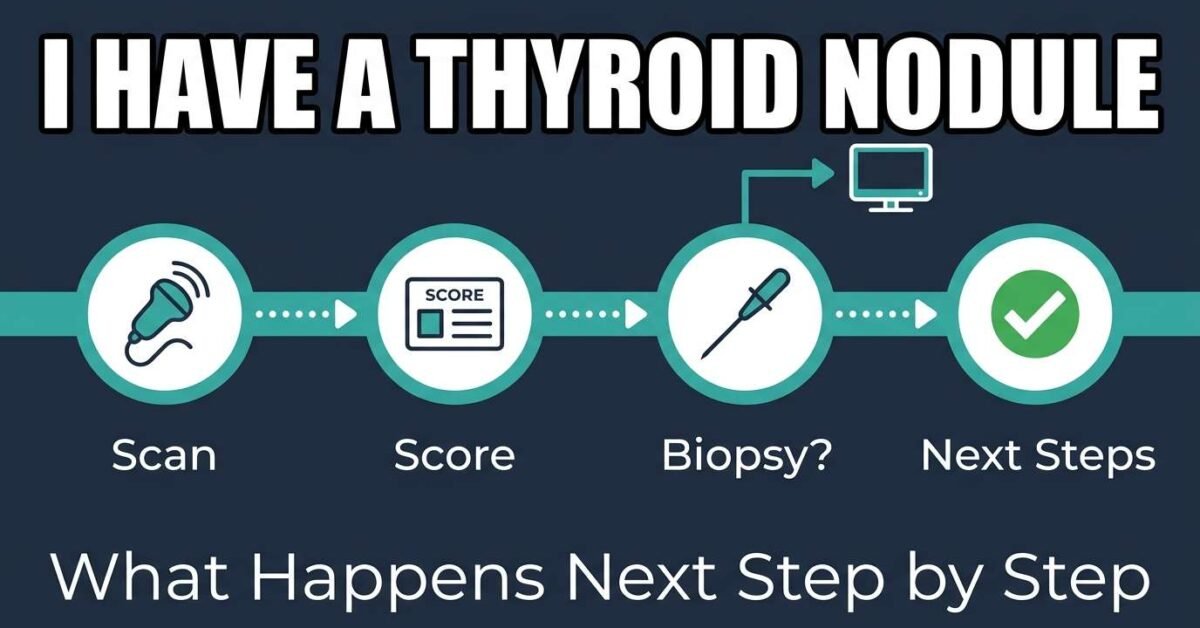
You have just been told you have a thyroid nodule. Maybe it was found during a routine physical, on a scan done for something else, or because you noticed a lump. Whatever brought you here, the question is the same: what happens next?
This guide walks through the standard pathway step by step, in the order things actually happen.
Step 1: The Ultrasound
If you have not already had one, the first step is a dedicated thyroid ultrasound. This painless, radiation-free scan takes 15 to 30 minutes and provides detailed images of the nodule’s size, shape, and internal characteristics.
The ultrasound report will describe five features: composition (solid, cystic, mixed, or spongiform), echogenicity (how dark it appears), shape (wider-than-tall or taller-than-wide), margins (smooth or irregular), and echogenic foci (calcifications).
Step 2: The TI-RADS Score
Your radiologist assigns points to each of the five features and totals them. The total determines your TI-RADS category from TR1 (benign) to TR5 (highly suspicious). Each category carries an estimated malignancy risk:
| Category | Suspicion | Cancer risk |
|---|---|---|
| TR1 / TR2 | Benign / Not suspicious | 0.3–1.5% |
| TR3 | Mildly suspicious | ~4.8% |
| TR4 | Moderately suspicious | ~9.1% |
| TR5 | Highly suspicious | ~35% |
Enter your features into the TI-RADS calculator to see your category and what it means.
Step 3: The Decision — Biopsy, Monitor, or Nothing
The TI-RADS category and the nodule’s size together determine the next step:
- TR1 or TR2 — no biopsy, no follow-up needed at any size
- TR3 under 1.5 cm — no action required
- TR3, 1.5–2.4 cm — follow-up ultrasound at 1, 3, and 5 years
- TR3 at 2.5 cm or larger — biopsy recommended
- TR4 at 1.5 cm or larger — biopsy recommended
- TR5 at 1.0 cm or larger — biopsy recommended
Read the full decision framework in our guide on when a thyroid nodule needs a biopsy.
Step 4: If Biopsy Is Recommended
A thyroid biopsy (fine needle aspiration) is a quick, outpatient procedure that takes about 15 to 30 minutes. A thin needle collects cells from the nodule under ultrasound guidance. Most people describe it as mild discomfort rather than pain. You can drive home and return to normal activity the same day. See our biopsy procedure guide for the step-by-step walkthrough.
Step 5: Understanding the Result
Biopsy results come back as a Bethesda category from I to VI. The most common result is Category II (benign), seen in 60 to 70 percent of biopsies. See our biopsy results guide for what each category means.
Step 6: The Outcome
- Benign — periodic ultrasound surveillance, no surgery needed
- Indeterminate — molecular testing, repeat biopsy, or diagnostic surgery
- Malignant — surgery, with an excellent prognosis in most cases
- Below the action threshold — nothing to do, genuinely good news
The most common outcome at every step is reassurance. Most nodules do not need biopsy. Most biopsied nodules are benign. Most thyroid cancers are highly treatable. The pathway exists to catch the small percentage that need attention while clearing everyone else.
Three Questions to Bring to Your Appointment
- What is my TI-RADS category?
- What is the nodule’s maximum diameter?
- Based on those two, is biopsy, follow-up, or no action recommended?
Frequently Asked Questions
What should I do if a thyroid nodule is found?
The standard next step is a thyroid ultrasound to characterise the nodule’s features. These features are scored using TI-RADS, and the category combined with the nodule’s size determines whether biopsy, follow-up imaging, or no action is recommended.
Should I be worried about a thyroid nodule?
In most cases, no. Thyroid nodules are found in up to 65 percent of adults and the vast majority are benign. Only about 5 to 15 percent of biopsied nodules are cancerous, and even thyroid cancer is usually highly treatable.
How long does the workup take?
The ultrasound itself takes 15 to 30 minutes. If biopsy is recommended, it can often be scheduled within days to weeks. Biopsy results typically take 3 to 10 business days. The complete pathway from discovery to a clear answer usually takes 2 to 4 weeks.
