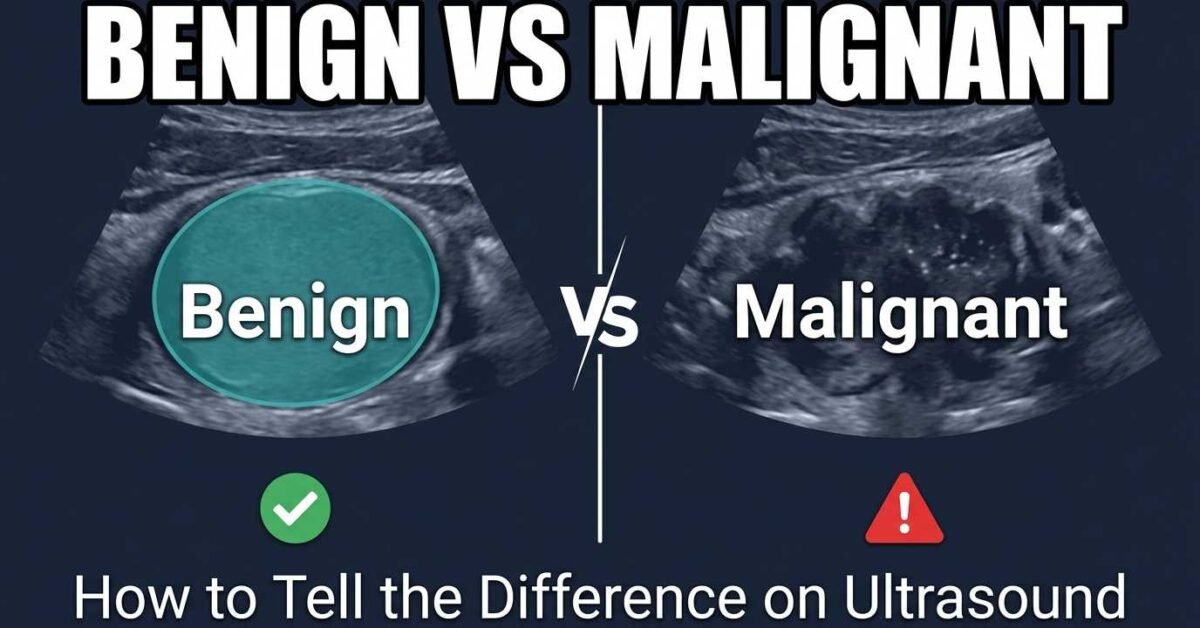
Learning that you have a thyroid nodule naturally raises one question above all others: is it cancer? The reassuring answer is that the large majority of thyroid nodules are benign, meaning non-cancerous. This guide explains how doctors distinguish benign from malignant nodules, what ultrasound features matter, and what the biopsy tells you.
Most Thyroid Nodules Are Benign
Thyroid nodules are extremely common, found in up to 65 percent of adults on high-resolution ultrasound. Of those that undergo biopsy, approximately 5 to 15 percent are malignant. The rest are benign growths such as colloid nodules, follicular adenomas, cysts, or nodules associated with thyroiditis.
This means the odds are strongly in your favour before any testing even begins.
How Ultrasound Separates Benign From Malignant
No single ultrasound feature can confirm or rule out cancer. Instead, five features are scored together using the ACR TI-RADS system to estimate the probability of malignancy:
| Feature | Favours benign | Favours malignant |
|---|---|---|
| Composition | Cystic, spongiform | Solid |
| Echogenicity | Anechoic, hyperechoic, isoechoic | Hypoechoic, very hypoechoic |
| Shape | Wider-than-tall | Taller-than-wide |
| Margin | Smooth, ill-defined | Irregular, lobulated, extrathyroidal extension |
| Echogenic foci | None, comet-tail artifacts | Punctate echogenic foci (microcalcifications) |
Enter your nodule’s features into the TI-RADS calculator to see the combined score, estimated malignancy risk, and whether biopsy is recommended.
Benign Thyroid Nodule Characteristics
Benign nodules tend to share several reassuring features. They are typically cystic or spongiform, isoechoic or hyperechoic, wider-than-tall, with smooth margins and no microcalcifications. Colloid nodules often display comet-tail artifacts, which are a specific benign indicator.
On biopsy, benign nodules return a Bethesda Category II result, the most common outcome, seen in roughly 60 to 70 percent of thyroid FNAs.
Malignant Thyroid Nodule Characteristics
Malignant nodules are more likely to be solid, hypoechoic or very hypoechoic, taller-than-wide, with irregular margins and punctate echogenic foci. The more of these features present, the higher the TI-RADS score. A score of 7 or more (TR5) carries an estimated malignancy risk of approximately 35 percent.
Even at TR5, however, about two thirds of nodules are benign. Only biopsy provides a definitive diagnosis.
The Role of Biopsy
Ultrasound estimates probability; biopsy determines reality. Fine needle aspiration collects cells from the nodule, and a pathologist classifies the result using the Bethesda system. Categories range from I (non-diagnostic) through VI (malignant). See our biopsy results guide for what each category means.
Types of Thyroid Cancer
When a nodule is malignant, the most common types are:
- Papillary thyroid carcinoma — approximately 80 percent of cases, excellent prognosis
- Follicular thyroid carcinoma — approximately 10 to 15 percent
- Medullary thyroid carcinoma — approximately 3 to 5 percent
- Anaplastic thyroid carcinoma — rare but aggressive
The fact that your doctor ordered an ultrasound or even a biopsy does not mean they think you have cancer. It means they are following a standardised protocol that catches the small percentage of nodules that are malignant while reassuring the majority that are not.
What to Do Next
If you have a thyroid nodule, the first step is ultrasound characterisation and TI-RADS scoring. Use the TI-RADS calculator to understand your category, and read our guide on when a thyroid nodule needs a biopsy for the size thresholds that determine the next step.
Frequently Asked Questions
How can you tell if a thyroid nodule is benign or malignant?
Ultrasound features scored with TI-RADS estimate the probability, and fine needle aspiration biopsy provides the definitive answer. No single ultrasound feature can confirm or exclude cancer, but certain combinations of features carry higher risk than others.
What percentage of thyroid nodules are cancerous?
Approximately 5 to 15 percent of thyroid nodules that undergo biopsy are found to be malignant. Among all thyroid nodules detected on ultrasound, the percentage is lower because many low-risk nodules never require biopsy.
Can a benign thyroid nodule become malignant?
Transformation of a clearly benign nodule into cancer is extremely rare. However, a nodule initially classified as benign on ultrasound may be reclassified if its features change on follow-up imaging, which is why serial monitoring is recommended for certain categories.
What are the signs of a malignant thyroid nodule on ultrasound?
Features associated with malignancy include very hypoechoic echogenicity, taller-than-wide shape, irregular or spiculated margins, punctate echogenic foci (microcalcifications), and extrathyroidal extension. The more features present, the higher the TI-RADS score and the higher the estimated cancer risk.
